Pages

Monday, 30 January 2017

Little Bunting

Although it's off patch, I just had to pay the Little Bunting that James Mc found on Trinity Hill late Saturday a visit. Full marks to James for this great find, who (thanks to news from Sue Murphy) kept on checking the flock of up to 80 Reed Buntings that are feeding/roosting here. A great example of how some clever thinking, and persistence, can pay off.

The weather this afternoon was dreadful, and Trinity Hill was fogged out and wet. You couldn't make out anything further than about 25m away, so I chose to just stand by some bushes and wait. About 30 Reed Buntings and 20 minutes later, 'tic tic'...


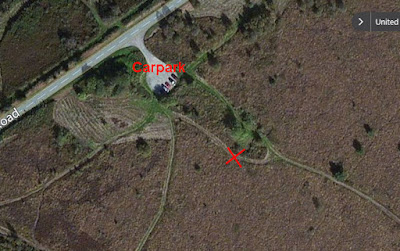
What a terrific little bird. Although when I say little, not that much smaller than a Reed Bunting if you ask me. Clearly shorter tailed though.  It was great to hear it call several times, so Robin-like but just a little cleaner, not so liquidy if that makes any sense.  If you're going to try and see it yourself hopefully this map helps, the red cross is where I stood...


Now back to the patch, my PWC patch to be precise. It took until today for Golden Plover to be added to my PWC list, despite up to 70 being present for most of this winter about two miles outside my PWC patch boundary!  There seemed to be a load more Lapwing in the valley too, and 'the golden one' was with a small group of Lapwing in the field opposite Colyford WTW at 9am.

My other recent PWC year tick (my first for a week in fact!) was a Little Owl on Saturday evening near Lower Bruckland Ponds. It's nice to know there are still three local spots for this declining species, but there are most definitely fewer around than five years ago.

For a damp, dreary and dull late January day, it's not been too bad at all!

Monday, 23 January 2017

Littorathey

See what I did there?  If not, hopefully once you've seen the contents of this post it will be more obvious :-).

Completely fogged out this morning on my PWC patch, which could well have cost me Whooper Swan as one flew east past Cogdon and on to West Bexington at 10am. If it could have seen our valley it may well have chosen to land here. Drat.

Thankfully the fog cleared early afternoon, but a few hours out and about failed to show much of interest. Except possibly a couple of Rock Pipits...

We used to get a double figure flock of Rock Pipits on Colyford Common during the winter months, and they always seemed to turn a bit pink in late winter and then get considerably pink and even a touch blue headed in early spring before disappearing. So safe to say they were probably mostly (or all?) Scandinavian littoralis birds.  But we haven't had these birds for several years now, so it was really nice to see two or three Rock Pipits on Colyford Common this afternoon...


The identification of winter plumaged littoralis Rock Pipit is a minefield. Well actually most papers and sources say it's impossible. Whilst there are features to look for in winter plumaged littoralis, none are clinching and a nominate petrosus Rock Pipit could also show these features.

This enabled me to conclude that today's birds on Colyford Common were.... Rock Pipits

To be honest they do just look like Rock Pipits to me, nothing that different to what I'd expect to see grubbing about among the boats on Beer Beach. But this doesn't mean they are not littoralis, as guess what, winter plumaged littoralis can look just like petrosus!  


Friday, 20 January 2017

Find Axe Birder an Axe Waxwing

Knowing that my window of opportunity for adding Waxwing to my patch list is pretty limited, I thought I'd try and increase my chances by offering a reward. Yes folks a REWARD!


The person who finds me my first Axe Waxwing will receive.... a whole entire homemade 'Jessicakes' cake!  And of whatever variety they want.... who likes Coffee and Walnut? Chocolate? Lemon Drizzle?  Choice completely YOURS.  

There's not many rules, in fact just these four;

1/ It must be a Waxwing.

2/ The Waxwing(s) must be on patch. I don't mean my Patchwork Challenge Patch but the whole Axe patch (which in summary is Seaton, Colyford, Colyton, Axmouth, Beer and everywhere in between).

3/ I must see it/them.

4/ If there's any debate over the true finder, my decision will be final.

Best of all about this is who says the finder has to be a birder?  This competition is open to everyone, Waxwings are striking birds that could drop in anywhere.

And in a final attempt to fire you all up...


Thursday, 19 January 2017

The Ton

Well I didn't have to wait that long at all!  I ended yesterday's blog post listing some of the easier species I am yet to see this year, but none of them were my 100th PWC species for 2017...


Yes that's our wintering female Tufted Duck at Lower Bruckland Ponds, along with three new friends. Two drake and a female Gadwall, the ton is done.


Earlier today looking down from Axe Cliff I could see a huge feeding flock out in the bay, of at least 280 Gannets and 150+ auks. From the sea front the light and viewing conditions were absolutely dreadful so I couldn't do much more with them, but hopefully they will hang around for a few days and attract some other species. A mid winter Pom Skua would do nicely.

Wednesday, 18 January 2017

Seawatching and Watching What I See

I was hoping to be able to call this post 'The Ton', but I've been stuck on 99 species for 2017 Patchwork Challenge since Sunday morning, when a lone Great Northern Diver flew distantly west past the sea front.  

I have found my increased effort on the sea this year really interesting.  Every day I'm seeing good numbers of Razorbills, Gannets, along with a few Red-throated Divers and Kittiwakes. Most days I see at least a couple of Common Scoter too, but sometimes more.  What really interests me are the seemingly random spikes of passage. For example all last week I didn't see a single Brent Goose, except for Thursday morning when 32 flew west in three flocks, including my first 3+ Pale-bellied Brents of the year.  That's 32 Brents that would have gone through unnoticed if I wasn't sea watching.  


This morning was a beautiful one, but viewing conditions were tricky with haze and bad light. There didn't seem to be much moving anyway, unlike yesterday morning when a gentle south easterly breeze was enough to get some pretty decent passage going.  Sadly I only had about twenty minutes, but Richard (known to fellow tweeters as @cork_head) spent far longer sea watching and noted good numbers of Common Scoter, a few Brents and several Red-throated Divers.  I was there long enough though to completely ruin my day...

Soon after my arrival I picked up four Common Scoter flying distantly west. I had followed them in the scope for some time when they were caught up by three smaller ducks also flying west. Despite the distance I was pretty happy they were Goldeneye, a cracking patch year tick, but after watching them for a short while something didn't sit right with me. The shape of the white in wing of the male just didn't see right, I could never recall seeing such a distinctive 'oval' of white on a Goldeneye before. And it was just as they were heading away that the thought of Smew entered my head.... I tweeted and texted birders further west but sadly nothing came of it.

I can't tell you how much I wish I had picked them up sooner/they had been closer/I'd looked more at the females. Even if they were 'just' Goldeneye it's a good year tick missed, but I have a feeling I let an absolutely stonking year tick go by....

Back to this morning and I haven't seen much despite a lot of wandering around in this lovely still and sunny weather, except for the Cattle Egret still in situ at Colcombe Farm in Colyton. I have to say I'm amazed it is still alone (except for its Little cousins). I was expecting to have a small flock of Cattle Egrets here by now, but maybe they are still to come?  It's coming into roost at Axmouth at about 17:00 now, when I first found it on 11th December it came in at 16:20 which just shows how much lighter the evenings are getting :-). I have to be honest and say thoughts of spring are already entering my head space, even more so after seeing these Snowdrops last week...


Being out more is making me notice much more about the local birding scene, which is nice.  Stood at Black Hole Marsh until well after dusk the other night (dipping Barn Owls!) showed three roosts. The Starlings have been roosting on Colyford Marsh all winter and number several thousand. Pied Wagtails are roosting on a small island in front of the Island Hide, but best of all are the several hundred Redwings currently roosting behind 'Walters Mound'.  It's interesting that Redwings arrive to roost quite unlike Starlings and Pied Wagtails, the latter often sit up before going down, and we all know what Starlings get up to in the sky before bed.  But the Redwings come in much later when it is almost completely dark, and they zip in low at speed often in decent sized flocks. 

Being out so much has also shown me what species of birds are having a good winter. The current winners include Cetti's Warbler (I've seen/heard eight different individuals here so far this year, and haven't been to Colyford Common once), Water Rail (squeals everywhere!), Chiffchaff, Goldcrest and Bullfinch. Man there are loads of Bullies about!  It's not such a good winter for other species of finch though, which I suppose isn't a surprise after last autumn which was so poor for finch vis mig. This year I'm yet to see Siskin, Redpoll or Brambling, and not just on my PWC patch, anywhere in East Devon! Other surprising gaps on my PWC year list are Nuthatch, Blackcap and Barn Owl. Hopefully 'the ton' isn't far away...


Friday, 13 January 2017

Dedicated to Kevin J Hale aka Bun

What a team player that man is. Even if he isn't playing, he's with you on your team. Legend.

There he is! Showing well in a striped hat.


Woodcock are pretty reliable at a few sites on patch, but within my PWC patch, or anywhere in the river valley, they are very VERY hard to come by. That's unless of course there's a seriously cold snap with plenty of snow, then they start to behave like Blackbirds and pop up everywhere, but that weather is rare here. Bun suggested the valley at Seaton Hole for me, as he's had them several times in the past in Couchill Woods just to the north. So on two occasions so far this month I have endured evening vigils here, but neither with any success.

Tonight though I was joined by the man himself, and he kindly offered to have a rummage around in nearby woodland as the sun set, whilst I stood within the boundary of my PWC patch. What a top man.  At times he was up to his waste in brambles, climbing up steep banks, slipping back down those steep banks, he just kept plugging away and all for my potential gain. After about five or so minutes I was feeling guilty so shouted out "let's call it a night"... But no, he was going nowhere "I'm just going to check down here by the stream".

Sadly though, despite all his hard work, it didn't have the desired effect. 

But as we walked back to our vehicles, moaning about how daft it is that a bird as beautiful, small, and rare as Woodcock can still be legally shot, something truly magical happened. At 17:15 I looked up towards the first few emerging stars of the night, and there one was!  It had just flown out of the strip of woodland in the Seaton Hole valley, did a couple of laps over the small field in front of us (almost looking like a gigantic bat!) and then disappeared off north.  Absolute result!!  And it's all thanks to Bun. If it wasn't for him I would have left ten minutes earlier.

My 98th bird of the year on my PWC patch. Hopefully the ton is just a few days away...

Tuesday, 10 January 2017

No Longer Dipping Dippers

Since Tim Wright saw one of the local Dippers from my PWC patch, I have been giving it more time and not just a quick scan each time I've been passing.

Yesterday I spent a total of 45 minutes watching the bit of the River Coly that can be seen from the bridge by the White Hart Inn in Colyford, but nothing.  Today though after about 40 minutes my prize came, and even sang for me! Dipper now well and truly on my Patchwork Challenge year list :-)


Earlier this morning a short sea watch showed nothing better than two Brent Geese and seven Red-throated Divers, but there's still a few Razorbill (no Guillemot as of yet this year!), Kittiwake and Gannet out there so must be plenty of food about.  Patchwork Challenge is making me look at the sea far more than I usually do in January, and it does make a difference. Brent Geese for example aren't usually an easy bird to see here before spring, but I've already seen 21 this year in seven different flocks!

I have now registered my Patchwork Challenge patch on the brand new Patchwork Challenge website.  I am a bit torn between entering into the Estuaries league or the Coastal South league. Although there clearly is an Estuary on my patch, I have so much more than just Estuary so maybe coastal would be best?  Will have to ask the powers that be.

Sunday, 8 January 2017

Firecrest

Phil text me just at the right time late this afternoon with news of a Firecrest at Seaton Hole, which is within my PWC patch. In the previous two winters Firecrests have wintered here, but this winter one has only been seen sporadically, and this was the first sighting of it in 2017.

Gladly it was still showing well when I arrived just after 4pm and I enjoyed some lovely views of it. I was enjoying myself so much that I couldn't help but photograph some twigs...

I particularly like that dark bramble branch running up the left side of the frame, I think this darkness is exactly what this otherwise pale photo needs.

I just LOVE the Ivy cover along the botton 1/5 of this photo, almost acts as a natural base to the photo. Also note that lovely 'V' of brambles just off centre. Nice.


Other birding today involved a sea watch from 08:15 for about 45 minutes. It's highly likely that Phil and I let a perfectly good Black-throated Diver fly past unclinched, it just remained far too distant but I have to say it did look the part. We were however perfectly capable to ID the four Red-throated Divers that also flew through (well one flew in actually). No wildfowl at all this morning, but still a few Razorbill, Gannet, a Kittiwake and three Great Crested Grebes out there.

In other rather gripping news, tonight Tim Wright had one of the Dippers from my PWC patch. Up to today they have only been seen up near Colyton but at 16:20 Tim had one from the A3052 at Colyford. It looks like I'm going to have to put even more time in here, I have been checking from the bridge by the White Hart daily but only for a few minutes at a time.


Friday, 6 January 2017

Micahelless

Just after 10am I stumbled across this gull on the Estuary...


It was larger than the nearby Herring Gulls, showed a nice dark mantle and yellow legs (not bright but that's ok for a winter YLG) and the legs did look quite long. I did think it had a little more head streaking than expected for an adult winter Yellow-legged Gull, but it wasn't heavily streaked not by a long way.  All in all it looked a pretty good winter plumaged adult Yellow-legged Gull to me, huddled in with a group of wind blown Great Black-backed Gulls.  It certainly wasn't one of those small, pinky-yellow legged, funny coloured mantled hybrid things. This next photo shows the size of it compared with an adult Herring Gull (far right)..


But then it gave an all important wing flap and this is when it all fell to pieces...


Ugly. So so so ugly. P5 completely wrong with just half a black band, and what's going on with P9? Nothing more than a white speck on the right wing, but what looks like a proper small window on the left wing!

This was a worrying bird for me. I have always found the 'usual' hybrids (presumed Herring x Lesser Black-backed Gulls) pretty obvious, but this was something else, maybe a Herring x Yellow-legged?

Earlier, before this headache, I enjoyed an hours sea watch from Spot On and saw:

10 Brent Geese (6w, 2e and 2 in)
14 Common Scoter
5 Red-throated Diver
2 Kittiwake
6+ Razorbill

Six Brent Geese


Yesterdays sea watch was far less exciting, but on Wednesday I struck lucky with a Jack Snipe along with 15+ Common Snipe in a small patch of Juncus near Boshill Cross. Now that was a very handy PWC year tick!
 

Tuesday, 3 January 2017

Frosty Morning

What a stunning morning, just what winter should be like. It started off here at -4 when I headed out at 8am, and was still just -1 at 10am. 


Birding-wise today was one of those days you want on a New Years Day bird race.  There's some resident species that although are probably always here, aren't always easy to find.  And these are even harder when considering my PWC patch is vastly smaller than the Patch.  But I was on it this morning.

A dog walk up and back the one lane in Axmouth that is on my PWC patch just wouldn't stop delivering with Green Woodpecker, Kestrel, Jay (two), Stock Dove, Marsh Tit (two), Red-legged Partridge, Treecreeper and Yellowhammer all added to the year list. I was also surprised to see a Water Rail and a Little Egret here in a tiny wooded stream, presumably birds slightly dispersed by the cold weather.

Prior to this Lower Bruckland Ponds gave me another tricky resident year tick, with two Mistle Thrush. And a sea watch was worthwhile first thing (despite the 'sea fog') with groups of five and two Brent Geese east and three Great Crested Grebes on the sea.


So all in all a pretty successful morning. Thoroughly enjoyable too which I suppose is most important.

Yesterday the only patch birding I managed was a 40 mins sea watch first thing. Pretty quiet, although two year ticks came in the form of two Red-throated Divers and a Common Scoter past.

The rest of yesterday was spent off patch with Jess and Honey, but I must just mention our trip to Topsham...


We basically went to the Rec at Topsham to eat a doughnut.  But came away having seen a Yellow-browed Warbler, a Long-tailed Duck, two Goldeneye, a few Avocet and Red-breasted Mergansers, and heaps of common wading birds. Now that's what I call a good doughnut!

Mid pm edit: I finally ran into the wintering Black Redstart this afternoon, on a house roof near Axmouth Yacht Club. Far more of a surprise though were a pair of Red-breasted Mergansers that flew east offshore just after 14:00. RB Mergs are just about annual on patch, but you could easily go a year without seeing one here. Bonus!
 

Sunday, 1 January 2017

Three out of Three!

I just have to post today, the first day of my big Patchwork Challenge attempt.

One of the best things about doing a year list is the big push on Jan 1st. Everything you see is a valuable year tick, absolutely everything. And spending the whole day out on your patch clocking up as many species as you can is such an enjoyable (but sometimes frustrating!) event. Sadly though I was working today, so no such fun for me.  With limited time it's sensible to prioritise the scarcer species, so this morning my three target birds were Cattle Egret, Tufted Duck and Grey Plover. None of these are guaranteed in a given year on the Axe Patch.

The first two were pleasingly easy. The Cattle Egret was the twelfth egret to fly out of the Axmouth roost this morning at 07:36, and the female Tufted Duck was easily visible in the pre-dawn gloom at Lower Bruckland Ponds. The Grey Plover however, well that wasn't quite so easy. No sign of it anywhere this morning, despite a nice high tide and a mass of waders right in front of the Tower Hide. 

Cue the extra mile. Despite the rain, late this afternoon during a fifteen minute break at work, I jumped into my car, scoped the mud north of Coronation Corner and there was my hat-trick. Grey Plover on the list.

My next target are the two Dippers that I first bumped into a few days ago.  Dippers have been really scarce on patch over the past few years, prior to this you would fairly frequently see them along many stretches of the River Coly.  It was Friday morning when I had two (one singing) just south of Colyton, and Phil has seen them in the same place on the two days since. My problem is they are currently about a field and a half north of my PWC patch, so I just have to hope they wander a little further down river - whilst I'm watching!

Saturday, 31 December 2016

Happy New Year


As the sun sets on 2016 I would just like to wish everyone a Happy New Year.

This is where I should also post a long review of the birds seen on patch in 2016, but to be honest my greatest highlights of 2016 have come from elsewhere. Saying that though, any patch tick is worthy of a mention in an end of year post, of which there were two for me this year. An overdue one with a Red-backed Shrike on Beer Head on 15th September...


And a unexpected one with a Least Sandpiper on Black Hole Marsh on 3rd August...


These two birds take my patch life list total to 257. But now for the real highlights...

It's been really exciting teaming up with Nikon and working alongside them this year, especially regarding the once in a life time project in Slovenia filming this. What an experience it was, so many incredible sights, sounds and people that have touched me forever. 


During the summer of 2016, although it was VERY hard work, being part of a small team that mapped pretty much all the breeding birds on the whole eastern half of Dartmoor was a challenge, but so SO rewarding - a proper monumental, important and historic survey. Getting up to the Moor at dawn meant we saw some incredible sights and so many birds. Hopefully the final report will be out soon, but I for one was encouraged by the numbers of birds like Cuckoos, Grasshopper Warblers, Redstarts, Tree Pipits and Whinchats that we came across.  Thanks to the RSPB and the Moor Than Meets The Eye project, and of course Chris and Kev for this opportunity.


I couldn't not include becoming an expectant father - this really is life changing. Now I suppose is a good time to mention that yesterday we went for our 20 week scan, and it was quite clear to see that we are expecting a..... BOY! Such thrilling news!  Although we've got a lot to sort out, we really cannot wait for May 2017.

It's easy to pick out the two low-lights for me this year, neither I want to dwell on, in fact one I don't want to mention at all. Missing a completely unprecedented movement of Cory's Shearwaters off Seaton on 20th August was seriously gutting, I was at Rutland all day!

So tomorrow is a New Year, and I cannot wait to get stuck into Patchwork Challenge. Today the Cattle Egret, Grey Plover and Tufted Duck were all still present, so I am hopeful of a good start to the campaign. Needless to say, you can watch my progress here on Axe Birding, and as ever thanks for reading.


Saturday, 24 December 2016

Merry Christmas

Following the shock joint announcement from BTO and RSPB, that in order to promote the less appreciated species of birds, from next year Robins are to be banned from all Christmas cards and decorations, I thought I'd start the ball rolling early here on Axe Birding....

A Christmas Caspian Gull!


I really do wish all readers of my blog (whether you've read it once or read it weekly) a very Merry Christmas. I hope the festive period is filled with love, laughter and happiness for you all. And maybe even some birds if you get the chance!  Plenty of food of course too :-)

Monday, 19 December 2016

Velvet Scoters

When I went down to walk the dog on the beach this morning, seeing a flat calm sea encouraged me to get my scope out and give it a scan. Good move!

On the first scan I picked up seven duck flying into the bay from the south west, they were four Common Scoter being led by three fantastic Velvet Scoters.  They flew into the bay and I thought were going to carry on east, but then made a large sweeping u-turn and flew off back west.  My first patch Velvets since 14th Nov 2013 so they were very much appreciated, hardly a surprise though given the numbers currently on the south coast. Hopefully we may get an Eider or two next?

I also must mention the Dartford Warbler that Ian Mc had on Seaton Marshes this morning, from the hide.  One was seen along the west walk of Seaton seafront a couple of weeks ago, so there's every chance it's the same bird and it's lingering. This is potentially very good news as it could be another target for Jan 1st.

The only other birding news I have to tell is that on Saturday I saw the Cattle Egret come into roost again in Axmouth (despite not seeing it in Colyton on Thursday or Friday), it flew in at 16:31. The Grey Plover was still on the Estuary as well.

After sunset on Saturday looking from Axmouth to Seaton.


Monday, 12 December 2016

Found it!

My first attempt at finding where the Cattle Egret is spending the daytime began at 07:30 this morning.  At 07:41 it flew out of roost in Axmouth, but it was still so dark and it flew upriver so surprisingly quickly that my plan of following it north just didn't work.

So this afternoon I drove around looking for cattle, and from a distance saw a bunch of egrets drop in near a farm in Colyton.  I soon realised it was the farm where the three Cattle Egret were back in January 2009, and a closer look showed these egrets to be 13 Little and the Cattle. Gotcha!


It's Colcombe Farm, but please don't drive down the farm track. View the egrets from the Colyton to Shute road. There's a bench on the left just after turning on to the Shute road from the Colyton to Whitford road, just before the upper track down to the farm and virtually opposite a lay-by.

I'd had a good morning as well. Was really pleased to see the Yellow-browed Warbler, Tufted Duck and Grey Plover all still waiting patiently for Jan 1st. And a wander around Colyford WTW showed there has been a sudden explosion in Chiffchaff numbers, with at least 45 feeding along the northern edge of the WTW and around the neighboring fields. 

Who said December was a quiet month?

Sunday, 11 December 2016

Cattle Egret

With not much to see over the past week on patch (mostly due to the horribly mild weather I presume) other than gulls, there's only really been one rarity on my radar. 

It's turning out to be the best UK Cattle Egret influx since 2008/09, with small numbers appearing (mostly in the south west) during the past week.  Back in 2009 we all thought it was the start of 'another Little Egret story', but since then they have become somewhat rare. So it's really nice to see a good flurry of records and reports of small flocks on the bird news websites again. Even better is the fact it's half a month away from my Patchwork Challenge year listing attempt!

Although we've not got many cattle in the river valley at the moment, we do have some, and plenty of Little Egrets so I've been optimistic for one here within the last week. But with no luck during the days I knew my next best chance was to watch the evening egret roost at Axmouth, the bonus is this will include birds that have been feeding outside the patch boundary during the day. My first free late afternoon slot was Saturday (yesterday), so at 16:10 I parked up at Coronation Corner and waited. And isn't it nice when a plan works...

The weather was really cloudy and grim, so by 16:20 it was almost completely dark. I'd seen about 25 Little Egrets come into roost (they always fly in from up river) when I picked up another egret flying in that I immediately knew was going to be a Cattle.

This shows that getting your 'eye in' really does make a massive difference. Because in the previous five minutes I'd seen numerous Little Egrets on the very same flight line, when this one came into view I could tell it was smaller and flying with quicker and shallower wing beats.  It was so dark that it wasn't until it flew over the road and into the roost site that I could see the crucial bits, but thankfully I could see it all clearly enough (completely different head and bill shape, all yellow bill, shorter legs, etc).  I found it interesting that it came down river and into roost all on its own, does this mean it had used this roost before?

This was my first patch Cattle Egret since 11th April 2014 (have missed one in between) so it was really great to see, but I doubt any will ever beat this beaut from June 2008...

Breeding plumaged adult Cattle Egret on the Axe Estuary 02/06/08


Bun probably had the Cattle Egret again tonight. Sadly it was too late and it was completely pitch black, so all he saw was a 'smaller egret' drop in, he just didn't get enough on it.  Hopefully tomorrow though I will be able to find where it's hanging out in the day...

Tuesday, 6 December 2016

Dusky Thrush (no not that one!)

More drivel today I'm afraid, blame this mild winter weather. Don't worry it's nowhere near in length as my last post! Oh and thanks for the responses to that one, been great to read all the honest accounts of Birding Blunders

You may remember a couple of weeks ago I wrote a post about how a 'grumpy birder' had logged on to the Bird ID page on Facebook and basically had a good moan about being asked to ID common birds. There were many phrases within his long rant like "buy a bird book" and "banging my head against a brick wall".  Here's my original post: http://stevesbirdingblog.blogspot.co.uk/2016/11/helping-others.html.

Go forward fifteen days (to 15:35 on Sunday 4th) and on the very same Facebook page a lovely lady called Rachel from Derbyshire posts three photos with a simple...

 "Just three for you today 😄 thankyou!"

Photo one shows a Starling, and would you believe it, the third photo is a good picture of a regular every day Blackbird.  Oh dear, 'Grumpy birder' would not be happy about this one bit. Rachel buy yourself a bird book and start working things out for yourself.  Unbelievable. 'Bangs head against brick wall'.

Oh yes, of course, there was also photo number two...

Photo (c) Rachel Jones


I have to be honest and say when I first saw this photo I wasn't sure if it was a wind up or not. But I told Rachel what the three species were, and she replied with two further photos of this absolute mega - a Dusky Thrush. It was no wind up.  And within a few minutes the Facebook Bird ID page went absolutely mental.

Fast forward two days and many happy twitchers and birders have seen this bird thanks to all the work put in by Rachel in sorting the access and parking arrangements. And of course because she felt comfortable enough to post this photo, with her two others of common birds, on Facebook.

So 'grumpy birder', and all others who think it's a good idea to go to places designed to help those who want help, only to have a good moan about the very people asking for help, well let this be a valuable lesson. If you take the time to encourage, who knows what will come of it one day.

Although personally I am not fussed about seeing this fantastic bird, I do have one question... Can I count it as a find tick??


Sunday, 4 December 2016

Birding Blunders

It's mid December and there's a storm blowing. A howling south westerly gale is battering the south coast of Devon, with frequent heavy downpours, but that doesn't put off the dedicated patch birder from skipping breakfast and heading down to the coast. He sets up his scope which he struggles to keep still in the wind, but for the first twenty minutes sees very little passing. 

All of a sudden a small white gull flies into view. It's flying into the wind but its clearly all white and small, no bigger than a Kittiwake. The bird remains distant as it flies west but it's clear the bird has some small black flecks along its wing, but otherwise it's really is pure white and is flying almost like a tern. Ivory Gull!!  Mega!  It turns more south and the observer watches it fly away... did that just happen!?  

Still shaking with excitement the birder grabs his phone, manages to send a text out to other birders, and quickly fires of a tweet "Distant 1w Ivory Gull off xxxxxxx, seems to have flown off out to sea!"

But as he puts his phone back in his pocket and continues to scan with his telescope, he picks it up again and it's flying back into the bay.  Fantastic! It keeps on coming, and coming, before dropping on the the sea where it joins a lone adult Kittiwake. Immediately something doesn't look right. It has an all yellow bill, it's the same shape as the Kittiwake, and the 'black flecks' are actually splodges of oil.... it's an albino Kittiwake.

Just as a sinking feeling tugs on the observers stomach, an adult Great Black-backed Gull knocks the albino Kittiwake on the head, and proceeds to swallow it.  It's at this point that cars begin to arrive and the first birders are running over...

Hypothetical Person A   

The birder immediately gets his phone back out of his pocket, begrudgingly sends the tweet 'sorry folks, the Ivory Gull was actually an albino Kittiwake' and sheepishly apologises to all the birders that have already arrived.  He then spends this next 24 hours with his phone turned off and consumes the advised maximum monthly intake of alcohol in one evening. 

Hypothetical Person B

As the first telescopes arrive the birder exclaims "sorry guys, no further sign". Alas there is no more sightings of the 'Ivory Gull', but then again it did fly back out to sea so that's not a surprise. To pull off his lie he needs to carry it all the way though, so submits a remarkably good description of a first-winter Ivory Gull to the BBRC, which sails through. The birder goes down in history as the finder of the first Devon Ivory Gull since 1853!


As an outsider not knowing the truth, who is the better birder?   Well it's clearly not the Muppet that is Person A who can't even tell the difference between a common seabird and one of the most obvious gulls in the world. What a complete stringer.  Person B however, what a star, a complete legend. Managed to nail a flyby Ivory Gull, which he deserved after spending so much time out and about....

Birders are humans. And humans make mistakes, in fact mistakes are what makes us human. When first learning about birds I think you kind of learn through mistakes, and you will probably make many of them, but however experienced and knowledgeable you become as a birder, blunders will still happen. 

It's the birders that never admit to making mistakes that concern me. Thankfully I am confident all the birders I know are like Person A, honest. But I'm sure there are some out there like Person B. Their egos so ballooned and with such (deluded) high standards to uphold, their pride would just not let them back down from their first call. They simply cannot be seen to make a mistake. So, who is the better birder?

Person A. All day long.

Even the most thorough and expert birders make mistakes. The best field birder I know and have ever birded with once spent the day counting an impressive Arctic Skua passage. He returned back to base only to find out all the sea watching locations both north and south of him recorded almost exactly the same numbers of Pomarine Skuas. He immediately knew he'd ballsed up. And admitted it. Everyone makes mistakes, it's how you deal with them that counts.  

It's important to learn from your mistakes (this does make you a better birder), and you have got to expect some flack, but move on. Deal with the error like my dog dealt with the cold water that had soaked into her fur after a swim in the River Coly this morning...


Writing this post got me thinking about my biggest birding faux pas, and three spring to mind...

"Osprey!"

It must have been about 2001 or 2002, before Colyford Common had a hide and was just a slope and a platform. The previous day I'd had an Osprey fly through south at dusk, and I was stood there with Phil A and Dave H. All the Estuary birds had taken flight, and I was frantically looking around through my binoculars for the reason. As I lowered my binoculars my eyes saw a bird flying very close to us, with a dark breast band, broad wings and a slow flap. My mouth said "Osprey" about half a second before my brain said 'Lapwing'.... there was no excuse!

A Redshank on Steroids.

On 16th August 2010 at Black Hole Marsh, although I was looking into the sun, I could see a long-billed, large and elegant looking Redshank-type. I didn't have to think twice about putting the news out that a Spotted Redshank was with a Greenshank on the marsh.  Here is the bird...


That evening Phil went down, and saw it again, closer and in flight. It was a Redshank. I still maintain it was a bloody weird looking Redshank (possibly of eastern origin?), but it was a Common Redshank.

But I'm good with Gulls.

At dusk on 25th January 2010 I was watching the gulls on the Estuary when a white-winged Gull dropped in north of Coronation Corner. It was so white I was worried it was an albino or leucistic thing, but when it was settled with Herring Gulls it looked smaller, cuter headed and longer winged. A second-winter Iceland Gull, nice. Here it is...


This bird stayed for months on the Estuary. And it was a Herring Gull. This one I took particularly hard as I do consider myself a 'guller'. I thought I had checked all the salient features, well I had, yet I concluded wrong.  Am pleased to say it never put me off gulls though :-)


So folks, I've been open and honest, now it's your turn. Let's have a birders amnesty, I'd love to read about your biggest gaffs and greatest embarrassments in the world of birding. Whether via a comment on this blog, a tweet, an email or a text.  Let's celebrate the fact we are human...

Tuesday, 29 November 2016

Winter Birding

I've seen a few nice things over the last couple of days, most of them distinctly wintry. I'm also finding myself willing every good bird I see now to stay put until Jan 1st - yes I'm already getting fired up for my Patchwork Challenge 2017 year list and it's only November! 

I'll start with yesterday afternoon, and an enjoyable half an hour along the Estuary up to dusk revealed three redhead Goosander (sat on mud north of Tower Hide), two Med Gulls (adults), 24 Dunlin and a Grey Plover.  It's been such a good autumn for Goosander on the south coast, and many other species of wildfowl (especially sea faring ones), I do wonder if that means we have got a proper cold winter coming?

This morning started on the sea front where I could see my first Great Crested Grebe of the winter off towards Seaton Hole. There were also three Black Redstarts about this morning, the two female-types still at Seaton Hole and an adult male near the Spot On Kiosk (thanks Dad)...


I also popped in to Lower Bruckland Ponds this morning, where the Yellow-browed Warbler was showing well right by the entrance bridge. It spent most the time flitting about in the trees as they do...


But in the frosty conditions it did briefly come right down to ground level...


Also present was a female Tufted Duck, which has been here for a couple of days at least...


Yellow-browed Warbler and Tufted Duck.  What a dream Jan 1st duo that would be...

Saturday, 26 November 2016

Patch News

Just wanted to stick this up here on behalf of the Countryside Team at EDDC. Anyone who has been to Black Hole Marsh recently will know how much this car park work is needed!


Also note the water levels will be very low on Black Hole Marsh for a time.  James needs to drain out all the fresh water that accumulated here from the floods of last week, and get some salt back in. If it stays too fresh for too long it could be disastrous for the ecosystem of the marsh.

Really hope you're all having a great weekend and are seeing lots of lovely things :-)