Pages

Showing posts with label bird ringing. Show all posts

Friday, 13 April 2018

East Budleigh Italian Sparrow

Since early November 2017 a male Sparrow showing characteristics of Italian Sparrow Passer italiae has been residing in East Budleigh with a House Sparrow flock. The bird was first found by local home owner and wildlife enthusiast Dave W and identified as a possible Italian Sparrow by local birder Chris Townend, who after careful liaison with locals, announced the news on Devon Birds on 11th Nov.

Possible Italian Sparrow in East Budleigh (c) Chris Townend - 16/12/17


Italian Sparrow is now treated as a full species, but relatively recent DNA research confirmed what many thought, that the species originated from hybridisation between House and Spanish Sparrows. They can be found throughout most of Italy, being one of the commonest birds in the country, with smaller numbers also breeding in France, Greece, Switzerland and Slovenia in regions neighbouring Italy. They're considered to be quite a sedentary species, although ringing studies have shown some sort of northward movement in the autumn. To cloudy matters though, House and Spanish Sparrows also hybridise in North Africa, but these aren't considered Italian Sparrows.

There have been several UK sightings of male Sparrows resembling Italian Sparrow over the years, some looking pretty convincing but others not so. The East Budleigh bird could well be described as being the most complete-looking candidate to date. Other recent records include single males in Cambridgeshire in November 2017, North Norfolk in August 2013, then again during the next two autumns, and  Hampshire in May 2014. There are many theories as to what these birds actually are and why they keep popping up. Are they simply odd House Sparrows? TreexHouse Sparrow hybrids? The results of a female Spanish Sparrow or two lurking in UK House Sparrow flocks? True Italian Sparrows? No one really knows.

Due to the complexity of this relatively new species and all the uncertainty around its identification, there have been no accepted British records of Italian Sparrow. In response to the submission of the above listed Norfolk bird, BBRC decided upon a 'Not Proven' verdict, although used the following wording in their published reply; 

"Ultimately, it was decided that while there was nothing wrong with the plumage of this individual, a 1st record of this species would require DNA evidence and it was unfortunate that this eluded us on this occasion"

This gave Chris an idea. He contacted me around Christmas last year, and once I'd obtained all the necessary paperwork and permission from the Special Methods Technical Panel of the BTO's Ringing Committee, a couple of weeks ago the green light was given for me to trap, ring, and remove three flank feathers from the East Budleigh possible Italian Sparrow for the purpose of DNA analysis. Approved special method projects like this always come with strict guidelines and rules, all of which I ensured were adhered to throughout the whole process.

Thanks to the kindness of local home owner Dave W, and almost ideal mist netting weather conditions, the morning of Monday 9th April saw the first attempt take place in a private East Budleigh garden. Amazingly a mere 45 minutes and three House Sparrows into the session, the possible Italian Sparrow flew into the only mist net set. No tapes or sound lures were used.  The bird was quickly extracted, ringed, processed (with a multitude of biometrics taken), three feathers were then carefully removed and the bird was briefly photographed for research/identification purposes, before being released.


In short, the bird looked as good in the hand for Italian Sparrow as it does in the field. I'm not going to go into great detail here, but I do have a couple of comments to make regarding the above photos and following my in-hand observations.

1/ Although Sparrows do tend to have slightly longer upper mandibles, this bird clearly has a slight deformity with an even longer and more hook-tipped upper mandible than expected. It hurt more than any Sparrow I've ever handled before that's for sure!

2/ The chestnut crown, as can be seen in the middle photo above, showed lots of buff flecking throughout. It wasn't grey and was only present at the very tips of the feathers. Sparrows often show pale fringing to crown feathers, particularly early in the season, so the presence of this is not at all surprising.

For anyone interested, the possible Italian Sparrow is still present today in the same general area. For viewing directions see Chris's original Devon Birds post here;
https://www.devonbirds.org/news/bird_news/devon_bird_sightings?blogEntry=16037

I just want to again thank Chris Townend for being the catalyst of this project, the home owner Dave for his hospitality, bird ringers Mike (my trainer) and Peter (a local A ringer) for accompanying me during this ringing session, and all the other individuals and organisations who offered their support and/or advice during the build up. Of course special thanks and recognition must go to the BTO for allowing this exciting and potentially highly educational development to take place, for which I've been humbled to be a part of.

See also Chris's post about Monday on his blog Cream Tea Birding.

Thursday, 11 January 2018

More Local Hawfinches

Yet again the day's highlight came within the last hour of light... A stroll with Jess and Harry from Musbury up to Musbury Castle rewarded me with two sightings of Hawfinch. One flew low north east over my head and landed in distant trees half way along the footpath from Musbury to Higher Bruckland Farm (just within the patch boundary!). Then when we returned to the car, which was parked in the small car park by the Church in Musbury, I could hear Hawfinch calling. It took some searching but I finally located it in the top of a tree just down and across Church Hill from us. Also saw 250+ Redwing and four Yellowhammer in the fields below Musbury Castle.

Earlier in the day, two adult Dark-bellied Brent Geese were sat on the sea with the Wigeon flock off Seaton Beach. They didn't stay long though, and after five minutes flew off west. January is easily the best month of the year to connect with this bellied-variety of Brent here, although most records are of birds passing offshore.

It was nice to get a mist net up for a few hours today too, my first bird ringing session of 2018. Although it was a modest catch with just eight new birds ringed, there was one rather nice highlight. It's a species that comes into the garden frequently, but up until today has always managed to avoid my nets...


Am sure you all recognise that eye, yes a Jackdaw...


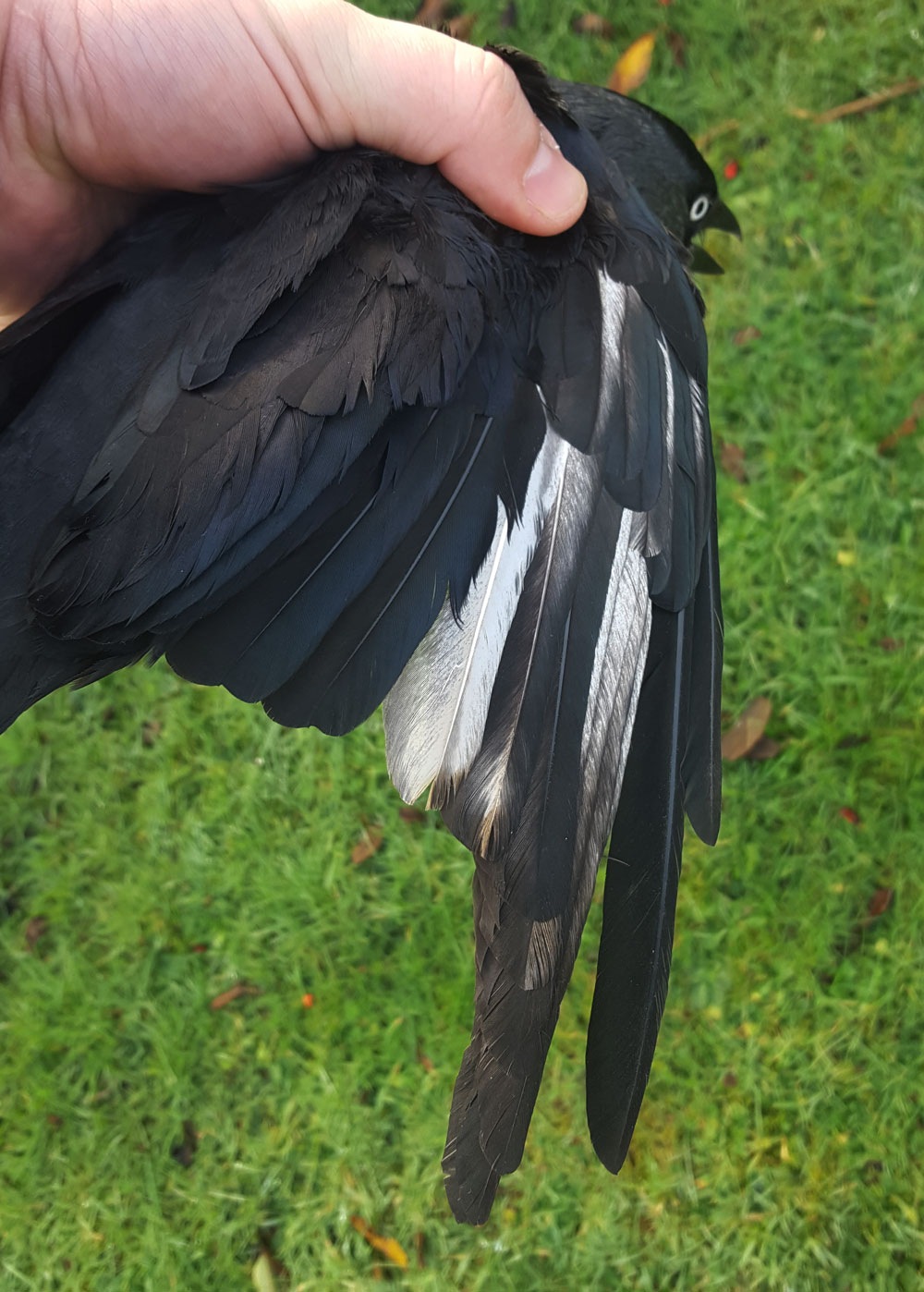
As you can just about see in the above photo, this bird had a few white/partially white feathers in its wings. This leucism is quite common in corvids, although I see it most often in Carrion Crows and less so in the other species...


Thursday, 25 August 2016

Mega Beer Head Morning

Mixed emotions from Beer Head this morning. One of my best ever early autumn falls, but I was bird ringing and managed to catch not that much at all!!  I knew it was going to be good straight away, as I was walking out to my net site in the half-light of dawn I saw a Spot Fly on a low fence with half a dozen Wheatear, and two Tree Pipits flew over calling.

The first two hours were really amazing, with birds just suddenly appearing in the bushes, but then quickly disappearing too.  The field I was ringing in was then completely invaded with Wheatears when a huge flock dropped in, but again they pretty quickly moved off west. Yellow and Grey Wags and Tree Pipits kept zipping overhead, it really was all go and so so exciting!!! At about 9am though it all went quiet. And I mean really quiet, the bushes just went bird-less. So weird how this happens...

But my one 60 foot mist net that usually catches most things I see was completely and utterly useless.  The north wind was just strong enough that birds could clearly see it as they were flying around, under and over it.  It may as well have been painted neon yellow to be honest - well it couldn't have done any worse! So so disappointing in this respect (especially as I saw the star bird of the morning 'bounce out'), but a superb few hours at the same time!

Pointless mist net!


So, forgetting about the ringing (which is what I should have done at 7am and just gone for a wander!) this is what I saw;

1 alba Wagtail
3 Grey Wagtail
30+ Yellow Wagtail (some with cattle, others over west)
15 Tree Pipit (my highest ever count for Beer Head, all overhead)
25+ Wheatear
2 Redstart (m and f)
1 Pied Flycatcher (a bit of a Beer Head mega, last seen bouncing out then flying around my mist net! Gutting)
5 Spotted Flycatcher
1 Blackcap
1 Garden Warbler
4 Whitethroat
10 Willow Warbler
5 Chiffchaff
1 Goldcrest (my first of the autumn here)

Ian Mc, Ian P and my Dad were also up Beer Head this morning, and from what they told me I reckon you could add another one or two Redstarts, a couple more Spot Flies and a load more Whitethroats to my totals.

Epic epic epic morning. Really hope we get many more like this, but it would be nice if I caught a few of them next time...

Monday, 22 August 2016

Beer Head

I've been visiting Beer Head twice a week at least for the last three or four weeks hoping to see signs of autumn migration.  Well I have been seeing some signs, but only very very small ones!  Late July and early August can see big numbers of Willow Warblers passing through, but not this year. Probably not helped by the clear skies and light winds that we've seen during this period - it usually takes cloud or a cold wind to drop any numbers - but I am worried they've not had a good breeding season.

Apart from the odd (and I mean odd, just one or two) Willow Warbler, it took until the 15th August before I saw any numbers worthy of a notebook entry. A Tree Pipit over east, eight Whitethroat, two Willow Warbler and a Wheatear grounded were noted on this date.

A Wheatear looking autumnal


These few birds gave me the encouragement I needed to get up here with my mist nets at the next available opportunity. So I did a few days later, but was a little late and having trudged out to my ringing site and being struck by how there were no migrants about at all, I just turned around and came back home! 

A veil of cloud and almost no wind on 18th tempted me up there again, and this time I actually stayed put and set up some nets!  A few hours with two nets gave me 15 birds of 5 species, including a control. They were:

6 Swallow (1 adult)
2 Robin
1 Dunnock
5 Willow Warbler (2 ads, 3 1st yrs)
1 Chiffchaff (a control, ring number HLV777)

Young Willow Warblers are just so yellow!

Chiffchaff HLV777 looking really scruffy in head moult


Usually I only catch young Swallows in the mist nets up here, so on catching an adult I thought I'd do some comparisons.  Adult Swallow (age code 4) on left, juvenile Swallow (age code 3) on the right...


So although I have had an enjoyable couple of hours of ringing, really it is still very quiet for passerine migration. Let's hope as we come towards the end of the month things pick up....


Tuesday, 12 April 2016

Beer Head

Up to Beer Head again this morning with the nets, joined by Peter for the first time this year - sadly I couldn't offer him an exciting session though.

It was soon evident the bushes were quiet, with just the odd Chiffchaff and Willow Warbler filtering through.  They could clearly see the nets as well which really didn't help - at one stage I watched a group of five Willow Warblers flitting along the bushes right towards one of my nets, but two went over it, two went around it and I caught just one!  

Two nets in two and a half hours saw 14 birds of six species ringed;

1 Blackbird
1 Blackcap
4 Willow Warbler
5 Chiffchaff
2 Blue Tit
1 Long-tailed Tit

Chiffchaff (left) and Willow Warbler (right).


With the clear skies I guess I wasn't surprised how few birds were in the bushes, but I was really surprised about how few birds were passing over.  I only noted five 'vis mig' birds overhead; two Swallows, two Meadow Pipits and.... well the and was a bit of a good one...a Short-eared Owl!


As can be seen from my video it was harassed by every Crow in Beer for a short while before it gained height and flew off south east across Lyme Bay.  What a lovely surprise, and one of the bonuses of having Beer Head as a ringing site :-).

Despite then spending the rest of the day at work, I still managed another year tick today. Whilst walking the dog around my estate tonight (about 20:30) I could hear a Grasshopper Warbler reeling from the edge of the marshes.  A few minutes later and I was stood right next to it - one of the best sounds of the bird world if you ask me. 

Tuesday, 5 April 2016

Beer Head Ringing

Looking at the weather forecast for this week, I had to take my mist nets to Beer Head this morning because it looks as though I won't have another chance any time soon!   With a gentle NW wind and plenty of high cloud the conditions couldn't really have been any better, but I was a bit concerned about a huge low that moved slowly east through Spain/France last night - right on the migration route. Thankfully though this didn't appear to be a problem...

Only set one 60 foot net, and in 4 hours caught 19 birds of 9 species. Two were retraps (a Dunnock and a Wren) with the other 17 being; 

1 Robin
1 Wren
1 Blackcap
3 Chiffchaff
8 Willow Warbler
1 Redstart
1 Linnet
1 Goldfinch

It was shaping up to be a really excellent session, but the phylloscs quickly dried up. I caught eight within the first half hour, but from then on only had the odd one drop in (I'm sure not helped by the net moving in the breeze).  The Redstart certainly brightened things up though :-)

First saw it in the field, but within 30 seconds it was in my very well placed net!

Just love the head pattern on a spring male Redstart

Classic spring Willow Warbler - so great to handle a few of these again


I saw an unringed male Redstart about an hour and a half after ringing the first one (think there were three on site), but other than that there were just a few more Willow Warblers and Chiffchaffs in the bushes.  Overhead passage was non-existent, the only notable bird I saw flying past remains unidentified! It was either a Goosander or a Red-breasted Merganser but I only saw it for a few seconds before it flew into the glare of the sun and then below the cliff.

Yesterday I saw my first House Martins of the year, with five over Lower Bruckland Ponds with Sand Martins and Swallows. There were plenty of gulls on the Estuary for most of the day, and among the 26 Lesser Black-backed Gulls were four intermedius-types. Also saw the Marsh Harrier numerous times during the day, including from the house last thing at night...

It's definitely a 2cy bird, but unsure of which sex. I keep thinking I can see a grey wedge on its underwing but the upperparts look female.


It was was nice to see several of the regulars (and Alan) up Beer Head this morning, spring is well and truly in the air!


Friday, 1 April 2016

Beer Head

Beer Head yesterday morning wasn't heaving with birds, not by a long way, but there was a nice late March selection. All in nice weather too which is always a bonus!

Best of all was a smart male Firecrest in the Sheepwalk, with a back up cast of a female Black Redstart, a female Wheatear, a sub-singing Willow Warbler, two Goldcrest, five Chiffchaff and seven Stonechat.

I often find the first arriving Wheatears don't allow close approach - bring on the showy Greenland hulks!

I was so pleased with the haul that this morning I took my mist nets up there for the first time this year.  Sadly though everything was the opposite to yesterday, especially the birds (none!) and the weather (bloody cold!).  Nice views though as ever, here's my main net ride half way through setting the net...

I am so lucky to have these spectacular views at this ringing site.

Thursday, 11 February 2016

Control Goldcrest

You may remember that within my blog post that featured the ringing of a stunning Green Woodpecker at Lower Bruckland Ponds last month (see here), I mentioned that one of the four Goldcrests I caught that morning was wearing a ring with a number I didn't recognise.  Well late yesterday I'm pleased to say I got all the info back from the BTO. I must say I really applaud the BTO at how much quicker they are at getting data like this back to us ringers these days - bravo ringing HQ!

Goldcrest CPX749 was ringed on 18/10/15 at Seacroft, Skegness, Lincolnshire. No doubt ringed soon after it made first landfall to the UK after completing that treacherous flight across the North Sea. Here are the full details and a map:


As you can see there were 94 days between ringing and recapturing, and a distance of 217 miles (350km) travelled. It wasn't weighed up at Skeggy, so I presume it was caught on a day of pretty intense ringing. A quick check on the Gibraltar Point Bird Obs website (link here), which is a bird observatory a mile or two south of Seacroft, shows that the 18th Oct 2015 was indeed a very busy day. Hope they don't mind me copying and pasting this on to my blog:

"October 18th. A new Pallas's Warbler was found during the morning at the North End along the sycamores along the northern boundary of the reserve. Other birds around, including those trapped, were a Richard's Pipit, a Yellow-browed Warbler, a Great Grey Shrike at the Wash Viewpoint in the afternoon, a Firecrest (East Dunes), a Grey Wagtail, a Redstart, an adult Caspian Gull (on the beach in the morning), a Short-eared Owl, a Marsh Harrier, 2 Merlin, a Kingfisher, a Treecreeper and a late Grasshopper Warbler. On the Mere were a Jack Snipe and a Water Rail, and on Tennyson's Sands another Water Rail. Flying south were 24 Siskin.
At Aylmer Avenue another 600 Redwing moved south and west during the morning along with 30 Fieldfare, 20 Song Thrush, 30 Blackbird, 10 Brambling, 8 Siskin and 6 Lesser Redpoll. There were 300+ Goldcrest around through the morning before they quickly moving on south. Interestingly none of the 194 Goldcrests ringed yesterday at Aylmer was retrapped today, amply demonstrating the rapid turnover of birds through the reserve when we have north-easterlies.

A morning ringing session in East Dunes, with James Siddle, provided 93 new birds: 36 Goldcrest, 3 Wren, 11 Robin, 5 Blackcap, 8 Goldfinch, a Grasshopper Warbler, a Reed Bunting, 4 Lesser Redpoll, 8 Song Thrush, 10 Redwing and 6 Blackbird; and 8 retraps: 2 Robin, 3 Goldcrest, a Blackcap, a Dunnock and a Goldfinch.


A longer ringing session at Aylmer Avenue by Mick Briggs and David Vincent, who were assisted in the morning by Neil Hagley of the Charnwood Ringing Group (Many Thanks, Neil), resulted in 241 new birds and 18 retraps.
The new birds were 138 Goldcrest, 48 Redwing, 19 Robin, 11 Song Thrush, 7 Blackbird, 5 Blackcap, 3 Fieldfare, 3 Greenfinch, 2 Wren, 2 Brambling, a Reed Bunting, a Dunnock and a Chiffchaff. The retraps were 9 Greenfinch, 2 Robin, 2 Dunnock, 2 Blue Tit, a Goldcrest, a Blackbird and a Chaffinch.
  
Ringing during October so far has resulted in 2333 new birds ringed - the best monthly total since October 2012. There have been an amazing 1266 new Goldcrests."


Source: http://gibraltarpointbirdobservatory.blogspot.co.uk/


So although not a surprising movement for a migrant Goldcrest, for me it's so special, as it is for the Ponds. And with so many Goldcrests ringed on the east coast during the autumn of 2015, its another recovery that helps paint the picture of how they then spread out to spend the winter across the UK and Western Europe.


Thursday, 21 January 2016

First Bird Ringing Of 2016

With a couple of days midweek forecasted to have little/no wind, I wanted to get out with my mist nets on at least one of them, so yesterday headed out to the superb Lower Bruckland Ponds...


Because it was so cold I only put two nets up, and didn't open them until the sun had come up. It's only right to be extra cautious when ringing in cold conditions like this.  The two nets in two and a half hours gave me just nine birds, but it was quality not quantity. 

Over the past few weeks I've been chatting to other patch birders about how scarce Green Woodpeckers have become, I hear them only very occasionally now and I've not seen one on patch for over a year. But as I was putting up my nets I heard one call in the distance, so once the nets were up I gave Bun a call to let him know there is still at least one left here!  While we were nattering it flew down from the slopes above and began feeding around the base of some of the small trees at the Ponds.  Occasionally it flew up to a large oak, which is when I was able to get this snap...


From this oak it kept returning to the same small trees to feed in, but after taking this photo it flew straight for the clump of trees which had one of my mist nets in.  I looked around the corner and was shocked to see it IN my mist net!!!  I ran...


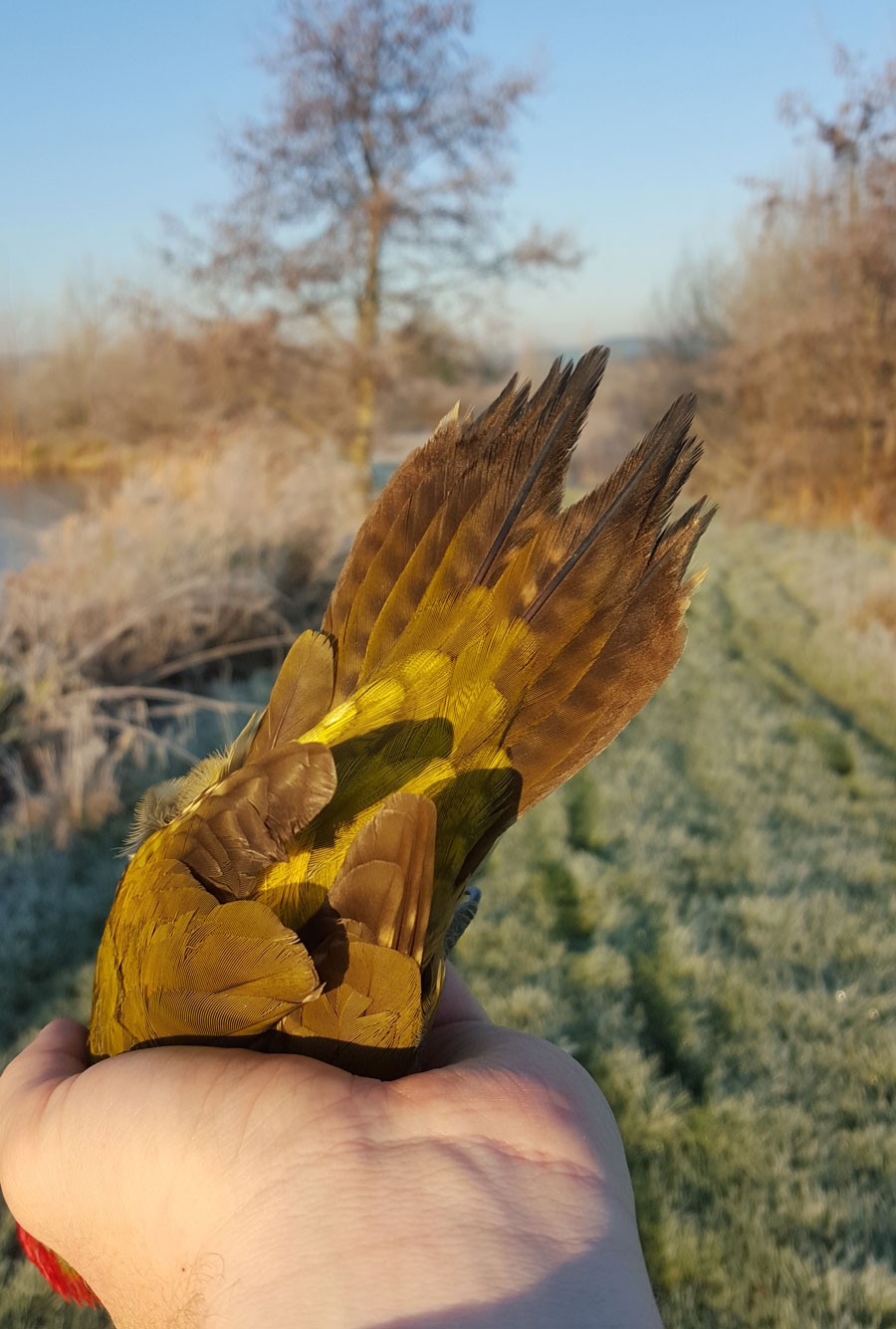
This, not surprisingly, is the first Green Woodpecker I've ever ringed.  And it's a bird I thought I would never ring around here, what an absolute privilege.  Lower Bruckland Ponds is a big site, and two mist nets covers such a tiny proportion of it - I was so so lucky!

The other eight birds caught included a couple more notable highlights. Two of the four Goldcrests I caught already had rings on, one was a bird I ringed here on 1st Nov 2015. Really interesting to see it is over wintering at the ponds, and it was half a gram heavier so it must be doing ok. The other ringed Goldcrest wasn't one of mine, anyone reading this recognise ring number CPX749

Two male Siskins were great to ring, the flock has been here since October but they are very hard to catch as they usually stay up at the tops of the trees...


And the last highlight, in fact the last of the nine birds I caught, was this fantastic male Stonechat - he's been overwintering at the Ponds and I see him most times I visit...


What a fantastic morning, lovely weather too. Sadly though it looks like we've slipped back to wet and windy conditions again...

Wednesday, 9 December 2015

Gotcha!

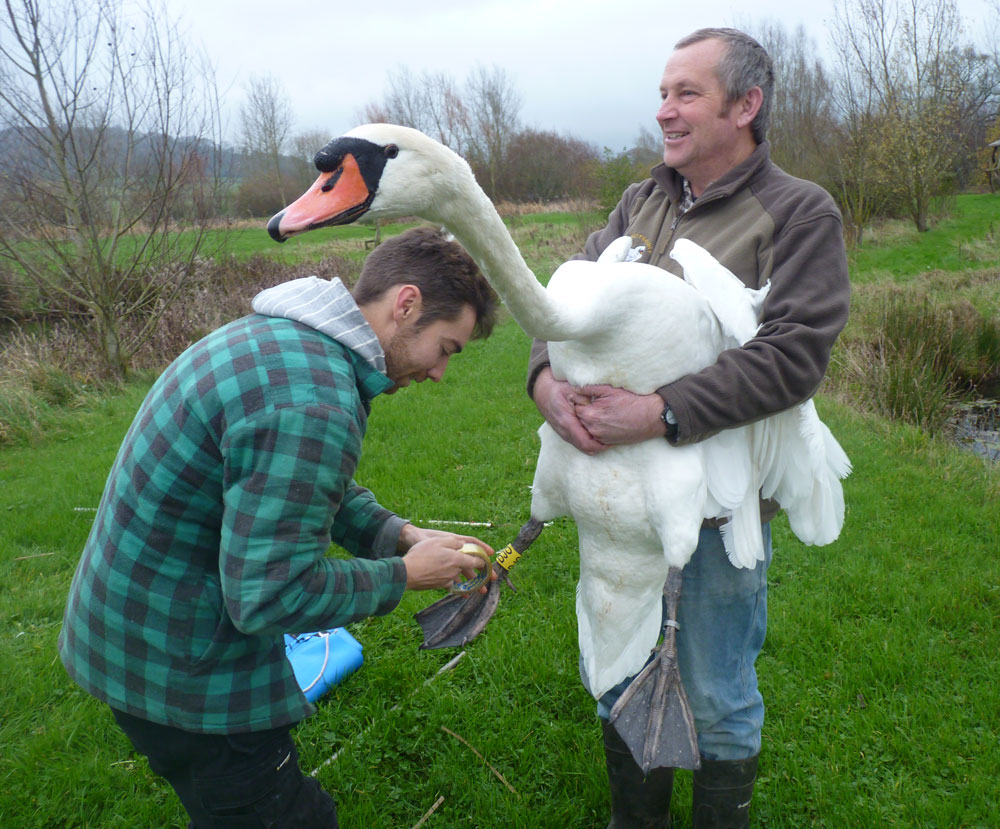
Mid last week the Abbotsbury Swannery boys came over again, hoping to catch the male Mute Swan that slipped the net a few weeks ago.  It wasn't as easy as our first attempt as the female clearly remembered us and remained a little nervous, which rubbed off on him. Despite this though within a few minutes thanks to some superb tiger-esk stalking from Steve G, he was in our hands...


As you can see from Steve's expression in the lower of the three photos he was a heavy boy, weighing 3kg more than the female at 13.5kg.  And he can now be known as DJO.

Saturday, 7 November 2015

A Tricky Siskin

I caught a couple of Siskin at the beginning of the week, which was really nice as I don't handle many of these at all.  Mind you there were a flock of 40+ hanging around one of my mist nets so I was expecting a few more to be honest.

The first bird, a female, was very easy to age as a bird born this year (age code 3)...

Siskin head (3f)

The standard open wing shot

The eagle eyed will notice in the above photo the difference between the unmoulted juvenile-type feathers and the moulted adult-type feathers.  The tertials show it really well (the three large feathers in a line closest to the birds body). The lower of the three tertials has not been replaced and due to its brown-ish cast can be aged as a juvenile feather, whereas the two smaller ones above are blacker, these have been moulted and are now adult-type feathers.  There's also a nice contrast between the moulted adult and two unmoulted juvenile greater coverts...

Greater coverts are always moulted from in to out in passerines, hence why whenever any aren't moulted it's always the outer most one(s).

Then there's the male. When I took it out of the net I thought it was going to be a young bird because it just didn't look like an adult male, but on ringing it I tentatively put it down as an adult (age code 4). However I was never happy with this as I know young Siskins can do very odd and extensive moults (sometimes even complete moults!) and looking at the photos it's gone back to being a young bird (age code 3) again. Here's why...

A nice male Siskin

It had an adult tail (rounded and all feathers similarly worn) and all greater coverts and tertials were adult-type feathers. But what gave it away for me was the longest alula feather...

Virtually the same pic but with numbers

Basically this young bird has moulted everything apart from its primaries (3), primary coverts (2), secondaries (4) and longest alula feather (1). You can tell this by the duller and slightly browner appearance of these juvenile feathers, compared with the blacker tertials (5) and greater coverts (6).  Also in an adult Siskin the wing flash across the primaries and secondaries is deeper yellow, as you can see in this bird it is pale yellow. 

I really love educational birds like this, and hope at least one person finds this post helpful/useful/educational.

Sunday, 1 November 2015

Lower Bruckland Ponds

With the forecast suggesting this morning was going to be cloudy and still I was keen to get out ringing, and opted for Lower Bruckland Ponds - what a session it was!  I only put two 60 foot nets up and in the first net round caught 21 birds!!  It wasn't just the nets that were busy, there were birds everywhere. The fog appeared to be disorientating migrating birds as I had small flock of Redwings flying in all directions. A Brambling north overhead was my first of the autumn and ten Fieldfare included a flock of eight that flew north.  LOVE MIGRATION!

Bird ringing always has the ability to surprise me, and yet again it did just that today.  I'm always dropping in to Lower Bruckland Ponds during the autumn to check through the Long-tailed Tit flock that seems to be semi-resident here, well I caught this flock on my first net round today.  I then caught another flock of un-ringed Long-tailed Tits, then another, and then another!  Nuts.

You can't do anything with ageing on Long-tailed Tits as both young and adult undergo a complete autumn moult so they all look the same, although one of today's did look a bit different...

Someone been for a manicure? Claws are usually dark.

My ringing totals for the morning were:

1 Robin
4 Chiffchaff
2 Goldcrest
3 Great Tit (1 retrap) 
12 Blue Tit (4 retrap)
27 Long-tailed Tit
1 Treecreeper
1 Goldfinch

So that's 45 new birds ringed.  Not bad for a session that I actually had low expectations for, and only two nets!

The Yellow-browed Warbler was still present in Primrose Way this morning, but there was no sign of it at midday so it may have moved on.  Later on in the day Clive pulled a good'un out of the bag with a Cattle Egret in Colyford, the second he's found in two days! Seems to be something of a influx of these happening at the moment, so maybe we can expect some more?

Saturday, 24 October 2015

Fieldfare Revisited

Seeing as the Fieldfare I caught at Beer Head yesterday was the first Fieldfare I've caught as a C ringer, I thought it deserved a bit more attention on the blog.  They do seem to be pretty mist net-savvy birds, unlike the smaller species of thrush that are caught much easier.

Such a smart bird

I thought I'd go through how we came to age and sex this bird in some detail.  I have to be honest and say as I've handled so few Fieldfare I'd forgotten you could sex them, but a quick look at the ringers bible, Svensson, revealed that a closer look at the crown feathers should tell all...


And here's our bird...

What do you think?

Look particularly at the feather showing the largest amount of black towards the top of the pic, the black shows a concaved shape as it runs up the spine of the feather, matching Svensson's female example nicely.  So a girl it is.

Then there's the ageing, and I have to say I had a feeling it was a bird born this year (age code 3) as it came out of the net, because overall for a Fieldfare it just looked a bit dull.  I can't believe I've called a bird this stunning dull, but adults have a lovely rich chestnut brown mantle and scaps and lead grey head and rump - not this one though.  

The photo is pretty poor quality I'm afraid but it was pre-sunrise!

I've marked where the moult limit is, between the brown inner replaced adult-type greater coverts, and the old juvenile ones.  As well as the colour difference, you can see the difference in wear between the two, with the old juvenile coverts looking pretty knackered, whereas the adult ones are much smoother edged. That's simply because the juvenile feathers are probably three or four months old, but the new replaced adult ones a month old at most. 

And as with most birds, the tail is usually pretty helpful too when it comes to ageing...

I always find it hard to spread a tail nicely for photographs

Again look at the wear, if this was an adults tail it would be a month or so old as the bird would have undergone a complete moult before autumn migration - but it is pretty ragged and worn.  I'm sure other 3's show pointier tails than this, but I've found tail shape can vary a lot between individuals even if they are the same age and sex  The colour of the feathers, dull brownish grey, also fits with the bird being a young female, adult males have jet black tails.

Hope you've enjoyed this post, it's nice to get a bit technical now and then.  I'll finish it with a quick snap I took of a couple of Reed Buntings that I caught at Lower Bruckland Ponds earlier in the week, they were both 3's and conveniently one of each sex...

If only I had a third hand I could have got many more photos!

Friday, 23 October 2015

Beer Head

Very much an end of autumn feel to Beer Head this morning.  The weather was as perfect as it could be with 100% low cloud cover and for the first couple of hours no wind at all.  Despite this there wasn't much moving about in the now pretty baron trees and bushes. Even overhead passage was disappointing with just a few flocks of Chaffinches and Meadow Pipits and very small numbers of the other expected species. 

As a result, it was no surprise that only twelve birds were trapped and ringed this morning. But although there many not have been the quantity, there was some excellent quality including three new species ringed for the site...

A stonking Fieldfare!!

I was really surprised to catch this, because unlike Tuesday (when we put in the same effort as today) there were no thrushes about, we caught no Blackbirds, Song Thrush or Redwing. But this is worth all of them and more in my eyes - my favourite of the regular UK thrushes.  What made this capture even better was that this was a new bird for Peter, and he really deserved a reward for joining me early this morning despite knowing he had to leave prior to 9am.

Peter has a habit of rubbing under his ear when he's excited...

So Fieldfare was the first bird in the nets this morning, and the second was this gorgeous Lesser Redpoll...

In my eyes an even more stunning capture - such a charismatic sweet little bird.

And later in the morning new bird number three dropped in to one of my two nets...

A Treecreeper, and you don't see many of these up Beer Head.  Don't worry I did make sure it wasn't a Short-toed!

The (not very) full list of birds ringed this morning looks likes this:

1 Fieldfare
4 Chiffchaff
2 Goldcrest
1 Great Tit
1 Long-tailed Tit
1 Treecreeper
1 Chaffinch
1 Lesser Redpoll

As well as these, we re-caught three birds, two Goldcrests and a Long-tailed Tit.  One of the Goldcrests we ringed here three days ago, and amazingly in that time had put on a gram in weight. That is a heck of a lot for a bird that weighs about the same as a 20p piece! Really interesting to see how quickly the fat reserves can build up on these tiny birds. 

And whilst on the subject of Goldcrests, I thought it was quite fitting that what could well be the last bird I ring on Beer Head this year (have you seen the weather forecast for next week?) was indeed a Goldcrest...

It's been an amazing autumn for this species.