Pages

Showing posts with label fieldfare. Show all posts

Saturday, 2 February 2019

Unreal Cold Weather Movement - 1st February

Winter can be a bit of a long, slow and sometimes dull season for the patch birder, this winter especially so on the Axe. There's not been much other than the usual fare so far, and numbers in general have been pretty poor.  But like any patch birder, whispers of snow in the forecast early last week raised my excitement levels, and Thursday night delivered a fine but widespread covering of the white-stuff...

Looking west over the valley


Major snow events often deliver some impressive bird movements on/over the Axe, but I really wasn't expecting much when I woke up on Friday morning.  It was only a fine covering of snow, it wasn't country-wide and I knew it wasn't going to be in any way a prolonged spell of cold. 

I spent the first hour of the day looking out from the house and garden, and what I saw seemed to confirm my thoughts; a couple of small groups of Lapwing, one Golden Plover and a flock of 15 Redwing flew over.  I then had a look around the Estuary, and other than a group of about 40 Fieldfare on Bridge Marsh - nothing else was where it isn't usually...


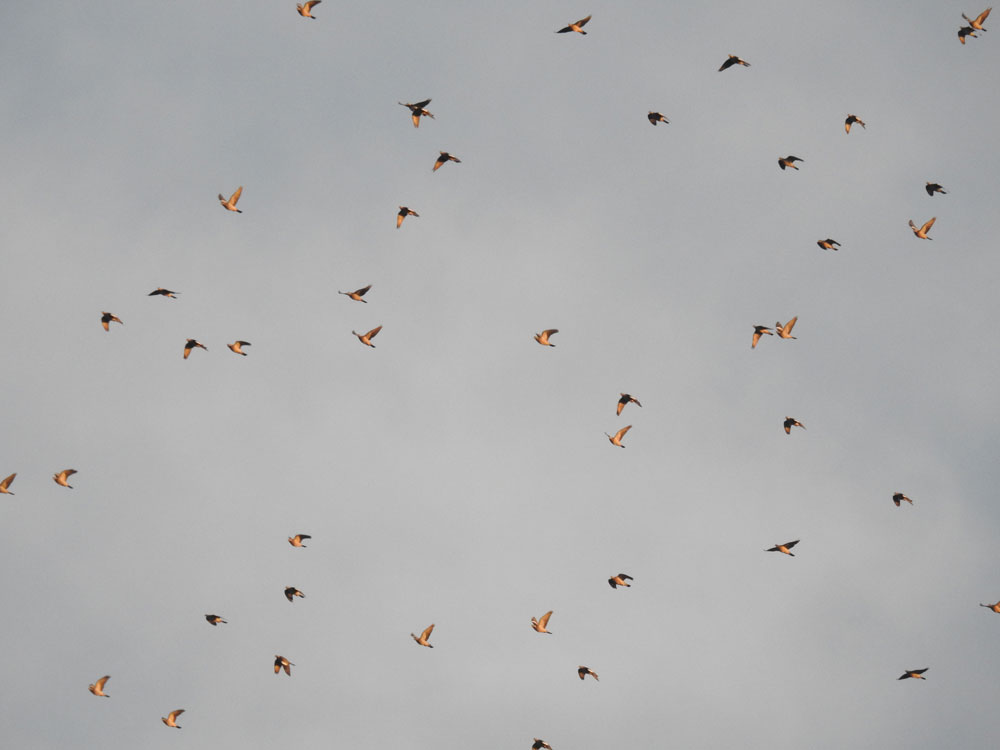
But then I went to the seafront....  and saw the most mind-blowing bird movement I have ever witnessed in my entire life. Just take a look at these two short videos. Make them full screen and turn the sound up...


Thousands upon thousands of thrushes!

I wish I could have just stayed there all day, but the only way I could quantify this movement in any way was by counting 'Portland-style' (a selection of 'sample counts').  Between 10:00 and 15:00 I carried out one 15 minute count, one ten minute count, two five minute counts and three two minute counts.  The last one at 15:00 showed that the passage had slowed a bit, but all previous counts gave an absolutely astonishing figure of between 400-500 thrushes passing PER MINUTE! Huge flocks were passing over, almost constantly - gaps often of only 20-30 seconds between flocks.  This statistic is staggering on its own, but when it's multiplied up it becomes really mind destroying.... Even if we take the lowest figure, 400, this suggests that somewhere in the region of 120,000 thrushes flew over Seaton on 1st February! As staggering as this number is, I am certain it's  an under estimation, especially as they were clearly passing in these numbers prior to 10am, and I've included nothing that may have passed after 15:00.  

Looking at the species break down, Redwings were by far the most abundant species, with an estimation of 80% of the all thrushes seen/heard being this species. This would make the Redwing day total somewhere in the region of 96,000! Unreal.  I did hear the occasional Song Thrush call emitting from the chaos and Fieldfare made up the remaining 20%.

James Mc at Lyme was also seeing this passage, as was Dan over at Sidmouth and Kev in Beer.  What I can't believe though is that was it.  No reports of this massive movement west of Sidmouth, in fact Dawlish Warren reported virtually no thrush movement at all! And the only reports east of us were from Portland where up to 10.000 Redwing were seen to leave north west over Ferrybridge (http://www.portlandbirdobs.com/2019/02/1st-february.html).  What on earth is that about!? Where did they all come from and where did they all go!?

Skylark were also moving in good numbers (I noted a couple of hundred, so 1000+ probably passed during the day), with a calling Woodlark over Seafield Garden at 10:45 being a nice highlight. Kev had a second one over Beer an hour or so later.  I also logged a couple of small flocks of Lapwing and the odd Linnet, Chaffinch and Siskin, but in general variety was poor and it was all about thrushes and Skylarks

As I'm typing this my mind is still blown to be honest.  Feels almost a bit like space, involving numbers that only people like Brian Cox can truly comprehend.  Just so so so many birds. 

About mid afternoon I had another look around the valley, and by now ground was starting to thaw and birds were congregating in these spots.  The slope just to the east of the Estuary was like a rolling carpet of Redwing, 500+ birds here (at the same time as the passage was still  happening over the seafront by the way!).  Bridge Marsh also showed lots of thrushes along with a flock of 60+ Skylark.  Then just up the road, the field north of Colyford WTW was again full of thrushes, a flock of Skylark, 300+ Lapwing and c60 Golden Plover.  Here's a few pics...

Redwings
One of the above Redwing!
Fieldfare
Skylarks
A Skylark
Meadow Pipit
Golden Plover with a Lapwing background


Best of all about this amazing influx of birds was that none of them looked to be struggling in any obvious way.  Everything I saw on the ground appeared to be finding plenty of food, and all the birds passing overhead were flying strongly and with purpose - not something weak birds can do.  It was really nice to witness a cold weather movement without feeling that sadness usually associated with snowy spells. I am really surprised this relatively small amount of snow caused such a drastic response from the birds - we had far less snow than last Feb/March but way more overhead passage.  Do they know something that we don't? 

And now to today...

The weather this morning (2nd) was completely different.  Still pretty cold, but crystal clear blue skies and most of the snow had melted away.  There were still lots of birds about, with thrushes flying around everywhere, but they were flying in all directions.  It was nice to catch up with two waders on the Estuary that Phil saw the previous day, a Bar-tailed Godwit and this Avocet...

Avocet and Black-headed Gull
Got to love an Avocet in flight!


There were also 47 Dunlin here which isn't a bad mid-winter count for us.  And that's it for this somewhat mammoth blog post.  Truly unforgettable stuff though.

Sunday, 11 November 2018

Arctic Tern Remains

Just a quick one to say the Arctic Tern was still around today, I watched it feeding off the seafront late this afternoon with Black-headed Gulls.  So 11th Nov becomes my latest date for a UK Arctic Tern!

I also noted my first Fieldfare of the autumn this morning, not far from my house - nice to hear that 'chack' again! Weeks later than I usually get my first though. 

Other news from the patch today include three Black Redstarts (one adult male) between West Walk and Seaton Hole.


Sunday, 18 March 2018

More Snow!

Like many other places in the south west today, it's been snowing here in Seaton from dawn until dusk. One snow event in a year is exceptional enough for us, two is unprecedented! 

The view from my bedroom window late this afternoon


The heavy snow didn't start until about mid morning, and it was amazing to see how quickly the birds reacted to this. Just proves they really do need to be able to feed constantly, and as soon as they realise they can't, sitting it out just isn't an option. They have to move.

I could do nothing more than have sporadic looks outside today, but these have shown incredible numbers of Fieldfare and Redwing flying west, thousands upon thousands, along with several hundred Starling and Golden Plover and smaller numbers of Skylark, Meadow Pipit, Pied Wagtail, Chaffinch plus a single Reed Bunting.  All seen from the centre of town. Incredible scenes.

The passage did seem to dry up mid afternoon, and unlike the last snow event, apart from a few Meadow Pipits there doesn't seem to be many birds struggling for food in gardens. Not a single Redwing in the road I live in late this afternoon, compared to about 500 two weeks ago! So although as things stand, this cold weather period doesn't look to be as severe on birds as the last, the timing is probably a bit worse.

Some local birds will have started nesting now, especially Blackbirds. Disaster for all these early breeders. And then there's the early arriving migrants, small numbers of Wheatears, Sand Martins and Chiffchaffs have already arrived in the UK after a long migration - and they now have to face this. There have been several reports of struggling Chiffchaffs today in particular, and late this afternoon I was deeply saddened to find this in the corner of a carpark in town...

Dead Chiffchaff
Sorry mate, you didn't quite make it


This beautiful Chiffchaff probably spent the last week or so traveling hundreds and hundreds of miles as it migrated back towards it's breeding grounds somewhere in the UK. All the obstacles it would have had to overcome, all the energy it would have used up. And all for this. Lying dead in the snow in Seaton. So so sad.

Monday, 13 November 2017

Odds and Ends

First of all, thanks to everyone who's made kind comments about the article I've written for the November edition of Birdwatch magazine. I was thrilled to be given the opportunity to pen a three page article all about birding the Axe Estuary and Seaton Wetlands during the winter months. I was even more delighted in the fact the Axe had been given so much magazine space! If you want to read it, when you're next in a Newsagents look for this front cover...

It's worth paying the price for the Sibe Blue Robin story and photos alone!


I've just got a few odd sightings to report from the last few days on patch, not that I've done much birding...

Last Thursday I had several sightings and 'soundings' of a Brambling bombing around where I live. Never saw it perched, but it was clearly perching somewhere.

The following morning (Friday) I saw my first Black Redstart of the autumn, with a female-type on roofs along Beach Road, Seaton. Offshore were big numbers of gulls, Kittiwakes and Gannets feeding, although mostly far out.

Sunday morning a calm sea revealed a lovely Great Northern Diver at first off Seaton, then off Seaton Hole. It came quite close inshore at times, but the light made photography tricky...


And today, my best sighting was of thirty Golden Plover with Lapwing in the usual fields alongside the A3052 by the Honiton turn-off. Sadly no small grey ones among them. There seemed to be a few birds moving this morning, from the back garden I had a few Chaffinch and Redwing, and a flock of six Fieldfare NW.

Hopefully I'll manage to get out a bit more during the remainder of the week.
 

Wednesday, 8 November 2017

Thrushes, Yellow-legged Gulls and more Vis Mig

Monday didn't give that me much time out, but I did grab an hours wander along the footpath running through Allhallows (a large ex-private school in Rousdon) with Hawfinch in mind.  Looks really good for them here, but none during my visit. It was nice to see heaps of thrushes though, including ten Mistle Thrush and plenty of settled Fieldfare and Redwing...

Fieldfare


Tuesday was a completely different day. Rain, wind and more rain. This meant the Estuary gulls got my attention, and at 2pm the 300 Great Black-backed Gulls and 45+ Lesser Black-backed Gulls (including some cracking intermedius) were accompanied by two Yellow-legged Gulls, a second-winter and an adult...

Second-winter Yellow-legged Gull (middle bird)
Adult Yellow-legged Gull (on right, with a Great Black-backed)
Both Yellow-legged Gulls, the adult looks small here but it wasn't


As you can see the adult was very clean headed, and a somewhat cute-looking bird, two features that meant my initial thought was Caspian Gull when I spotted it. Sadly this didn't go beyond an initial thought as it soon became apparent it was a Yellow-legged. Oh what I would do for an adult Casp here...

This morning the sun was out again, so Axe Cliff was the obvious place to go. Richard P joined me and we spent an hour or so on the cliff-edge before the westerly passage dried up. Amazed there were no Pigeons, maybe they've all gone through now? What vis mig there was included;

1 Grey Heron
1 Mistle Thrush 
20 Skylark
3 alba Wagtail
60 Meadow Pipit
139 Chaffinch
1 Redpoll
10 Linnet
1 Greenfinch
2 Bulfinch
1 Reed Bunting

A vis mig Grey Heron!
Incoming Grey Heron with Seaton Hole as a backdrop

Saturday, 28 October 2017

When Wood Pigeons Become Cool

I'm going to kick this blog post off with a video. Make sure you turn the volume up so you can hear their wing beats...


Yesterday proved a major Wood Pigeon day for us, with James Mc seeing somewhere between 30 and 50 thousand pass through (I really must buy him a notebook!) though sadly I only managed to witness about twenty minutes of this. But today, with clear skies forecasted for the first few hours of the day, I wasn't going to miss round two. James joined me for an Axe Cliff vis mig watch 08:00 - 10:00.

There were fewer Wood Pigeons today (for us anyway) with probably about 15,000 seen flying west. Still, many of them passed really low over our heads, or just in front of us below the cliff edge. As the morning went on flocks started passing higher both out to sea and inland, so we probably missed thousands!  I tried to capture their magic on camera but it's never the same...


Although this would have proved enough excitement, there was plenty more to be seen this morning.  After three busy nights of thrush passage, it was good to finally see more about in daylight hours. There were almost constantly ones and twos of Blackbirds, Song Thrush and Redwing taking off or dropping in, along with my first three Fieldfare of the year west. Pity the four Ring Ouzel James saw here yesterday weren't still about, or some more, but hey ho.

I stupidly forgot my notebook this morning, so the higher counts are more like guesstimates, but this is roughly what would have gone into my notebook (west unless stated); 

3 Lapwing 
7 Golden Plover (a five and two singles)
15,000 Wood Pigeon
50 Stock Dove (probably a gross undercount!)
6 Rook
200 Jackdaw 
140 Starling 
70 Skylark (most of these were inland of us so we probably missed more than we saw)
70 Blackbird (total includes both settled and migrating birds)
40 Song Thrush (total includes both settled and migrating birds)
45 Redwing (flying in all directions!)
3 Fieldfare
10 alba Wagtail
50 Meadow Pipit
70 Chaffinch
3 Brambling (all singles)
80 Linnet
15 Siskin
1 Redpoll 
6 Bullfinch
25 Reed Bunting


With all these passing migrants the predators were having a field day. Two Peregrines were almost constantly having a go at the Pigeon flocks, plus we saw three different Sparrowhawk...


Sadly the fields at Axe Cliff are a shadow of their former self. Since they've been ploughed, flattened and replanted this year with winter crops, they're proving completely unattractive to ground feeding birds. In past years today would have also shown hundreds of larks, pipits and finches feeding in the fields, adding another exciting element to birding here, but today absolutely nothing. I really can't believe Yellowhammers are hanging on, but they are...


After Axe Cliff I had a 15 minute look over the valley. A Great White Egret had flown west past Abbotsbury earlier in the morning, and by my reckoning was due to drop in on the Axe any minute. Sadly though, having now missed five here this year (Bob Longhorn found another on Black Hole Marsh yesterday, which stayed 45 minutes), this bird decided to completely bypass us and flew up the Exe instead. Typical! The other bird I was hopeful for was Glossy Ibis, as yesterday saw something of an influx of these into the UK. Despite checking all the visible ditches and scrapes, no luck. Guess what Sue Murphy found on Colyford Marsh late this afternoon though, yes, our first Glossy Ibis of 2017. I had the right idea - just picked the wrong time!

A few days ago it was nice to see a Cattle Egret still with us. Or was, I haven't seen it since! It was feeding with a few Little Egrets near the cattle on Bridge Marsh on Wednesday...


Am really looking forward to some more vis migging, hopefully there's a few more sessions left in this autumn. The question is though will a Hawfinch reward my efforts?  Only time will tell...

Friday, 25 November 2016

Autumn's Not Over Yet

The raw north wind continued today, and it continued to encourage some decent passage.  This morning a constant trickle of small Redwing flocks were heading north, along with my first three Fieldfare of the autumn. 

A walk along the beach late morning, for only half an hour, showed a lovely group of four Red-breasted Mergansers (two pairs) fly in from way out, bomb around in all directions for about five minutes (including up the Estuary a short way) before heading off east. 

Not quite patch gold, but better than patch bronze - so can only be patch silver!!


Then my day took a downward turn.  Just before midday I picked up six geese flying in from the south, but they were miles out to sea.  Their flight path though meant they were going to eventually fly right over my head so I just watched them.  The closer they got the more they flew into the sun, so they just looked all black. Then annoyingly just as they were in direct line with the sun they turned and started flying away high east... Nooooooo!!! And it got worse, as they flew into better light I could see they were grey geese! And definitely not Greylags. Gutting. They had necks, and seemed to show a bit of paler grey mid way along the upperwing, so they were probably White-fronts but it looks like I will never know. Drat.

To cheer myself up I had a look through the gulls on the Estuary. Three Med Gulls were as good as it got, a first-winter and two adults, including this ringed individual...

Such fab birds!

Saturday, 30 April 2016

Dartmoor

I've been lucky enough to spend quite a bit of time on Dartmoor over the last few weeks, and will be spending a heck of a lot more time up here over the next 11 weeks...


The weather really has been mixed, the above photos were taken on the nicest day, on other mornings we had to sit out snow and hail showers, and the first day saw a raw east wind whip up late morning.  

As expected it's been nice to see plenty of the usual Dartmoor summer birds; Cuckoos daily, Curlews, Redstarts, Whinchat, Snipe, etc. A Fieldfare on the 28th was my biggest surprise, the latest I've ever seen one in the county, but considering the temperature at dawn was -1 it was probably feeling at home...


When we are out on the moor we don't have much time to hang around, none at all really.  But when this Fox appeared in front of me I just had to stop and film it for a short while, and luckily for me it did a full on mouse-pounce...


Now back to the patch. I'm really pleased that the Hoopoe is still here today, and remained in view pretty much all day for the constant trickle of visitors, there's some stunning photos of it appearing online.  It's clearly been quite a good day today, I've not gone out birding at all but two dog walks and an eye open from my back garden has given me some nice birds. Allhallows mid morning showed ten Wheatear, two Willow Warbler and a Whitethroat. A wander around Colyford late afternoon showed a female Whinchat, and from the house this evening a female Goosander flew up river and my first Swift of the year flew south.  

Wish I had gone out birding today after all!

Thursday, 19 November 2015

Not About Gulls!

Despite my best efforts I haven't seen any more interesting gulls on the Estuary, so I can assure all that this blog post is a gull-free zone...

It's been rather wet and windy this week, and last week, well for the whole of November to be honest! I've not been able to do any bird ringing because of this, but I have still had a dog to walk (and gulls to check!).

This is proving to be one of my best ever autumns on patch for winter thrushes (despite the mild weather!). Every time I go out I'm seeing Redwings, and more often than not Fieldfares too (saw 45+ two days ago) and I don't just mean fly overs which is the usual way we see them in the autumn. In most other years I don't see many winter thrushes settled around here until Christmas time, so it really is notable. And whilst on the subject of thrushes, I should mention here the house tick I had on 12th with four Mistle Thrush from my kitchen window.

Black Redstarts keep popping up in front of me too.  After seeing a male and two female-types at Axmouth Yacht Club on 4th Nov, I had three female-types here on 11th (with none in between, so all three could have been new birds?). Away from here I had a female-type in the main car park in Beer on 9th, and about two hours ago was treated to my third ever from my house, another female-type just a few roofs down.

Female-type Black Redstart at Axe Yacht Club on 11th.

The Glossy Ibis is still about, we went down to just one bird several weeks ago, and it's currently spending most its time on the first lagoon on the right through the first gate at Seaton Marshes 

Something that for me has been lacking this month, and this autumn, is Wood Pigeons.  I missed the biggest morning of passage, but have seen some flocks flying west. They've not had the ideal weather window to move en masse though, instead they've been trickling through in less than perfect conditions. Oh what I would do for a cold, still and sunny morning!

Wood Pigeons migrating over Axmouth Harbour.

Sunday, 1 November 2015

Lower Bruckland Ponds

With the forecast suggesting this morning was going to be cloudy and still I was keen to get out ringing, and opted for Lower Bruckland Ponds - what a session it was!  I only put two 60 foot nets up and in the first net round caught 21 birds!!  It wasn't just the nets that were busy, there were birds everywhere. The fog appeared to be disorientating migrating birds as I had small flock of Redwings flying in all directions. A Brambling north overhead was my first of the autumn and ten Fieldfare included a flock of eight that flew north.  LOVE MIGRATION!

Bird ringing always has the ability to surprise me, and yet again it did just that today.  I'm always dropping in to Lower Bruckland Ponds during the autumn to check through the Long-tailed Tit flock that seems to be semi-resident here, well I caught this flock on my first net round today.  I then caught another flock of un-ringed Long-tailed Tits, then another, and then another!  Nuts.

You can't do anything with ageing on Long-tailed Tits as both young and adult undergo a complete autumn moult so they all look the same, although one of today's did look a bit different...

Someone been for a manicure? Claws are usually dark.

My ringing totals for the morning were:

1 Robin
4 Chiffchaff
2 Goldcrest
3 Great Tit (1 retrap) 
12 Blue Tit (4 retrap)
27 Long-tailed Tit
1 Treecreeper
1 Goldfinch

So that's 45 new birds ringed.  Not bad for a session that I actually had low expectations for, and only two nets!

The Yellow-browed Warbler was still present in Primrose Way this morning, but there was no sign of it at midday so it may have moved on.  Later on in the day Clive pulled a good'un out of the bag with a Cattle Egret in Colyford, the second he's found in two days! Seems to be something of a influx of these happening at the moment, so maybe we can expect some more?

Saturday, 24 October 2015

Fieldfare Revisited

Seeing as the Fieldfare I caught at Beer Head yesterday was the first Fieldfare I've caught as a C ringer, I thought it deserved a bit more attention on the blog.  They do seem to be pretty mist net-savvy birds, unlike the smaller species of thrush that are caught much easier.

Such a smart bird

I thought I'd go through how we came to age and sex this bird in some detail.  I have to be honest and say as I've handled so few Fieldfare I'd forgotten you could sex them, but a quick look at the ringers bible, Svensson, revealed that a closer look at the crown feathers should tell all...


And here's our bird...

What do you think?

Look particularly at the feather showing the largest amount of black towards the top of the pic, the black shows a concaved shape as it runs up the spine of the feather, matching Svensson's female example nicely.  So a girl it is.

Then there's the ageing, and I have to say I had a feeling it was a bird born this year (age code 3) as it came out of the net, because overall for a Fieldfare it just looked a bit dull.  I can't believe I've called a bird this stunning dull, but adults have a lovely rich chestnut brown mantle and scaps and lead grey head and rump - not this one though.  

The photo is pretty poor quality I'm afraid but it was pre-sunrise!

I've marked where the moult limit is, between the brown inner replaced adult-type greater coverts, and the old juvenile ones.  As well as the colour difference, you can see the difference in wear between the two, with the old juvenile coverts looking pretty knackered, whereas the adult ones are much smoother edged. That's simply because the juvenile feathers are probably three or four months old, but the new replaced adult ones a month old at most. 

And as with most birds, the tail is usually pretty helpful too when it comes to ageing...

I always find it hard to spread a tail nicely for photographs

Again look at the wear, if this was an adults tail it would be a month or so old as the bird would have undergone a complete moult before autumn migration - but it is pretty ragged and worn.  I'm sure other 3's show pointier tails than this, but I've found tail shape can vary a lot between individuals even if they are the same age and sex  The colour of the feathers, dull brownish grey, also fits with the bird being a young female, adult males have jet black tails.

Hope you've enjoyed this post, it's nice to get a bit technical now and then.  I'll finish it with a quick snap I took of a couple of Reed Buntings that I caught at Lower Bruckland Ponds earlier in the week, they were both 3's and conveniently one of each sex...

If only I had a third hand I could have got many more photos!

Friday, 23 October 2015

Beer Head

Very much an end of autumn feel to Beer Head this morning.  The weather was as perfect as it could be with 100% low cloud cover and for the first couple of hours no wind at all.  Despite this there wasn't much moving about in the now pretty baron trees and bushes. Even overhead passage was disappointing with just a few flocks of Chaffinches and Meadow Pipits and very small numbers of the other expected species. 

As a result, it was no surprise that only twelve birds were trapped and ringed this morning. But although there many not have been the quantity, there was some excellent quality including three new species ringed for the site...

A stonking Fieldfare!!

I was really surprised to catch this, because unlike Tuesday (when we put in the same effort as today) there were no thrushes about, we caught no Blackbirds, Song Thrush or Redwing. But this is worth all of them and more in my eyes - my favourite of the regular UK thrushes.  What made this capture even better was that this was a new bird for Peter, and he really deserved a reward for joining me early this morning despite knowing he had to leave prior to 9am.

Peter has a habit of rubbing under his ear when he's excited...

So Fieldfare was the first bird in the nets this morning, and the second was this gorgeous Lesser Redpoll...

In my eyes an even more stunning capture - such a charismatic sweet little bird.

And later in the morning new bird number three dropped in to one of my two nets...

A Treecreeper, and you don't see many of these up Beer Head.  Don't worry I did make sure it wasn't a Short-toed!

The (not very) full list of birds ringed this morning looks likes this:

1 Fieldfare
4 Chiffchaff
2 Goldcrest
1 Great Tit
1 Long-tailed Tit
1 Treecreeper
1 Chaffinch
1 Lesser Redpoll

As well as these, we re-caught three birds, two Goldcrests and a Long-tailed Tit.  One of the Goldcrests we ringed here three days ago, and amazingly in that time had put on a gram in weight. That is a heck of a lot for a bird that weighs about the same as a 20p piece! Really interesting to see how quickly the fat reserves can build up on these tiny birds. 

And whilst on the subject of Goldcrests, I thought it was quite fitting that what could well be the last bird I ring on Beer Head this year (have you seen the weather forecast for next week?) was indeed a Goldcrest...

It's been an amazing autumn for this species.