Pages

Showing posts with label wildfowl. Show all posts

Saturday, 31 March 2018

Two More Geese and a Glauc

The last day of March offered the Axe even more wildfowl variety, with two new geese for the year. 

This morning Ian Mc found a Greylag on Bridge Marsh, which remained in the valley all day. Late March/early April often sees a spike in Greylag records for us, suggesting it must be some sort of spring passage, although from where to where who knows...

Greylag Goose standing proud


Then this evening Tim Wright located a Barnacle Goose, the same one that Dave Helliar has seen recently in the Chard area...

Barnie!


As Barnacle Geese go, well let's just say it's not the best. This bird shows surprisingly grey flanks and belly, some brown in the black of the neck and breast, and a bit more white than usual in the head area. Nevertheless I still think it's a pure bird, just a grubby first-winter individual probably of 'suspect' origin. 

Yesterday, as you'll have probably already seen from other local blogs, Ian Mc scored his fourth white-winged gull of the year on the Axe. Thankfully this one I actually managed to see, a stonking first-winter Glaucous Gull. A proper massive and fairly dark one too - the best type :-)

As we reach to the conclusion of March 2018, some may find it interesting to know that thanks to two cold snaps, a decent flurry of early spring migrants, 11 species of gull and the whole host of wildfowl that we've seen, 136 species of bird have been recorded on the Axe Patch this month.  Pity the sea wasn't busier as that could easily have added another five or more.

Wednesday, 28 March 2018

Garganey and Egyptian Goose

I ended my last post saying how good last week had been for wildfowl on the Axe, well this week it got even better!

This morning an Egyptian Goose plodding around on Bridge Marsh with the Mute Swans was a nice surprise. Although I had a couple fly through the patch last spring, we haven't had a settled bird for quite a few years now...

"I want to be a Swan!"


Then this afternoon, a pair of Garganey graced the valley and I was delighted to catch up with them on Axe Marsh from Norcombe's Gateway early afternoon...


Absolute beauts. A drake Garganey is without doubt my favourite dabbling duck of all time, and sits in my top five of ducks (Smew, Eider, Scaup and Long-tailed Duck - all drakes - the others). But don't underestimate the female, with those gorgeous head stripes and almost russet breast.

Although the Axe is a south coast Estuary with plenty of pools, ditches and marshes, we do surprisingly badly for Garganey. They just never seem to stick. Even these two during the course of the afternoon were flying around all over the place, and even spent half an hour or so towards dusk just sat on the water on the lower Estuary! No doubt they will be gone by the morning. I was so thrilled to see them as I've not seen a spring drake here since March 2010, I've missed four since! My last Garganey on the Axe was a surprise juvenile on the late date of 18th Oct 2013.

Many thanks to Mr White for finding these, and Dad for tracking them to where I managed to see them.

March has been quite good for us, I wonder if there's another surprise or two before the month is out?


Tuesday, 21 November 2017

Exe Estuary Cruise and EDG Review

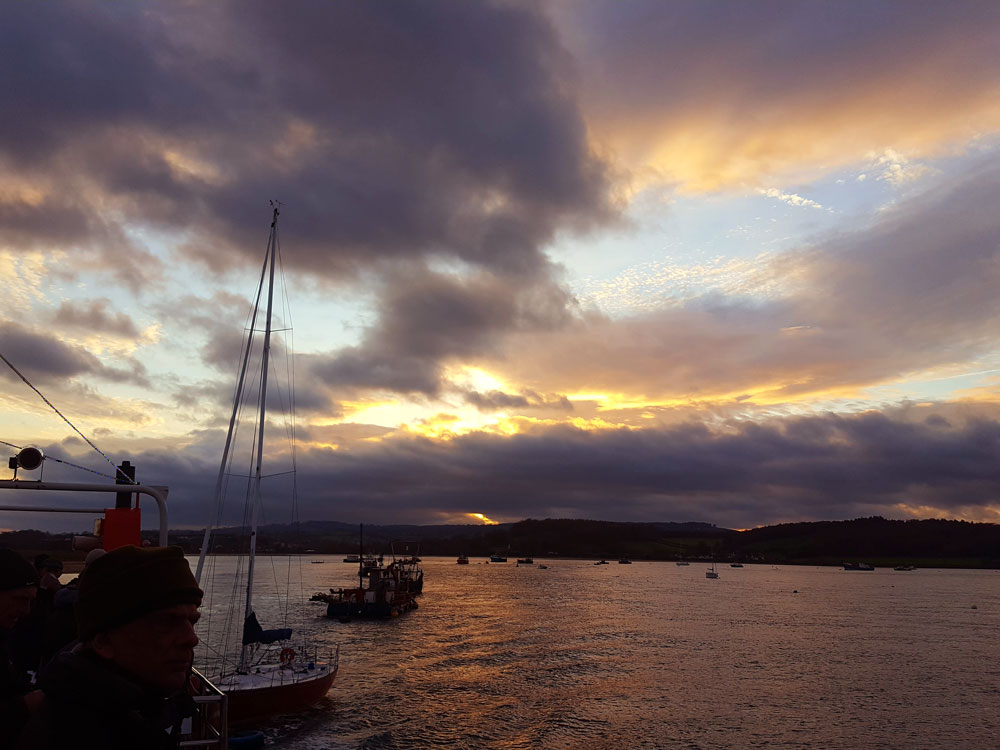
On Saturday just gone, I was thrilled to join my Dad on a Stuart Line Cruise up the Exe Estuary, which set off from Exmouth at 1pm. Dad has led some of these winter trips for many years now, and I always like to try and get on at least one a winter.


With no telescopes on the Stuart Line Cruise, it's a great place to test out binoculars and get a true feel of their capabilities and limits. So no better place than this to try out the Nikon EDG's that were sent to me to try out earlier in the week...


The light remained nice and flat throughout the three hour cruise, there was no wind and plenty of birds - a fantastic trip! 

On the lower part of the Estuary, hundreds and hundreds of Brent Geese proved a spectacle, along with good numbers of Shag, and in the deeper water here two Great Northern and a surprise Red-throated Diver (rare in the river), the resident Slavonian Grebe, only a few Red-breasted Mergansers (still lots of these to arrive) and a very distant Long-tailed Duck, which was way way off to the east north of Mudbanks.

Red-throated Diver

Slavonian Grebe with a typical Exe back drop

The ultra distant Long-tailed Duck, only identifiable thanks to the amazing zoom on the P900!


As we travelled up the Estuary towards Topsham, the usual change in species occurred with Avocet, Dunlin, Curlew and Black-tailed Godwit becoming the most numerous species. A flock of c230 Golden Plover roosting on the mud were nice to see, along with good numbers of Lapwing among the usual smaller numbers of Grey Plover, Greenshank, Bar-tailed Godwit, Knot and a lovely little flock of 30 Sanderling.   There were also impressive numbers of wildfowl present, mostly around the Clyst area with thousands of Wigeon and probably well over a hundred Pintail. Three Kingfishers pleased the punters on the boat, as always.

It was nice to see three Common Seal on the trip, including a small youngster. Two allowed their photographs to be taken...


And what about the binoculars? Well I was really impressed. Superb image quality and light levels, which I have come to expect with Nikon products now. They were a really comfortable pair of binoculars too with a thick neck strap, and for me they're the perfect size allowing a good solid grip to keep them steady, an important attribute in optics when boat birding.  They allowed me to pick out all three divers on the trip, and I doubt I would have spotted the Long-tailed Duck at all had I been using other optics. It honestly was a dot, but through the EDG's it did at least look like a Long-tailed Duck-shaped dot! It's these small differences that can sometimes make all the difference when birding.


Thursday, 2 February 2017

A Trio of Tails

So yesterday I mentioned how the excellent numbers of wildfowl on the flood water in the valley didn't contain anything other than usual Axe species. But this morning...


Three truly beautiful drake Pintail on Bridge Marsh. Happy days.

Wednesday, 1 February 2017

Usual UK Winter Weather!

Boy has it been grim out there this week, with pretty hefty winds, lots of rain and all round dampness.  But there has been plenty of birds about which more than makes up for it.

Not before time our now seemingly semi-resident Cattle Egret has pulled in some friends. Twilight Tim had four yesterday afternoon in the usual spot at Colyton, and this morning I saw at least four leave the egret roost at Axmouth and head north between 07:20 and 07:30. I actually think there were five as it looked like a group of four left together, followed by a single bird about two minutes later. Also noted c30 Little Egrets and a brucy bonus in the form of a Woodcock over east just after 7am. Really don't see many of these in the valley, I guess it was returning to the cover of the wooded hills after a night of feeding on the marsh. Didn't have to risk your life for me after all Bun!

The flood water in the valley over the last few days has been heaving with wildfowl, particularly Bridge Marsh and the field opposite Axmouth FC (the field that's usually just a field, but has had Cattle Egret, Bewick's Swans, Garganey, Little Gull, Curlew Sandpiper, several Little Ringed Plovers, Long-billed Dowitcher, Lapland Bunting and Water Pipit!). Sadly the wildfowl on show have only been the common Axe species, but it's been nice to see and be able to properly look through over 500 Wigeon, 100 Teal and a few Shoveler


Gull numbers however have been very poor, despite the gull-friendly weather.  The only increase has been in Mediterranean Gulls, with three winter plumaged adults down river at dusk yesterday, an adult east over the sea this morning, and a slightly hooded adult opposite Axmouth FC this afternoon...


Sea watching has also been quiet - which I guess is to be expected in late Jan/early Feb. As well as the Med Gull this morning, three Red-throated Divers and a Common Scoter flew west. Yesterday I finally managed to see a Guillemot after a month of just Razorbills, with one in winter plumage settled off Seaton Hole, along with another lone Common Scoter past west.

No sign of the Trinity Hill Little Bunting during a 45 mins look this morning, but it finally popped out at about 13:00 for others.

Thursday, 4 February 2016

Winter Swans In Somerset

I have a real soft spot for wildfowl, especially geese and winter swans. On Tuesday afternoon I noticed on the web that a Southlake Moor on the Somerset Levels had both Bewick's and Whooper Swans. Having not seen either for a good few years I was immediately tempted, and when I googled where Southlake Moor was - not that far away at all - I was even more tempted! 

I know many birders who don't really 'get' winter swans - big white birds that, let's be honest, 90% look like Mute Swans.  But for me they are just so emotive, a real symbol of winter. When I was at Spurn, the sight of a flock of Whoopers flying south over the North Sea on a cold November morning, heading for their winter retreat (probably Norfolk), was one of the greatest spectacles of the year.  And living down here in Devon now, I don't see many of them any more.  So, Wednesday morning came, and without thinking twice I was loading up the car and off to Burrowbridge...

Burrow Mump

I parked up in the car park just below the mump, where I was greeted by a vast expanse of water...

Wildfowl haven

...and the stunning sight of eight Whooper Swans on the very nearest bit of it!  I couldn't believe my luck at just how close they were, especially considering how much water they had to choose from...

All eight Whoopers, five adults and three immatures

Such an awesome sight

A phone-scoped pic

Not the usual view of a Whoopers bill

They were absolutely top value, frequently calling to each other, wing flapping - completely and utterly fulfilling my winter swan-needs. And then it got even better...

Scanning further afield I picked up two more adult Whooper Swans with Mute Swans on the flood up towards Burrow Wall Farm, and then spied six more winter swans even further away - these were looking Bewicky.  I jumped back in to the car and tried looking at the flood water from the village of Stathe...

Success!  A short walk along a public footpath gave me an excellent view point where six adult Bewick's Swans were in full view. Unfortunately they weren't as close as the eight Whoopers but nevertheless great to see, especially as there are so few in the UK this winter...

Phwoarrr...

Phone-scoped Bewick's showing the bill pattern

I know they're naff pics but I just can't help posting them!

So that's the swans dealt with, but this place was about so much more!  I was absolutely staggered by the sheer numbers of wildfowl present, really jaw-dropping.  There were easily 8-10,000 Wigeon spread around, along with c500-800 Pintail, a thousand or so Teal, c250 Shoveler and a few Gadwall.  I can tell you this is quite something when you are used to looking at no more than 300 Wigeon day in day out! 

So many ducks!

This spectacle really opened my eyes. I am such a dedicated patch birder, and have been for so long now, that the bird scene here completely sculptures my birding. Checking a flock of 300 Wigeon say two or three times a week is my birding, I scan through them once or twice, nothing rare, job done. Flipping heck at Southlake Moor you could scan the Wigeon daily for a month and still not find a lurking American Wigeon! 

And that's got me thinking, does this mean I have become a lazy birder? Am I so settled in a birding routine that I am no longer (to quote the very sadly recently departed Martin Garner) 'pushing the boundaries', or my boundaries anyway...

I think I need to embark on a few more off patch forays...

Friday, 31 July 2015

Unseasonal Ducks...

Well I say unseasonal, but in recent years July has proved a good month for wandering wildfowl. I once had a flock of Pochard fly in off the sea during a heavy rain shower in this month - and they are a true patch rarity.

Anyway today's oddities were two Gadwall at Lower Bruckland Ponds, and then these that dropped in out of nowhere...

Tufted Ducks

They only stayed for about 30 seconds, before flying off back west. In this brief post I must also mention the Little Ringed Plover on Black Hole Marsh early yesterday morning, as amazingly it was my first of the autumn!

Thursday, 7 November 2013

Wonderful Wildfowl

This is going to be a very duck orientated post, as pretty much everything I've seen that's notable has been a form of wildfowl!!

We are a week into Novemember, and I am at 185 for the patch year list. I'm going to have to be honest now and say I think 200 this year is impossible. There's only been 190 species recorded by everyone on patch so far in 2013, so I reckon even if I saw 100% of all the species seen on patch by the end of the year then I still wouldn't be at 200! Oh well. I can't wait to see who wins the competition though - I won't stop trying!

On the last day of October I was on 184, so what was number 185?  On Monday morning, a look along the Estuary was made a lot better when I picked up a Pochard flying up, and then back down the valley north of Coronation Corner. It appeared to land on the river somewhere around Colyford Marsh, but a look from the Farm Gate afterwards failed to locate it.  Pochard has become a great rarity here, and this was the first record for the patch in about two years!!

Just before the Pochard excitement, a sea watch revealed almost as much excitement with three Velvet Scoters. First of all, two flew in from the east and landed distantly off Beer. Then just a few minutes later I picked up another one, on its own, flying west far out.  I love Velvet Scoters so was well happy with these, and it certainly made up for the lack of anything else on the move at sea.

Going back to the end of the previous week, I had a female Pintail and drake Shoveler on the morning of the 1st. These were on the Estuary along with the lingering Curlew Sandpiper (which I last saw on Monday 4th) and Ruff. The Spotted Redshank is still knocking around too.

Back to the sea, and on Tuesday morning a Red-breasted Merganser and two Brent Geese were the highlights. With a look at Lower Bruckland Ponds showing the continued presence of the two Tufted Ducks. A nice surprise were calling Bearded Tits from the Farm Gate, I didn't see them though so have no idea how many or where exactly they were!! Possibly the same birds that Fraser found on Black Hole Marsh last month?

A seawatch yesterday morning didn't show any wildfowl of note, but it did show plenty of Kittiwakes! Sadly though variety was lacking - and I still haven't seen a 2013 patch Little Gull!

Then there's today. All was quiet, then this thing flew in and joined the local Shelduck... (apologies for the poor photos - it was very distant)

.....WTF!??

I knew it wasn't Ruddy, Cape or Australian Shelduck, but whatever it was it was STUNNING! Really gorgeous deep velvety red, and in flight it looked superb with flashes of bright white!

The nearest I can find online is this http://www.flickr.com/groups/hybridbirds/discuss/72157601886415063/ which is a CommonxRuddy Shelduck hybrid. A new one for me!

Steering this post away from the duck-theme, I've just heard a few Crossbills calling from the back garden. Sadly I couldn't see them but they were flying west.

Monday, 18 February 2013

South East Winds = Wildfowl

Spring, autumn or winter, if there's some south east in the wind then there's probably going to be some wildfowl movement.  This isn't just the case for the Axe, it was the same when I was at Dungeness and Spurn Bird Obs.  Obviously at Spurn and Dunge it is on a totally different scale, but I was happy with what I saw this morning - although a year tick would have made it even better!

Best bird was found by Ian M, this female Goldeneye on the Estuary which I saw early afternoon...

Pity it wasn't a Goosander!

Sea watching earlier showed two Pintail and a Common Scoter fly east, but little else.

Pintail is always a good bird here, and Goldeneye even better - it just so happens I've seen both already this year.  And to put into perspective just how bad Feb has been for sea watching, I'm pretty sure the Common Scoter this morning was my first one of the month! 

It really felt like spring today, very mild and some glorious sunshine.  Yesterday Jess and I spent the day on Dartmoor, the wind was pretty chilling, but again, it felt pretty spring like. In fact it looked very spring like with plenty of this near Warren House Inn...

Frog spawn!

I've got a very busy couple of weeks ahead of me, with little time for any patch birding. If I'm around I'll twitch a patch year tick though obviously!

Tuesday, 13 December 2011

Flooded Out

Lots of flood water in the valley this morning - which is always brilliant! There were ducks everywhere, but as always there was almost too much water to look over! It was even better this afternoon when most of the flood water had dispersed, and what seemed like every duck and goose in the valley was on the remaining water on Bridge Marsh...

Lots of birds in a small area - ideal! Pity the light wasn't better though

There were at least 400 Teal and 350 Wigeon here, along with plenty of Mallards and Canada Geese. I couldn't find anything different though, but the light was awful so that Green-winged Teal could have been hiding in there somewhere.

No sign of the Snow Bunting this afternoon - and that Spotted Sandpiper still hasn't found the harbour yet! I wonder where it has actually gone, it hasn't been reported from Lyme Regis for weeks now.

Just to complete this short blog post, there were four adult Med Gulls on the Estuary yesterday early afternoon, and on the 9th the Wheatear was still on Seaton Marshes and at least 15 Chiffchaffs (all with yellow/green on them somewhere) were at Colyford WTW.

Thursday, 2 December 2010

Cold Weather Birding

Apologies for the lack of blog posts - when I've been on this laptop within the last few days I've had much more important things to think about! I have been updating the Devon Birding Blog when I could though.

So, I hope you are ready to read one monster blog post covering the last FOUR days! It is worth reading as I have seen lots of nice stuff. The best day was today, and that's right at the end. So you may as well read the rest of the rubbish between that and this....

MONDAY

Spent the first couple of hours of light at Colyford Common - it was freezing! Three Ruff flew low north west over at 8am, and amongst the frost were one Water and 11 Rock Pipits and a Green Sandpiper.

A look along the A3052 revealed 13 Golden Plovers (one by the pig fields, 12 beside Boshill Cross). All day small flock of Lapwing were flying south down the valley and presumably out to sea.

A good look along the Estuary and over Colyford and Seaton Marshes produced wildfowl totals of: 12 Brent Geese (the same flock as a couple of weeks ago), c450 Wigeon, 380 Teal (a good count for us), 11 Shoveler and six Gadwall...

Four drakes - Gadwall aren't common here

Shoveler on ice from Seaton Hide

Two adult Med Gulls were on the Estuary and a look at Lower Bruckland Ponds showed no unusual ducks, but a Cetti's Warbler was my first ever there.

Tuesday

This was a day of limited birding for me. First thing I had to carry out my monthly bird survey in private woodland near Colyton. I was surprised to see quite a bit of snow still on the ground (bearing in mind we hadn't had any at all in Seaton!)...

There were even some light snow showers

I flushed four Woodcock during my walk round, which was nice! Even nicer though was a lovely flock of ten Lesser Redpolls.

Small flocks of these just oooooze with character - I love 'em!

I returned home, and stayed here for a good while. Early afternoon though a text from Dad tempted me out down to the Estuary to see three Goosanders...

The same three Gav saw on the sea the previous day maybe?

Whilst here, out of nowhere, this appeared....

...a sleeping adult Spoonbill! For much better pics of it click HERE

Later, a further check of the Estuary produced five lovely Ruff just north of Coronation Corner, four Med Gulls and a 'weirdo' Gull. At first I thought my 'weirdo' Gull was a LBBGxHerring, but it may just be a weird yellow-legged Herring Gull. I took this photo at 16:15; it was almost dark, with an exposure time of 1/4!...

Its legs were yellow - just not bright yellow like an adult YLG. Also note slightly darker mantle shade, slighter size and intense head streaking

Tuesday didn't end well! The alarm at work wouldn't set, so I didn't get out of there until 23:30!

Wednesday

Up for work at 7am, then after a short three hour shift a sweep of the Estuary showed a Knot and the Spoonbill still. I then returned home to bury myself in my laptop once more! I really should have had a kip - 'cuz I was knackered and was due back at work at 17:00. Yes - a lovely split shift!

I got fed up with my laptop, so mid afternoon had another look about. Couldn't find anything different - well that was until I had a look at the small flock of Swans opposite Stedcombe House at 16:00. There sat an adult Bewick's Swan...

Nice!

At first I presumed it was the same bird we had last winter - that often frequented the same spot. But its bill pattern gave the game away - quite different from last winter's bird. Here's a closer pic of today's bird, with a head shot of last winter's bird cut and pasted in...

See, quite different; and it's even obvious on photos as crap as these!!

Today - what a day!!

I woke up to this...

White out!!!

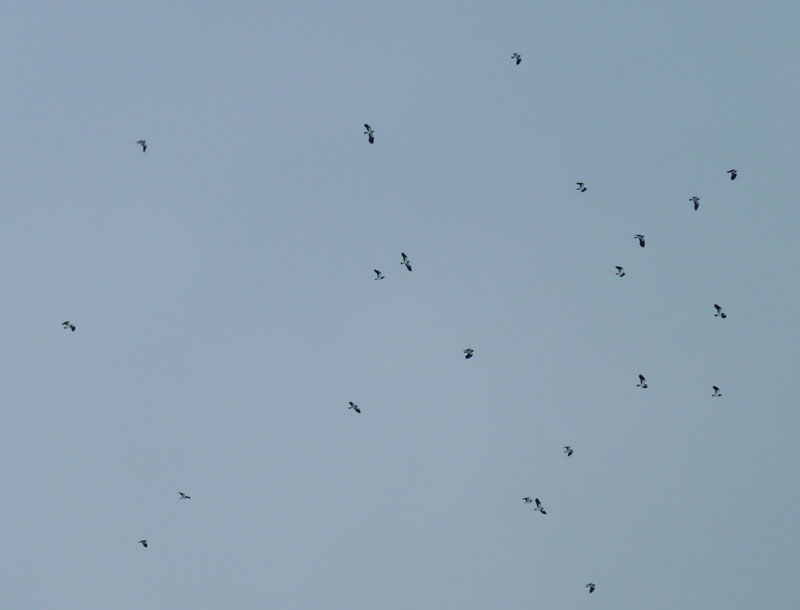
Our road was an ice rink - so I knew I couldn't go out in my car. As I was tucking into my Cheerios, out the front room windows I noticed a small flock of Lapwings fly west. So I kitted myself up and headed out...to the front garden!

Bloody hell it was BRILLIANT! When I started I really didn't think I was going to witness a cold weather movement on the scale that I did!! I watched and counted 08:40 - 12:00.

Most of the birds were flying west, except thrushes and Starlings which were mostly flying north east. So if I haven't put a direction after a species assume this is the way it was going.

I can see the sea from my place, and I could see ducks flying over it. But I only counted ducks which were obviously flying over land - this gave me two garden ticks!! Ok, so this is what I saw....

22 Shelduck
140 Wigeon (50 north)
21 Teal (6 north)
4 Shoveler (in with a flock of Shelduck - garden tick!)
6 Tufted Duck (a mega garden tick, 3 of each sex; they flew west but soon came back east)
1,453 Lapwing (the largest single flock was of 70 birds - a well impressive passage)
1 Golden Plover
1 Curlew
30 Common Snipe (a few of these flew north, have only ever seen a couple of these from the garden before today!)
1 Redshank (flew north - second record for the garden)
5 Buzzard (all singles - and all were properly 'on the move')
2 Kestrel
90 Wood Pigeon
1 Mistle Thrush
63 Fieldfare
259 Redwing
86 Starling
1,154 Skylark (biggest flock was of 230 birds - saw even more later in the day as well!)
14 Meadow Pipit
40 Linnet

There were probably loads more finches involved in this movement, but separating 'vis mig' birds to birds moving from garden to garden from where I watched is almost impossible.

Well what a morning! I really wasn't expecting that!! Here's a couple of pics...

Lapwing flocks

Snipe

After lunch, I gambled and got in my car! Thankfully I made it in one piece to the sea front, and spent 13:35 - 14:35 looking out to sea.

First of all, Skylarks were still moving. During this watch, and during the rest of the day I counted another 930 over west - with several flocks well out sea. For me then, that makes a day total of 2,084 Skylarks west - epic!!!!

Now to the sea, and it was clear wildfowl were also well on the move. On the sea there was a large flock of Wigeon, Teal with a few Gadwall. Now and then though, some would leave this flock and fly upriver, but also several flocks came in from the south and the east and joined them.

Wildfowl quality came in the form of three Eider on the sea (1 immature drake) and a nice flock of 16 Pochard and three Tufted Duck which flew in from the south, then west, then east, then west, then east, then finally away west...

Any fresh water diving duck is a rarity here!

Further interest over the same came from seven Red-throated Divers (4 on the sea and 3 west) and 12 Great Crested Grebes (easily my highest count so far this winter).

It was very hard to tear myself away from this action - but I did and took a look along the Estuary. A female Tufted Duck and 40 Dunlin being the only note worthy birds.

Had a nice surprise at the Farm Gate though. Funnily enough I was scoping up the field were Gav had just found a few Woodlark, when I suddenly realised I could hear Woodlarks! Two flew low north (and slightly west) over Norcombe's field - result! I wonder if these two and Gav's are from the wintering population that normally resides in the stubble fields above Axmouth.

A quick stop up the road showed the Bewick's Swan was still present with our flock of 12 Brent Geese.

Seaton Marshes was pretty much my last port of call - and the lagoon was smothered in ducks! Nothing out of the ordinary though. There wasn't much on the Borrow Pit either, but a single Grey Plover flew over heading north east. Ian Mc had seen one earlier on the Estuary, but as this had come from the direction of the town I presume it was another.

So what an excellent day indeed! Phew! Now time to ruin it and go to work. I do have one last picture for you though, taken during my visit to Seaton Marshes...

He was searching non stop for food!

Well I hope you enjoyed reading this mammoth post! I wonder what tomorrow will bring....