Pages

Showing posts with label wading birds. Show all posts

Monday, 20 July 2020

Raining Waders and Juv Yellow-legged Gull

The rain during Saturday night and into Sunday morning dropped an unseasonably good number of wading birds into the Axe Valley, particularly to Black Hole Marsh.  Not necessarily a good thing mind, as seeing so many adult Black-tailed Godwits and Dunlin so early in the season may indicate some big problems on their breeding grounds. 

It's thought the north west wind and rain brought these exceptional numbers to the UK. It was a UK wide influx.


The star bird was a cracking summer Turnstone, my first of the year on the Axe, although it remained on the far side of the marsh...

Nice to see one in such smart plumage


By the end of Sunday the Dunlin flock had reached 51 birds (all adults) and Black-tailed Godwits for me 55, although 70 were present mid morning (again all adults).  Common Sandpipers were present in good numbers too, c14, but with many young birds in with them there's no worries about their breeding success.  Same can be said for Little Ringed Plovers too, with five juveniles present at dusk (eight today!).

Common Sands galore!


There were also three Lapwing, two Greenshank, one Green Sandpiper and two Med Gulls (ad and juv). Kingfishers have suddenly become 'common' again, as they do at this time of year here, and great to see another young Oystercatcher chick on the marsh after one pair have already got one off...

Odd that both pairs have only had one chick though, it's usually two or three per pair


Have been at work for most of today, but a last gasp check along the Estuary revealed a sight I have been longing, and expecting to see, for about two weeks now!  My first juvenile Yellow-legged Gull of the year, and boy was it worth the wait.  Juv Yellow-legs are so variable in appearance, but every now and then you see an absolutely corker, one that has literally been lifted out of the guide books and put in front of you.  This was one of those...

What is not to love (except for the distance and heat haze!)


In the above image note the long-winged and high chested appearance, very pale ground colour to head neck and belly (Herring's rarely show pale ground colour to underparts, they can often to head), clear dark eye patch and plain dark tertials.

I first found it on the view shown in the following picture, and can't express enough how identifiable it was just on this single view. They can be that obvious I promise...

Facing away behind the right hand of the two sleeping Great Black-backed Gulls


Even on this view we can see jet black tertials and a clear black tail band, dark eye mask and pale head.  Something not often written about juv Yellow-legs is that they just have a very 'contrasty' look to them - pale underparts, brown upperparts, black tertials and tail band and white tail. Juvenile Herring Gulls are very rarely anything other than plain brown - although I must add the caveat that a little later in the season watch out for juv Lesser and Great Black-backed Gulls.  Structure is important too, and in the second photo you can see a fairly long pair of legs and an overall bulk and stance I find more reminiscent of Great Black-backed Gull, especially the case when it's a big Yellow-legged like this one.

I really hope this is my first of many, although will be surprised if any are as stunning as this!


Tuesday, 13 August 2019

Best Job Ever?

On Sunday evening I was delighted to lead a tram of 19 (plus Allan our driver) up the Axe Valley on a Birdwatch special. 

The weather during the afternoon was overcast with some heavy downpours, and the forecast looked a bit iffy for the duration. But in reality except for a couple of spots of rain as we left Seaton Station, everything including the weather was just so kind to us.  The wind dropped to almost nothing and the rain and clouds soon cleared revealing a magical soft golden light across the valley...


The birds were just as kind to us, and I'll start with the punters favourite as always, Kingfisher.  We had four sightings of probably two birds, with one sitting in full view for several minutes which left smiles on everyone's faces.  The hunting Barn Owl that remained in view for about ten minutes was also a firm favourite, this also posed well for the tram full...

Barn Owl

On the other side of the Estuary, one of the lingering juvenile Marsh Harriers hunted over the reed beds before landing distantly in a field opposite...


For the whole journey, low-flying Swallows, House Martins, Sand Martins and (a surprisingly high number of) Swifts showed really well as they fed low on flying insects. Whilst on the subject of passerines, three Wheatears showed well around Sheep's Marsh...

Wheatear - I just love the pale-edged black primaries

What was really special for me was the variety and numbers of wading birds on show.  At the top end of the trip where we turn around by Colyford scrape, as if three Green Sandpipers, a young Turnstone, a Dunlin and 11 Ringed Plovers weren't enough - a Wood Sandpiper took off from the small pools north of the scrape and flew south, calling all the way.

Adult Ringed Plover left and juvenile Turnstone right
Green Sandpiper

Thankfully on the return journey the Wood Sandpiper showed better, unusually feeding on the Estuary with a group of Redshank...

Look at the size difference - juv Wood Sandpiper flanked by two Redshank

Black Hole Marsh showed good numbers of Black-tailed Godwits and Dunlin plus a close Greenshank, with the Estuary giving another three Greenshank, a further three Turnstone (four is a cracking good count for us!), two Whimbrel, a heap more Black-tailed Godwits and at the very least 14 Common Sandpipers.  

Next year I'm going to try and arrange a few more Birdwatch tram trips for autumn, particularly August and September.  Seeing large numbers of wildfowl during the winter is always good, but nothing quite beats the variety, quantity and almost endless possibilities that can be seen during a trip in one of these months.

Friday, 9 August 2019

Balearics and a Beast

It's high time I summarised my recent bird sightings, which thanks to today have become a little more interesting...

Black Hole Marsh had a spate of activity early last week, and although I missed the two Wood Sands that dropped in for half a day, three adult Little Ringed Plovers stayed put long enough for me to catch up with, although they were often flighty and vocal...

Little Ringed Plovers - surprisingly all adults!

On the same day I also saw a single Ringed Plover, two Greenshank, three Green Sands (also vocal and flightly), ten Dunlin and two juv Med Gulls on Black Hole Marsh.  Along with a brute of a juv Yellow-legged Gull on the Estuary and a Lesser Whitethroat on Colyford Common.  

I've not had chance to do Beer Head/Axe Cliff so far this autumn, but Willow Warblers keep popping up in front of me. Ian Mc did ok up Beer Head yesterday morning with a Pied Fly and good counts of Wheatear and Willow Warbler - although this wind will presumably have halted any further passerine passage.  Does looks like it's kick started some sea passage though which is good!

I gave the sea a couple of ten minute watches this afternoon, showing the odd Manx Shearwater and several Gannets passing, but things livened up a bit more during a 40 minute watch from 17:40 this evening when I recorded;

11 Balearic Shearwater
4 Manx Shearwater
1 shearwater sp.
1 Med Gull (juv)
2 Kittiwake
2 Common Tern
3 wader sp.

Great to see some Balearic action, with ten of the 11 passing in a ten minute window from 17:45, including a fairly close flock of five which looked so awesome. I haven't had any decent counts of Balearics off here for a good number of years - they seem to be sticking more to the west part of Lyme Bay these days - so every one of these 11 were very much appreciated.

A look up the Estuary just after this watch revealed an absolute beast of a juvenile Yellow-legged Gull, a real brute...

A truly epic bird - that juvenile Herring Gull looks so tiny in comparison!
Long legged, long winged, huge billed - what a treat!  Quite a dark one too (esp around the face), although note the pale ground colour to underparts

Friday, 28 June 2019

Wood Sandpiper and Lesser Emperor

It's been good to spend a bit more time out today, and I'll start with the birds.  A mid morning visit to Black Hole Marsh was timed exceedingly well, as Ian Mc had just found a Wood Sand...

Wood Sand and two Dunlin

Not just any old Wood Sand - a breeding plumaged adult!

Remained distant so was a good test for the P900


I've had a look back through my blog and notes, and am pretty sure this is my first every June Wood Sand on the Axe.  We don't usually see the first returning autumn ones until mid July at the earliest, and all spring birds have been in April and May.  Not only is it the earliest, but it's the least worn adult I've seen too - still in pretty much full breeding plumage. So so different to the pale brown juvs we see in August, nice.

Also on Black Hole Marsh were numerous Black-tailed Godwit and Redshank (one juvenile), two Dunlin, three Teal and a Green Sandpiper. A little later Sue Smith also had a Little Ringed Plover and a Greenshank - autumn seems to be starting early this year.  Although saying that, many of the Black-tailed Godwits and Redshank never actually left us!

A Black-tailed Godwit looking like this can surely only be an adult, so why not even bother going north?


A little later an enjoyable tram ride showed additions in the form of a Greylag Goose on the Estuary and a Lesser Whitethroat singing at the north end of Colyford Common.

I also found time for some dragonflying this afternoon, which was nice because during the last month weather and work has not allowed for much of this.  I spent an hour and a half at Lower Bruckland Ponds dreaming of finding a Vagrant Emperor (been an influx of these to the east coast), so when I spotted a mostly brown Emperor with blue restricted to segment two I thought I'd only gone and done it....but not quite!  I soon realised it was a male Lesser Emperor, still a cracking insect and a really exciting find, but I can't help by feeling just a little short-changed!

Male Lesser Emperor Lower Bruckland Ponds


This is the fourth male Lesser Emperor I've found here (16th July 2006, 10th Aug 2012 and 19th June 2017) but easily the most enjoyable, because it was actually showing well. Hence why for the first time I actually managed to get photographs!  The other three were all brief flybys with Emperors in hot pursuit, but this one seemed to have found its own territory and spent the half-hour I was there patrolling - I even watched it fly up and pluck a Common Blue out of the air before feasting on it.  Amazing!  

Male Lesser Emperor again - showing blue on side of seg 2 (unlike Vagrant Emperor)

Out of focus but still so recognisable!


Other Odonta on show included my first couple of Small Red-eyed Damselflies of the year, at least 16 Scarce Chaser (one female), eight Four-spotted Chasers and excellent numbers of the other usual species.  This is such a great dragonfly site.

Now I know I have posted plenty of Scarce Chaser photos on this blog before, but as they are one of my favourites I just can't help but post a few more...

Scarce Chaser male

Scarce Chaser male from underneath

Scarce Chaser mating pair


What a top late summer day! 

Monday, 8 April 2019

More Birding Required!

I've not seen loads or been out that much, but I have seen enough to write this...

There's been a refreshing pulse of wader activity on the Axe Estuary since the turn of the month, kicked off by a Ringed Plover north of Coronation Corner on 2nd with three Dunlin.  On 6th whilst sky watching from my bedroom window, I was surprised to see a very high-flying flock of c30 Black-tailed Godwits power in from the north west then drop like a stone into the valley. Frustratingly as they twisted and turned before heading off down river I could make out a smaller, plain-winged wader in their midst. I suspect it was a Knot, but there was knot anything I could do about it. The following evening (7th) it was nice to see our first Whimbrel of the spring with ten Curlew just north of Coronation Corner, and this morning a flock of 18 Dunlin were zooming around at high-tide not knowing where to land.  Hopefully Kentish Plover is next :-)

Axe Estuary at dusk


With the strong winds at the end of last week I gave sea watching a go on Friday 5th.  The direction and strength of the wind however meant shelter was very hard to find on the sea front, so twenty minutes late I gave up and checked elsewhere.  Still, in that time two Pale-bellied Brent Geese flew west and a Manx Shearwater flew east - my first of the year for both.

My passerine highlight of the last few days surprisingly wasn't a migrant species, but a Dipper.  They've been really reliable on our section of the River Coly this year, and yesterday I was delighted to stumble upon an active nest - not where I was expecting to find one either.  I gave them the space they deserved and was rewarded with prolonged views of an adult Dipper plunge-diving. So lucky to be able to watch this on my patch.  

There are more hirundines about now, although I am still yet to see a House Martin.  Sand Martins were well represented during the grim weather of last week, with just under 100 in the valley on 3rd, with small numbers of Swallows seen pretty much every day now.  Willow Warblers are now starting to pass through in decent numbers, tonight I watched six feeding in an isolated clump of Blackthorn in the valley even as the sun was setting. Amazing to think that by the morning they will probably be hundreds of miles away!

A well defined setting sun over Colyford


I saw my first Red Kite of the season from work yesterday morning (7th) thanks to Phil. He had seen it fly east over Beer Head and I happened to be outside when it carried on east over Sheep's Marsh and the Estuary. I wonder how many more (hundreds!?) I will see as the year progresses.

And I will end this somewhat disjointed post with my absolute highlight of April so far. During a morning outing to Black Hole Marsh with Harry on 6th I was suddenly aware of the charming calls of Med Gull.  Two second-summers were flying around calling to each other low over the marsh before landing on one of the islands, both with pretty much full hoods.  An amazing sight and sound, and proof to anyone that gulls are anything but boring!


Wednesday, 19 September 2018

Autumn Moves On

Thought it was high time I wrote a few more words here. I am getting out now and then just not finding the time to blog about it.

I suppose the biggest news is we are well and truly in September....and don't we know it!  Meadow Pipits streaming over with fewer and fewer Tree Pipits, Yellow Wagtail vis mig replaced by Grey Wagtails and alba Wagtails, Chiffchaffs taking over from Willow Warblers as the most common phyllosc in the bushes. Autumn has well and truly moved on to the next phase, which I think of as the 'middle phase'...

Wheatear Axe Cliff - 14/8/18


The Estuary has seen a run of good birds this month, with four Spotted Redshanks together on the 1st being an amazing local sight. Osprey, Ruff, Turnstone, Wood Sandpiper have all been seen by others, with Cattle Egrets being frequently seen over the last couple of days, in fact Mark Dobinson had ten on Seaton Marshes this morning!

I was hoping to get a look at the sea this morning considering the rough weather, but only had time to muster a couple of quick scans of the gulls on the Estuary.  Proved worthwhile though as there were a couple of first-winter Yellow-legged Gulls in with them, one in the morning and one early afternoon. I didn't have a camera to hand for bird two but the first allowed some pics...

The bird on the left, nice pale headed individual

A flash of its tail


Hope to see some of the Cattle Egrets soon!  They may be getting commoner but I always enjoy seeing them.


Friday, 3 August 2018

Wading Birds

I have just written the Axe Estuary monthly report for July, and what a great start to 'autumn' 2018 we've had. Yes I know it is early to be using the 'a' word, but before you start throwing your keyboards at the screens let me clarify I don't mean autumn as in the calendar autumn, I mean it as in the autumn bird migration (southward post breeding passage). Every year the autumn passage for wading birds starts in July, often in June in fact, but this year in particular we've had an excellent variety of species. This sadly though probably indicates they've not had a good breeding year, so although we are seeing more, it's bad news.

I missed the first two Wood Sands of the year here (and the first since 2016), and I guess I missed the third as only one of the two that Tim Wright had drop in on Black Hole Marsh on Wednesday night was still present on Thursday.   When I saw it Thursday morning it wasn't close like it was later in the day, but great to see nonetheless...

A juvenile Wood Sandpiper along with an adult Dunlin


Personally I've also seen a couple of Greenshank, three Green Sands (great comparison on offer of adult and juveniles), the lingering Spotted Redshank, 40+ Black-tailed Godwit, up to 16 Dunlin and Common Sands and a Snipe.  The first few gorgeous lemon yellow Willow Warblers have been noticeable in the bushes over the past week, looking extremely lovely. A lovely adult Hobby flew low south west through Black Hole on Thursday too, which could well have been a local bird.

With a couple more sunny days now upon us, my search for a local Southern Migrant Hawker continues...


Wednesday, 30 May 2018

Black Hole Marsh

Whenever I've been outside during the past week I've been mostly looking for/at Starlings! The beginnings of what could well prove to be a mightily impressive influx of adult Rose-coloured Starlings into the UK is underway, following exceptional numbers seen in central and eastern Europe.  Most the local Starlings are still in their family groups at the moment, but there does seem to be plenty of them dotted around so hopefully some big groups will start to form.  We are all very keen to see an Axe Rose-coloured Starling following the painful near miss we suffered in Colyford many years ago. An adult bird graced private gardens for almost a week in June, and we only found out about it the day after it was last seen...

Today has seen some classic murky grey and sometimes wet weather, and being late May that's meant wading birds!  Tonight Black Hole Marsh was bursting with Arctic nesting waders including 24 Dunlin, six Sanderling, four Ringed Plover and singles of Grey Plover (cracking breeding plumaged adult, been around a few days now) and Bar-tailed Godwit. Ian Mc had a Turnstone and a few more Sanderling on the Estuary earlier in the day too.

I didn't have long so couldn't get closer to any of the birds by going up to the Tower Hide, but still want to include some pics here to give you a flavour of the evening...

Grey Plover, in this plumage they are hard to beat!

Sanderling and Dunlin, doing what these late May waders always seem to do whenever I see them - feeding frantically! 

A Bar-tailed Godwit taking a more relaxed approach to life!

Monday, 5 March 2018

Cold Weather Movement or Spring Passage?

It's been great to see birds behaving as they should be again today, and where they should be. Wading birds and wildfowl on the river, and thrushes in the fields and not in the middle of housing estates. There are still plenty of birds about though...

I've had three tours of the Estuary today and a visit to Black Hole Marsh. Most birds seen were lingerers from the last few days, except for a couple more Avocet and a two fold increase in Gadwall. My highlights were; 

8 Pintail
290 Wigeon
12 Gadwall (two 6's in the morning, an 8 and 4 in the afternoon)
80 Teal
7 Shoveler 
10 Avocet (a double figure Avocet count for the Axe is exceptional!)
700+ Lapwing
9 Golden Plover
1 Grey Plover
72 Black-tailed Godwit
2 Bar-tailed Godwit
2 Dunlin
4 Mediterranean Gull (all adults)
70 Skylark (in the field opposite Colyford WTW)

I was really hoping for a Bittern today, with my thinking being the increased water levels may reveal one that's been lurking in the reeds since the cold snap... If it happened I wasn't in the right place at the right time. No sign of any Ruff or the recent Spotted Redshank for me today either.

What has been so incredible about the recent cold weather movement is the number of wading birds that's been involved. Since last Thursday there has been a staggering twenty species of wading birds recorded on the Axe Estuary. To put this in perspective we usually only have nine species of waders that regularly winter on our tiny Estuary, although it's been eleven this year with singles of Greenshank and Ringed Plover bucking the trend. Twenty is usually only possible in a short space of time like this in May or September - but even in those months it doesn't happen that often. A lot of these waders are lingering too, with the Avocet flock ever building, and the Spotted Redshank, Grey Plover and Bar-tailed Godwits still here from last Wednesday/Thursday. Knot and Sanderling (four of the former, three of the latter) and a whole lot of Dunlin (193!) were the only brief visitors, being seen by new patch birder Billy on Thursday afternoon but not since (he also found the Spot Red and Barwits).  

Watching the Avocets today, and having read something on the Portland Bird Obs website the other day, suddenly it clicked. Let's just think about this, why would an Avocet sat on a snowy Estuary somewhere decide that upping sticks and flying tens/hundreds of miles was the best thing to do, instead of just sitting there and waiting for the tide to drop?


Avocets are a March species for us, no we don't usually get ten, one to four would be a more typical count. But March is clearly the month they begin to migrate back to their breeding grounds. So maybe, although for the Lapwing, Golden Plovers, thrushes and other passerines what we witnessed was undoubtedly a cold weather movement, for other species of wading birds, are we actually seeing spring passage?  We know that heavy rain showers cause migrating wading birds to drop in, so a gigantic snow front that has tracked north across the English Channel, well that's going to ground everything that's trying to fly through it right!?  

Rewind to March 2013 (blog post HERE). Many early spring migrants arrived, like Sand Martins, Chiffchaffs, Little Ringed Plovers, Stone Curlew, Ospreys and Ring Ouzels, but a brisk northeast wind and freezing temperatures meant they all stalled on the south coast and went nowhere for several days.  It was so tragic to watch so many Chiffchaffs struggling to find food on pavements and in gutters, do you remember it? Well I'm wondering whether this is something similar, but as it's happened earlier in the month its not affected the species that we think of as the early spring migrants, but the true early spring migrants like waders, gulls and wildfowl?

And discuss...

Friday, 15 December 2017

Busy Bridge Marsh

The last few days have seen excellent numbers of wildfowl and waders feeding on Bridge Marsh, well over a thousand birds. My best counts have been 650 Lapwing, 85 Curlew, 79 Black-tailed Godwit, 290 Wigeon and 160 Teal. Really superb birding and thoroughly enjoyable, just a pity I've not been about to pull a rare out of the mix. Well that's apart from the wintering Glossy Ibis, which hasn't always proved easy to catch up with since its arrival. He/she joined the masses of birds on Bridge Marsh this morning...


Earlier in the day it was nice to finally catch up with the Seaton Hole male Black Redstart, which was actually on the houses near where the cars park at the top of the slope and not down on the beach.  A brief look out to sea showed it to be fairly quiet, although a lone Brent Goose flew west.  

To finish, another sunset shot I'm afraid, taken this evening from Seaton Beach. The tip of Beer Head looked to be glowing thanks to the angle we were viewing from...


Tuesday, 21 November 2017

Exe Estuary Cruise and EDG Review

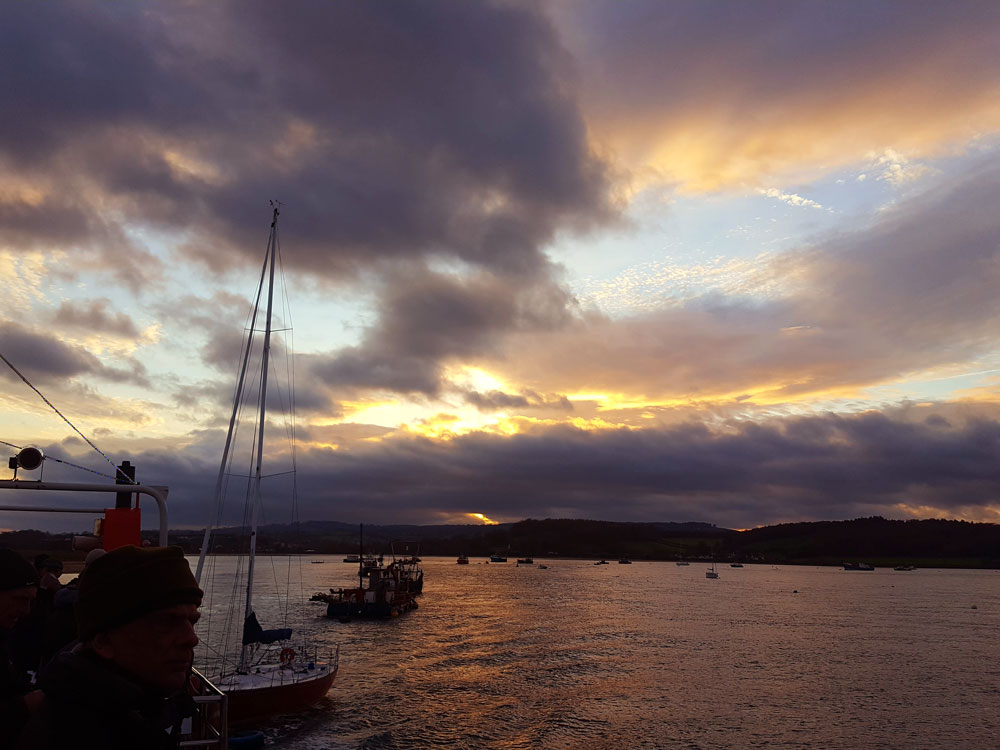
On Saturday just gone, I was thrilled to join my Dad on a Stuart Line Cruise up the Exe Estuary, which set off from Exmouth at 1pm. Dad has led some of these winter trips for many years now, and I always like to try and get on at least one a winter.


With no telescopes on the Stuart Line Cruise, it's a great place to test out binoculars and get a true feel of their capabilities and limits. So no better place than this to try out the Nikon EDG's that were sent to me to try out earlier in the week...


The light remained nice and flat throughout the three hour cruise, there was no wind and plenty of birds - a fantastic trip! 

On the lower part of the Estuary, hundreds and hundreds of Brent Geese proved a spectacle, along with good numbers of Shag, and in the deeper water here two Great Northern and a surprise Red-throated Diver (rare in the river), the resident Slavonian Grebe, only a few Red-breasted Mergansers (still lots of these to arrive) and a very distant Long-tailed Duck, which was way way off to the east north of Mudbanks.

Red-throated Diver

Slavonian Grebe with a typical Exe back drop

The ultra distant Long-tailed Duck, only identifiable thanks to the amazing zoom on the P900!


As we travelled up the Estuary towards Topsham, the usual change in species occurred with Avocet, Dunlin, Curlew and Black-tailed Godwit becoming the most numerous species. A flock of c230 Golden Plover roosting on the mud were nice to see, along with good numbers of Lapwing among the usual smaller numbers of Grey Plover, Greenshank, Bar-tailed Godwit, Knot and a lovely little flock of 30 Sanderling.   There were also impressive numbers of wildfowl present, mostly around the Clyst area with thousands of Wigeon and probably well over a hundred Pintail. Three Kingfishers pleased the punters on the boat, as always.

It was nice to see three Common Seal on the trip, including a small youngster. Two allowed their photographs to be taken...


And what about the binoculars? Well I was really impressed. Superb image quality and light levels, which I have come to expect with Nikon products now. They were a really comfortable pair of binoculars too with a thick neck strap, and for me they're the perfect size allowing a good solid grip to keep them steady, an important attribute in optics when boat birding.  They allowed me to pick out all three divers on the trip, and I doubt I would have spotted the Long-tailed Duck at all had I been using other optics. It honestly was a dot, but through the EDG's it did at least look like a Long-tailed Duck-shaped dot! It's these small differences that can sometimes make all the difference when birding.