Pages

Showing posts with label turnstone. Show all posts

Monday, 20 July 2020

Raining Waders and Juv Yellow-legged Gull

The rain during Saturday night and into Sunday morning dropped an unseasonably good number of wading birds into the Axe Valley, particularly to Black Hole Marsh.  Not necessarily a good thing mind, as seeing so many adult Black-tailed Godwits and Dunlin so early in the season may indicate some big problems on their breeding grounds. 

It's thought the north west wind and rain brought these exceptional numbers to the UK. It was a UK wide influx.


The star bird was a cracking summer Turnstone, my first of the year on the Axe, although it remained on the far side of the marsh...

Nice to see one in such smart plumage


By the end of Sunday the Dunlin flock had reached 51 birds (all adults) and Black-tailed Godwits for me 55, although 70 were present mid morning (again all adults).  Common Sandpipers were present in good numbers too, c14, but with many young birds in with them there's no worries about their breeding success.  Same can be said for Little Ringed Plovers too, with five juveniles present at dusk (eight today!).

Common Sands galore!


There were also three Lapwing, two Greenshank, one Green Sandpiper and two Med Gulls (ad and juv). Kingfishers have suddenly become 'common' again, as they do at this time of year here, and great to see another young Oystercatcher chick on the marsh after one pair have already got one off...

Odd that both pairs have only had one chick though, it's usually two or three per pair


Have been at work for most of today, but a last gasp check along the Estuary revealed a sight I have been longing, and expecting to see, for about two weeks now!  My first juvenile Yellow-legged Gull of the year, and boy was it worth the wait.  Juv Yellow-legs are so variable in appearance, but every now and then you see an absolutely corker, one that has literally been lifted out of the guide books and put in front of you.  This was one of those...

What is not to love (except for the distance and heat haze!)


In the above image note the long-winged and high chested appearance, very pale ground colour to head neck and belly (Herring's rarely show pale ground colour to underparts, they can often to head), clear dark eye patch and plain dark tertials.

I first found it on the view shown in the following picture, and can't express enough how identifiable it was just on this single view. They can be that obvious I promise...

Facing away behind the right hand of the two sleeping Great Black-backed Gulls


Even on this view we can see jet black tertials and a clear black tail band, dark eye mask and pale head.  Something not often written about juv Yellow-legs is that they just have a very 'contrasty' look to them - pale underparts, brown upperparts, black tertials and tail band and white tail. Juvenile Herring Gulls are very rarely anything other than plain brown - although I must add the caveat that a little later in the season watch out for juv Lesser and Great Black-backed Gulls.  Structure is important too, and in the second photo you can see a fairly long pair of legs and an overall bulk and stance I find more reminiscent of Great Black-backed Gull, especially the case when it's a big Yellow-legged like this one.

I really hope this is my first of many, although will be surprised if any are as stunning as this!


Tuesday, 13 August 2019

Best Job Ever?

On Sunday evening I was delighted to lead a tram of 19 (plus Allan our driver) up the Axe Valley on a Birdwatch special. 

The weather during the afternoon was overcast with some heavy downpours, and the forecast looked a bit iffy for the duration. But in reality except for a couple of spots of rain as we left Seaton Station, everything including the weather was just so kind to us.  The wind dropped to almost nothing and the rain and clouds soon cleared revealing a magical soft golden light across the valley...


The birds were just as kind to us, and I'll start with the punters favourite as always, Kingfisher.  We had four sightings of probably two birds, with one sitting in full view for several minutes which left smiles on everyone's faces.  The hunting Barn Owl that remained in view for about ten minutes was also a firm favourite, this also posed well for the tram full...

Barn Owl

On the other side of the Estuary, one of the lingering juvenile Marsh Harriers hunted over the reed beds before landing distantly in a field opposite...


For the whole journey, low-flying Swallows, House Martins, Sand Martins and (a surprisingly high number of) Swifts showed really well as they fed low on flying insects. Whilst on the subject of passerines, three Wheatears showed well around Sheep's Marsh...

Wheatear - I just love the pale-edged black primaries

What was really special for me was the variety and numbers of wading birds on show.  At the top end of the trip where we turn around by Colyford scrape, as if three Green Sandpipers, a young Turnstone, a Dunlin and 11 Ringed Plovers weren't enough - a Wood Sandpiper took off from the small pools north of the scrape and flew south, calling all the way.

Adult Ringed Plover left and juvenile Turnstone right
Green Sandpiper

Thankfully on the return journey the Wood Sandpiper showed better, unusually feeding on the Estuary with a group of Redshank...

Look at the size difference - juv Wood Sandpiper flanked by two Redshank

Black Hole Marsh showed good numbers of Black-tailed Godwits and Dunlin plus a close Greenshank, with the Estuary giving another three Greenshank, a further three Turnstone (four is a cracking good count for us!), two Whimbrel, a heap more Black-tailed Godwits and at the very least 14 Common Sandpipers.  

Next year I'm going to try and arrange a few more Birdwatch tram trips for autumn, particularly August and September.  Seeing large numbers of wildfowl during the winter is always good, but nothing quite beats the variety, quantity and almost endless possibilities that can be seen during a trip in one of these months.

Thursday, 25 January 2018

Off-patch Turnstones

Not really sure why Seaton is such a black hole for Turnstone, but I don't think there's ever been a record of an over-wintering bird here. However if you travel eight miles to the west, a small flock are ever present on Sidmouth sea front virtually pick-pocketing for food, or six miles to the east of us this lovely little gang can be found around the Cobb at Lyme Regis...


And at both sites they allow super close views...


Top birds. Always great fun to watch, but clearly stubbornly site-faithful!


Saturday, 29 July 2017

More Yellow-legged Gulls and More Waders

Had a really enjoyable hour and a bit in the Tower Hide with Phil and Clive this morning, oh and Harry of course who as usual slept through all the chit chat and excitement. There were lots of birds about on the rising tide, including a couple of local scarcities which was nice.  

So that most of you don't switch of now I'll start with the wading birds and end with the gulls. Even if I do say so myself though, you would be a fool not to look at today's Yellow-legged Gull helpings as they are a bit good.  But for now the non-gulls; 

3 Teal
2 Ringed Plover
12 Dunlin
2 Whimbrel
20 Black-tailed Godwit
5 Common Sandpiper
1 Turnstone

Turnstone with Dunlin and two Redshank

Two adult Ringed Plover


At least one of the two juvenile Yellow-legged Gulls on show was an additional bird to yesterday's four - the more distant of today's two had more pale notching on its tertial tips than the average Yellow-legged and any of yesterday's. Still within variation though and all other features ticked the right boxes...

Bird one. Classic pale ground colour to underparts, large size and hefty bill, square head shape, long pale legs, dark centered scapular and coverts and mostly black tertials just with some pale notching on tips of the upper two.


Bird one. A lovely thick set bird and looked quite long necked at times.

Bird one in flight. Pale head contrasting with darker breast streaks, pale inner primary window also visible but no tail detail on this shot sadly.


And then there was bird two, which may or may not have been one of last night's four. It was unquestionably though an absolute stunner and was almost always the closest gull to the Tower Hide...

Bird two. An even paler bird and another chunk.

Bird two. Tertials much better on this bird, all black with narrow white edging. Note the brown cast to the mantle and scapular feathers, another trait of juvenile Yellow-legged.

Bird two. This shot shows really well the classic Yellow-legged Gull (irrelevant of age) head and bill shape. This bird had a really striking dark eye mask, almost hiding the eye.

Bird two. A swimming shot - looking suitably long winged and long billed.

Bird two. Can just about see the tail here, which is really white with a neat black tail band. This bird has a little bit of extra black on at least one of the tail feathers just above the tail band.

Bird two. As with most juvenile Yellow-legged Gulls at this time of year, this bird is already starting to moult in to first-winter plumage. There are several second generation feathers coming through here, but the most obvious two are smack bang in the middle. They are more rounded feathers, not pointed, worn and brown like the juvenile ones, but white, grey and black. You can see why they are called 'anchor-shaped'.

Bird two. To complete the photos a flight shot, which was mostly ruined by the Herring Gull in the foreground! Still the pale ground colour and typical juv YLG wing pattern can be seen well.


Ok no more gull pics...well not today anyway!  

Oh I almost forgot, I've heard at least four Willow Warblers today, hooet-ing from various different places on patch. Numbers of these will rapidly build up now as autumn rolls on...

Monday, 2 September 2013

A Week's Worth Of Witterings

Thought it was about time I wrote a blog post! I've certainly got a fair bit to write about, so I'll try and keep it brief and put in plenty of pretty pictures.

To start with, let's rewind a week to Bank Holiday Monday. Just before Jess and I were heading out for the day I received a phone call from Sue Smith who thought she had a Black Tern on Black Hole Marsh. I was there in a shot (half way through shaving!). Thankfully the Tern remained, although only just - it flew off north about a minute after I arrived!  It looked quite a pale one to me, and I don't remember ever seeing a juv Black Terns with a pale brown mantle (they've always appeared dark to me), but it was just a Black Tern. Not that that's a bad thing though as they're really scarce on patch - so a very welcome patch year tick. See pics HERE and HERE.

So I headed off to Sherbourne for the day a happy chappy. And totally unrelated to anything else on this post, look what we saw...
 
A gold post box!

And if you can't remember why there's these gold post boxes around...

I saw him win this medal....on telly. Well done Peter!

The following day saw me rushing down to Black Hole Marsh again, this time for a juv Little Gull seen from the Tower Hide. Sadly I was about five minutes too late despite my fastest sprint from the car park to the hide!  Oh well, you win some you loose some. I did see a juv Cuckoo though, and am sure it is a second bird as to me it seemed a lot more rufous than the the first bird (which hadn't been seen for at least a week before).

I didn't have much birdie time last week, but when I did (except for the Tern and Gull twitch) I went in search of autumn passerine migrants, hoping for a rare warbler, Ortolan or Wryneck. Sadly none of these materialised with my best find being a juv Osprey over Beer Head on Wednesday 28th. I first picked it up just offshore after the gulls went up from the camp site, then it came in and flew west right over our heads - luckily Karen and Ian weren't far away. 

My first of the autumn

Also on Beer Head on Wednesday morning were: 35 Yellow Wags, 26 Wheatear, 5 Chiffchaff, 2 Willow Warbler and singles of Grey Wag, Tree Pipit and Whinchat.  Despite these fairly good counts, they all felt like lingering migrants from the weekend/bank holiday fall.

There's a Whinchat in the lower pic

Thursday morning I thought I'd give Axe Cliff it's first visit of the autumn. No good to be honest as they haven't cut the crop yet so Ortolan potential = zero! Still, I had three Tree Pipits and a Yellow Wag over and a few Wheatear and a Spotted Flycatcher on the deck, so it wasn't a total waste of time.

Saturday saw me give Black Hole Marsh a proper look for the first time for over a week! It was the first time I saw the 'Curlew Sandpiper show' with at least 15 juveniles scattered about amongst the Dunlin and Ringed Plover...

Some are coming stupidly close to the hide too!

 Also present were two Little Ringed Plovers, a Ruff and this juv Turnstone...

Taking time out from stone turning and having a bit of chill time!

This afternoon I gave Black Hole Marsh another look. On the marsh was a similar selection of birds to Saturday, but a trip to the Tower Hide was certainly worthwhile.  I thought I heard Spotted Redshank call shortly after I arrived, and soon spied two likely suspects roosting up river from the Tower Hide, both clearly juvs. I got everyone on to them (everyone who was interested anyway!) but we had to wait a little while until we saw some head and bill - they were clearly very sleepy!  The rising tide pushed them about which allowed me to get this superb flight shot...

You won't see any better flight shots than this!

They eventually moved on to Black Hole Marsh and mingled with the Blackwits and Redshank.

Just before my visit to Black Hole Marsh I had a look around Lower Bruckland Ponds. Whenever I go here I always spend a lot longer wandering around than I was planning too as there's always so much to see and photograph!  Best of all today were a couple of lovely male Ruddy Darters...

Check out that body shape! Is that what they call an hour glass figure!??

I don't think I normally see Golden-ringed Dragonflies this late in the year, but have seen plenty recently including this showing one at LBP today...

One of my favs these

Along with the expected Migrant Hawkers...

The dragonfly of the autumn

It's not just dragonflies that distract me here, because as always there were lots of butterflies too. The best being the second flight period of Dingy Skippers...

Dull but sweet!

American waders are turning up all over the place at the moment - so I know where I'm going to be doing most my birding over the next week....

Saturday, 3 August 2013

Black Hole Marsh, Butterflies and a Balearic

Black Hole Marsh looks EPIC at the moment. There's lots of mud and it absolutely stinks, which means there's lots of lovely flies and bugs for wading birds to eat.  This afternoon Ringed Plover, Dunlin, Black-tailed Godwit, Redshank and Common Sands were spread about all over it - as were Green Sandpipers, 13 of them (with a 14th on Colyford Marsh).  Highlights were a stunning juv Ruff, and this juv Little Ringed Plover...

It's been here several days now

Two Med Gulls included an adult and the usual juv...

Starting to moult into first winter plumage

Yesterday morning the wading bird situation was pretty similar, just with the addition of a Turnstone which flew around calling for a few minutes as I was leaving. There were also three Teal (come on Garganey!).

Before yesterday's visit to Black Hole Marsh I had a 45 minute sea watch. I would have stayed longer but I just couldn't get out of the wind! Numbers were represented by Gannets (lots, with birds going both ways) and Common Scoter - 17 of them. There were a few notable singletons too, with a Balearic Shearwater west, a Bonxie east (my first Skua of the autumn) and a Turnstone that flew out from the Estuary. 

It's not been hard to notice the excellent numbers of butterflies flying since the suns reappearance, I thought I'd photograph a few of them too...

Peacock

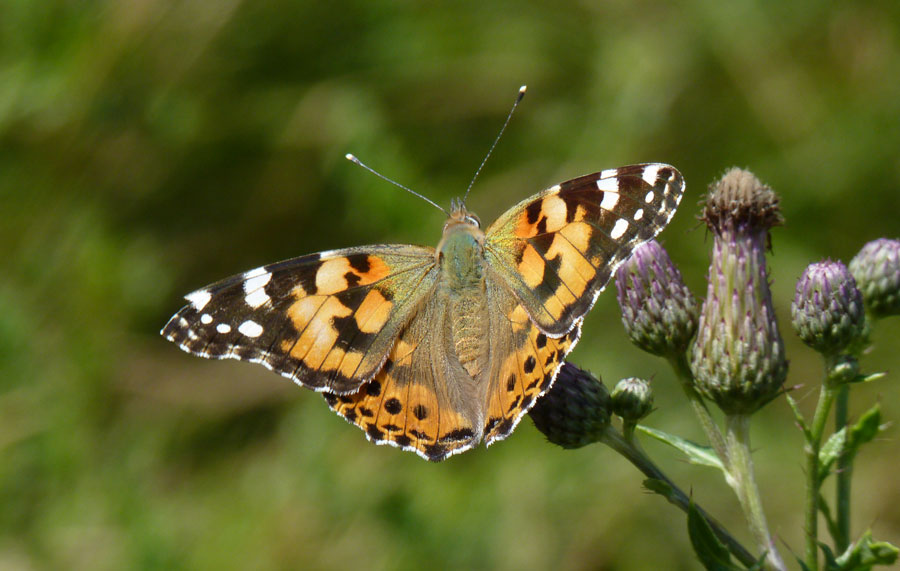
Painted Lady - such a stunning underwing

Gatekeeper

The underwing of a Comma - and that's why they're called Comma's!

Thursday, 30 August 2012

No Seawatching For Me

This week has seen two outstanding days of sea watching, for Devon and the patch. Gavin has been present when most of the stuff has flown past, so read his accounts of the sea watching antics HERE. Monday was the best day, and I only had chance for an hour out so headed down to Black Hole Marsh. Wednesday was the next best day, but I had a meeting in mid Devon from 10am so had no time for sea watching at all! Typical isn't it - if only Tuesday and Thursday were the two wet and windy days then I would have seen lots!

The numbers of Long-tailed Skuas have been the biggest surprise, with the patch scoring three this week. Again, Gav has a good write up of this on his blog, and although I missed all of these, I am more than happy with the two I've seen over the years. Actually, out of all the rare/scarce birds I've seen on patch, the adult Long-tailed Skua that graced the sea over Seaton Bay back in May 2006 for some reason has stuck in my head more than anything. I can still picture it now, and recall the exact chain of events and the expletives that were uttered! What a beaut.

Ok, so what have I seen this week...

My hour out on Monday at Black Hole Marsh did prove worthwhile, as a juv-type Garganey appeared in the middle of the lagoon amongst 60 or so Teal. As soon as I found it I sent some texts out as this species is a bit of a patch rarity, but before all the texts had sent, one bird out of all the c300 birds on Black Hole Marsh took off and flew low north...the bloody Garganey! Sodding typical. The in flight views though showed it was a male.

Also on the marsh was; 43 Blackwits, 42 Dunlin, 24 Ringed Plover, ten Green Sands, eight Common Sands, three Lapwing and the Spotted Redshank and Tufted Duck still.

On Tuesday I had a whizz round many parts of the patch, including Colyford Common and Marsh, the Estuary, the flood opposite Axmouth FC and Black Hole Marsh. This revealed a decent selection of birds - excellent for the Axe to be honest; three Lapwing, 26 Ringed Plover, one Knot, 44 Dunlin, four Snipe, c25 Black-tailed Godwit, nine Common Sands, 14 Green Sands, one Spotted Redshank, three Ruff, one Turnstone and a Kittiwake!

The Kittiwake didn't look well at all, and is still present today so it isn't looking good for it...

It doesn't look too bad in this pic though

On Wednesday morning, before I headed off for my meeting I had chance for a quick look over Black Hole Marsh. One of the first birds I saw after I got in the hide was a small stint with the Dunlin and Ringed Plover over in the 'Solitary Sand corner' of the marsh. It was soaked wet (there was very heavy rain) and remained distant and I had to leave for my meeting.I had to leave it as a 98% Little Stint!

Whilst away, it was confirmed, so on my return at 14:00 I quickly dropped in for another look. It was closer, but the weather was still dull and awful...

..hence this crap photo!

Again there was a good number of birds on the marsh including two Turnstone, and the Ruff and Knot still.

And that brings me to today. I was down Black Hole Marsh early again (yes, I am determined to get Spotted Crake on my patch list!)...

Very tranquil compared with yesterday!

There was a bit less variety on the marsh, but the Little Stint and three Ruff were still present, and a few more Blackwits present - 44. Still no Spotted Crake though!

Later on in the morning, a quick look around other sites in the river turned up the Garganey again. It was on flood water opposite Axmouth FC along with a load of Mallard and c20 Teal. It could be quite elusive at times in the long grass, but I'm pleased to say at least three other birders managed to twitch it successfully.

And to complete this post, on 7th August I saw two colour-ringed Great Black-backed Gulls from the tower hide. One was 0.AA8, and the other L:AP8...

Looking suitably monstrous - I do love Great Black-backs!

Well I've just heard back from Bruce Taggart - and it wasn't a channel-hopper as they usually are. This bird was ringed on Looe Island, Cornwall, as a pulli on 25/6/11. This is the first sighting of L:AP8 away from Looe.