Pages

Showing posts with label ruff. Show all posts

Monday, 13 July 2020

Male Ruff and Med Gulls

Wader passage is really gaining momentum now, with Black Hole Marsh proving more and more inviting as the water levels drop daily.  

It really feels like we are going to score a 'big one' in the next few weeks, but until then this stunning male Ruff will do just fine...

Best one I've seen on the Axe!

The combination or black and rich chestnut looked stunning


Lots of Black-tailed Godwits, Redshank, Common Sandpipers, a few Dunlin and Lapwing and a Greenshank were also present.  Plenty of small gulls and a couple of Teal too - it's looking so good!

Over the last few days it's been great to see a continued presence of excellent numbers of Med Gulls.  The other morning a quick look along the Estuary made me feel like I was on the Fleet...

There were 11 in total in this flock of 24 small gulls (5.5 pictured!)

Looking like a male at the back and a female


...and long may it continue. Any number of Med Gulls is never too many!

Thursday, 30 April 2020

Garden Mega

Well you can't say I didn't see it coming - although really wasn't expecting it from the house! Find below a snippet from yesterday's blog post...


At about 18:30 today, whilst I was in the middle of Harry's bath and bed routine, Twilight Tim (Davey) messaged that he'd found an Iceland Gull on the Estuary.  But by the time I got to my phone there was a second message to say it had flown off south, along with some suitably gripping video footage.  However 15 minutes later there was another message to say it was back. Many thanks for the updates Tim.

I positioned myself at the bedroom window and tried to get a look at every gull I could see in flight over the small section of Estuary inline with mine.  Much to my surprise, ten minutes later bingo, Iceland Gull flying low north up the Estuary! I really wasn't expecting it as most gulls that take off from the Axe Estuary mid-afternoon onwards fly south, which would have ensured it remained out of view from me.

It was flying steadily north, and after the few seconds I was watching it, just as it was about to disappear behind the tree in the foreground that blocks my view north east, it chose to circle around twice with a Herring Gull, before then continuing north out of view.  This gave me a couple of extra seconds to grab my camera and take these two photos.  Yes they can only be described as dreadful shots, but it is a real credit to the capabilities of the P900 that in these couple of extra seconds, at a distance of about half a mile, through a not very clean window, I managed to get anything identifiable at all!

Striking even at this distance!

Just as it flew out of view


Although Iceland Gulls are annual here, they very often don't stick around for long and I've just never been looking out the window at the right time - this is a full fat house tick! 

These distant views were a really good reminder of how big Iceland Gulls can look in flight.  Most Iceland Gulls at rest are clearly smaller than Herring Gulls, and if you see a large looking white-winged Gull in flight it is so easy to incorrectly conclude Glaucous (which are so much bigger than Herring Gulls at rest).  Yes Iceland Gull maybe smaller than Herring Gull, but they are a long winged bird and their whiter wings will always make them 'appear' larger than a darker winged bird even of similar size - especially in dull light conditions.   Just something to bare in mind if you encounter a flying white-winger.

Iceland Gull takes my lockdown house list to 85, with the other addition since my last post being Dunlin and Water Rail, both heard after dark on 28th.  The latter being particularly vocal.  Am pleased to report the Grasshopper Warbler continues to reel, although it seems to have moved a short distance as it's a bit quieter from the garden now. 

Although my camera was with me in the bedroom for the gull, I stupidly didn't take it with me today for my daily family walk.  As we came back through Black Hole Marsh the Ruff was showing exceptionally well, as can be seen with this phone pic...

Why oh why did I go camera-less!


And how can I not end this post without bragging about these beauts Jess cooked up today.  We are trying to eat sensibly during lockdown, but you've got to allow a treat now and then...

She's good at photographing the fruits of her labour too!


Stay safe everyone.


Wednesday, 29 April 2020

Waders

This drastic weather change has seen a significant pulse of wader passage on the Axe Estuary, which is to be expected with rain in late April.

This morning the star bird was a Ruff briefly on Black Hole Marsh, before flipping over to the Estuary. Obviously we all know how stunning/bizarre spring males are, but this was a she, and she was truly beautiful.  A really small and dainty bird, probably not that much bigger than a Curlew Sand, but so exquisitely marked.  Just look at those tiger-striped tertials and greater coverts, absolutely stunning...

I wonder where she's been wintering and where she may be heading off to breed?

Hello there Mrs


Also today, probably the same Grey Plover I saw from the house last week, and which Phil heard a few days ago, was showing distantly on the Estuary. Along with a single Bar-tailed Godwit, four Whimbrel and a few Dunlin and Ringed Plover...

100% winter plumaged Grey Plover on this side

But a few black spots on this side, with a Bar-tailed Godwit and a Whimbrel


Good to see there's still some gull passage going on, with two first-winter Common Gulls and at least 25 Lesser Black-backed Gulls on the Estuary this morning... 

All ages - I keep reminding myself there's still time for a late white-winger


Yesterday I took my exercise walk in the afternoon, and was delighted to see a flock of thirty odd Dunlin on the Estuary. Then in true spring fashion, in came another flock and I was now looking at 64 Dunlin and five Ringed Plovers.  In birding I don't find much more exciting than being amongst spring wader passage, when out of nowhere flocks of breeding plumaged waders drop in en-route to their tundra breeding grounds, having wintered somewhere south of the UK.

So many waders! Never a common sight on the Axe.

Always feeding in such a frenzied way!


More rain tomorrow so possibly more waders to come!? Stay safe everyone...

Friday, 30 August 2019

It's Autumn on the Axe

It's been a good week locally for birds, one of the best autumn weeks we've enjoyed for several years I'd say, and this is why...

First of all I'll start with Ospreys. A couple of weeks ago, on the 18th in fact, I happened to be outside at work (in the middle of Seaton) when an Osprey flew low south west overhead shortly after 10am.  It disappeared as quickly as it appeared, unlike the juvenile Sue Smith found from Tower Hide on 25th.  This one, clearly an amateur fisher, is still around today, and can be easily seen fishing on the Axe given a bit of time.  It's great having a long-stayer again, our first proper lingering bird for what seems like years...

Osprey with a typical back drop - lots of alarming gulls!

The Tower Hide is the best place to see it from, although I have stayed clear of here as I know it's proving a busy place for photographers at the moment - and rightly so.  This has to be one of the best sites to photograph fishing Osprey in the UK (away from breeding grounds)?

Going in for a dive

I had a second Osprey on the 27th, when one flew in from the north west over Seaton cricket pitch, then continued south west at quite a height.  Our usual bird was back fishing on the Estuary an hour or so later so am happy this was a different individual.  Whilst on raptors, at least one Marsh Harrier remains in the valley, and I had a second fly west over Lyme Regis on the morning of the 23rd.

Now to the wading birds and Black Hole Marsh.  After another little pulse of Wood Sandpipers with three on 25th, it really kicked off yesterday.  Late afternoon on 29th, inline with something of a national arrival of these species, Phil texted with news of three Curlew Sands and three Ruff - nice.  I went down there that evening and saw all six of these goodies, along with three Greenshank, a juvenile Knot, several Yellow Wags and plenty of the usual species...

All three Curlew Sands - a cracking adult and two juvs
Three juv Ruff - I think a male and two females
Juv Knot

Over the course of today, the three Ruff have dispersed, but a lovely adult Little Stint has joined the fun and games.  Unlike the adult Curlew Sand which is still very summery, the stint is more advanced in its moult to winter plumage...

Little Stint on the left, and Curlew Sand in shot too
On the right here, such a delicate little beauty

A juvenile Bar-tailed Godwit was also new in, mixed in with the vast numbers of Black-tailed Godwits...

Note the difference in leg-length!

Had some better views of the Curlew Sands too.  The adult really is cracking, only seen one or two better than this on the Axe before...

Look at that!
Constantly feeding though! 

Also tonight a Green Sand, two Ringed Plover, the Knot still (which has developed an occasional limp), a Whimbrel and heaps of the usual species.  I am so glad the water levels have now been sorted on Black Hole because the mass of birds it's attracted will no doubt continue to attract even more - the next few weeks could be really good.

The one thing I have really missed this August is Beer Head. I simply haven't had chance to get up there, but those who have have been seeing plenty.  Phil turned up the highlight, with a brief Wryneck yesterday morning, but the large counts of migrants coming in most mornings have proved equally gripping.  Looking forwards, Yellow Wags will start picking up in numbers now, they usually peak over the few days when August ends and September begins, so hopefully I will be able to cash in on this at least.

 'til next time...

Thursday, 8 March 2018

Lyme Regis Little Gull

I took a trip over to Lyme Regis today in the lovely spring-like weather to catch up with James Mc and to enjoy some of his and his wife's wonderful food. Whilst I was there I thought Id take a look at the lingering Little Gull(s) too. 

In the end though, I spent far too much time chatting and eating, and realised as I was wandering back to my car I was twenty minutes over my ticket! As a result all I could do was scurry down to the sea edge with Harry, enjoy thirty seconds of ace Little Gull action, and then hurry back to the car.  This brief encounter with an obliging and close Little Gull in such calm and pleasant weather left me wanting more, so two hours later I was back!  Obviously I can't compete with the long-lenses for pictures, but simply watching it gave me all the enjoyment I needed - what a super little bird...


And a little video...


I've seen plenty of Little Gulls, several hundred, but none quite like this bird. This first-winter is feeding often just a few feet off Monmouth Beach and the Cobb, and coupled with the amazing weather of today, it gave views that are quite simple not the norm for this species. Most the Little Gulls that I've seen over the sea off Seaton have been during strong winds and heavy rain, or as a dot a mile out to sea!  I urge you to fill your boots with this bird while it's there.

Turns out I'm going to have to do a bit of investigative work here too. Although there was just the one bird there today, for the past few days there have been two first-winter Little Gulls. BUT, I've come across a report of a third bird here either yesterday or the day before, an adult.... which may or may not coincide with the disappearance of the adult Ross's Gull from Weymouth... 

Back to the patch, and we still have a nice selection of wading birds on the Axe, including Avocet today. Having missed the three Ruff last Sunday I was pleased to see a stunning male in with the roosting Redshank and single Greenshank yesterday - a right corker too.

Looking at the weather forecast just now, all bets are off for an arrival of Wheatear this weekend...

Thursday, 28 September 2017

Ruff Influx and Spoonbill

Today is the first day this week that I've managed any time out birding on patch. And that's with the whole week off work!  I managed two looks along the Estuary at mid tide (early morning and mid afternoon) and an early afternoon visit to Black Hole Marsh.  It was quite a fruitful day really with my totals being; 

42 Wigeon
50+ Teal
1 Spoonbill
7 Ringed Plover
2 Dunlin
1 Curlew Sandpiper
1 Little Stint
19 Ruff
1 Bar-tailed Godwit
2 Green Sandpiper
5 Common Sandpiper
1 Spotted Redshank
3 Greenshank

There's two stand outs on that list, Spoonbill and the exceptional Ruff count.  The Spoonbill was completely jammy as I saw it with my naked eye from the kitchen window flying south west away from Black Hole Marsh. Doubt soon crept in with such a brief and distant naked eye only view, but sure enough when I went down to Black Hole an hour later... "there was a Spoonbill here about an hour ago, didn't stay long though and flew off towards the Estuary". Presumably this was also the bird that dropped in briefly at Abbotsbury today.

As for the Ruff. Wow. Just wow. I had at least ten early morning on Black Hole Marsh, Dad had 14 mid morning and when I went down there early afternoon there was an incredible 19 on view. All were juveniles, and they were mostly hanging out in two flocks of seven with the rest loosely dotted around.  Not sure if this is a record count for the patch, I highly doubt it as 'back in the day' am sure Phil saw loads together at times, but my previous highest single count here is of 17. Can't remember the date off hand but it was in the winter during a very cold snap with lots of snow and ice around.

Six of the 19 Ruff on Black Hole Marsh this afternoon


The Spotted Redshank was the lingering juvenile on Colyford Scrape, and the Curlew Sandpiper (juv), Ringed Plovers and my highest count so far this autumn of Wigeon were all along the Estuary this morning.

In other news, it's that time of year when I need to edit my mini-bio to the right of this page, and increase my age by one. Though to be honest life is going by so quick it feels like I'm changing this at least three times a year!  At the age of 32, well, I can't even begin to explain just how happy and content I am with life, it would take pages and pages of text. But the source of it all is simple...

My world

Tuesday, 19 September 2017

Patch Update

This won't take long. Well it can't to be honest as I've got to go....
Our first Little Stint of the autumn appeared mid morning today on Black Hole Marsh, found by Clive (it wasn't there at 9am!). Also present two Ruff (a second juvenile joined the lingering bird yesterday morning - present at first on Colyford Marsh but now both are on Black Hole), the juvenile Curlew Sandpiper (for its fourth day) along with small numbers of Greenshank, Green and Common Sandpipers, 26 Dunlin and seven Ringed Plover.  The Spotted Redshank wasn't on Colyford Scrape this morning, but this is where it has been most days.

Here's some (poor) pics of the star birds...

Juvenile Little Stint - it remained distant but no doubting this one!

Dreadful pic of the juv Curlew Sandpiper

Ruff number one

Ruff number two - with a Snipe in the early morning sun on Colyford Marsh. Why wasn't it a Buff-breast!?

Juvenile Spotted Redshank


And that's that.  I'll leave you with the view from Colyford Common hide early yesterday, the sun rising over the Axe Valley on a lovely mid September morning...


Sunday, 3 September 2017

Washout

South easterly winds coupled with rain is exactly what you want to see in the forecast when September comes around. Perfect conditions for bringing waders, gulls, terns, wildfowl and seabirds in to the south coast. So no surprise I was up early today and could not get out of the door quick enough!  In reality though by the end of the day I'd got very wet for very few new arrivals. Well there was one excellent new arrival, but I managed to let it get away...

Mid morning whilst sat in the kitchen chatting on the phone to James Mc I noticed a large wader flying towards the house, still a fair way off to the east.  It instantly looked odd.  It continued flying west and as it got closer I literally threw down my phone and ran to my binoculars. Annoyingly they were in the car outside, and when I finally grasped them away went the wader over the roof tops to the west.  Thanks to this species fairly distinctive size, proportions and flight style I know it was a Stone Curlew. But having seen no plumage features with naked eye views only in the pouring rain, it was gone for good... so so so annoying. And what a house tick that would have been!

What I have seen today, and managed to actually conclusively identify, include a drake Gadwall on the Estuary this morning, and the following on Black Hole Marsh at dusk; 

50+ Teal
1300 Black-headed Gull
1 Mediterranean Gull (adult)
130 Herring Gull
8 Great Black-backed Gull
11 Lesser Black-backed Gull
1 Common Tern (adult) 
12 Ringed Plover
c50 Dunlin
6 Greenshank
6 Common Sandpiper
3 Green Sandpiper
5 Snipe

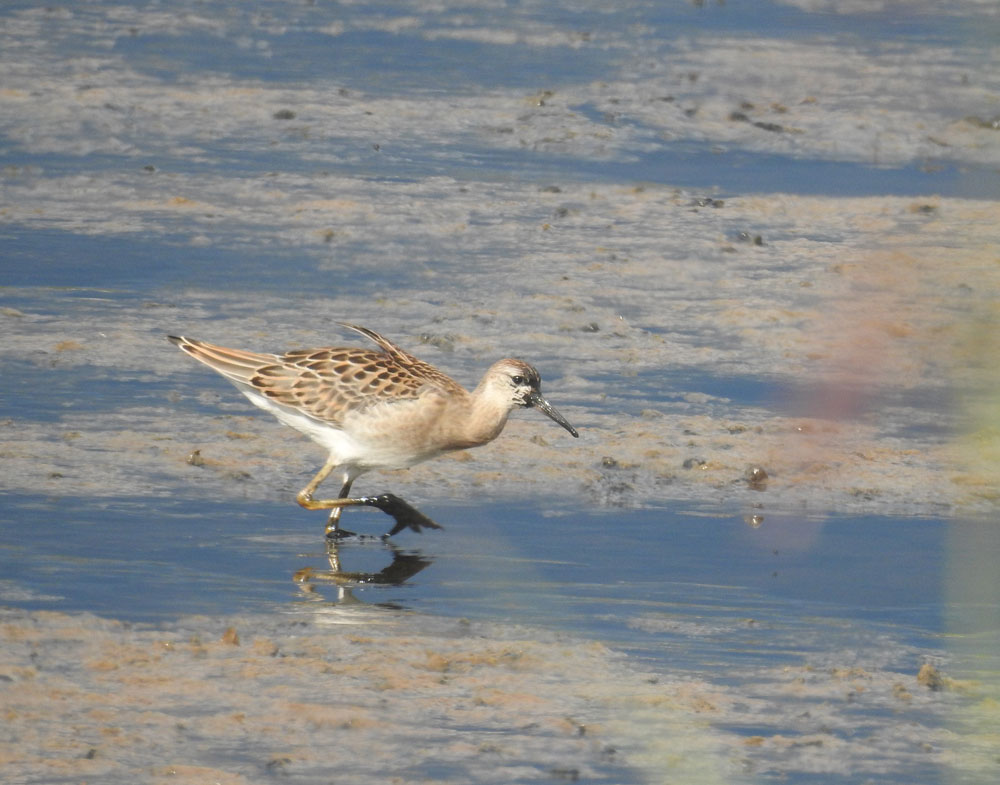
Sadly the Ruff seems to have left us now, but I did manage this pic before he went...

Juvenile male Ruff


And I couldn't help but snap this juv Ringed Plover showing at stupidly close range...


Really hope I've not missed the Black Tern boat for the year - thought that was virtually a dead cert today. Oh well, maybe tomorrow?


Monday, 28 August 2017

Yellow Wagtails Galore!

It's proving to be an absolutely stonking autumn for Yellow Wagtails. We always do well for them here in late August/early September, especially at Beer Head, but this year there are stacks more than usual. 

For the last few days up to 100 have been present in the valley (they can be found wherever there's cattle or on Black Hole Marsh) and most mornings Beer Head goers have been seeing upper double figures flying west. Plus this morning I added a load more with a visit to Axe Cliff, which I will happily write about now...

Beer Head has been pretty well covered so far this autumn by the usual gang; Ian Mc, Phil A, Bun, Clive W and Dad. This gang would usually include me, but this autumn I've decided to really concentrate on Axe Cliff which usually plays second fiddle, hence why Axe Cliff is within my Patchwork Challenge patch.  I went up there a few weeks ago but it was before the autumnal rush, and for the last week Harry has been suffering with a cold so our nights have not been too good (to say the least!). Thankfully though I finally made it up there this morning for a good walk about, albeit later than I would usually visit. An hour and a half from 08:30 produced;

6 Tree Pipit (two grounded, four west)
7 Meadow Pipit (grounded - my first of the autumn)
140+ Yellow Wagtail (all grounded in the stubble fields, I reckon I would have seen 200+ had I walked more fields)
1 Wheatear
3 Whinchat
1 Stonechat
3 Blackcap
2 Whitethroat
5 Willow Warbler

The bushes never do that well at Axe Cliff, but oh my word the stubble fields were amazing. I don't think I've ever seen Yellow Wagtails like it - they were everywhere!

This is what the Axe Cliff stubble fields are looking like at the moment

If you enlarge this photo, all the dots flying above the stubble are Yellow Wags!

Two Yellow Wags - they weren't easy to photograph as they spent most their time feeding in among the stalks

One of the Whinchats


Down in the valley, Black Hole Marsh is pretty samey wader wise but it's nice to have a juvenile male Ruff with us, which has been here since the afternoon of 23rd. There are a few more Snipe (11) and Teal (25+) about as well, and I'm sure a scarcity or rarity is only a matter of days away.

Which leaves me just to say goodnight...

Tonight about twenty minutes after sunset on the lower Axe Estuary looking towards Seaton

Wednesday, 14 September 2016

Autumn Returns

You may have picked up on some frustration in my recent blog posts that despite daily visits, Black Hole Marsh has remained very samey - except for the lovely juv Sanderling on Friday 9th that is.  

Thankfully though, yesterdays frequent thunder storms and heavy rain showers seem to have got things moving again.  A flying visit mid afternoon yesterday showed a nice due of Curlew Sandpiper and Ruff new in... 

Juv-1w Curlew Sandpiper


I was back down there for dawn today, and saw;

1 Avocet
6 Ringed Plover
22+ Dunlin
1 Curlew Sandpiper
1 Knot (juv)
14 Black-tailed Godwit
6 Bar-tailed Godwit
2 Ruff
3 Common Sandpiper
1 Green Sandpiper
2 Snipe

Out of that list the Avocet is the stand out bird.  Although they are annual on the Axe, this is the first that I've ever seen on Black Hole Marsh. I'm also pretty sure this is our first of 2016 following a blank spring.  I didn't have time to walk to the Tower Hide so you will have to make do with an ultra distant record shot...

Good job Avocets aren't little brown things!


The second Ruff and the Knot were also new arrivals, as was a second Knot on the Estuary about half an hour later.  

It's not just been a wader day, seems to have been a good one for passerines too.  Colyford Common mid morning showed six Wheatear and two Whinchat...

Love autumn Whinchats!

Whinchat on the baordwalk

A Wheatear and Ruby Red Cattle


A late morning visit to Axe Cliff was also fairly rewarding, despite the heat and the time of day. 

What a view!


10:45-12:10 here produced;

1 Golden Plover
12 Wheatear
7 Whinchat
50+ Meadow Pipit
1 Tree Pipit
1 Sedge Warbler
3 Whitethroat
1 Willow Warbler
3 Chiffchaff
90 Linnet

The Golden Plover was my first of the autumn, and flew over west. Thankfully I picked it up on call so didn't need to worry about the Lesser varieties. The Whinchat count was decent (a five and a two) and the Tree Pipit I flushed out of long grass.

I'm not sure if it is good to see so many Meadow Pipits. When they replace Yellow Wagtail as the most frequent fly over migrant you know you've moved into the next phase of autumn migration. I've been hearing them going over fairly often now for the past three of four days, and have only had one Yellow Wag. Autumn rolls on...