Pages

Showing posts with label patch year tick. Show all posts

Thursday, 28 November 2013

Getting Back To It

First of all, I have to say thank you so much for all the comments, emails, texts and tweets in response to my previous post. I do have more to say, but I'm not going to. It's time to draw a line under it...
_________________________________________________________________________________

...and get back to what this blog is about.

We have been blessed with flat calm seas for a few days, and decent cloud cover making conditions ideal for sea scanning. Bird wise though there has been very little on the sea, with species you'd expect to see several of (Great Crested Grebe, Common Scoter, Cormorant, Shag) few and far between, or totally absent.  Thankfully though the last few days have seen a bit of quality appear!

I haven't seen Long-tailed Duck here for six years, and before that I'm pretty sure I've seen just one other. So you can imagine my thrill when I picked up two feeding in the bay off the Spot On Kiosk yesterday morning. Both are immature/female-types, but beyond that I've never been too confident at ageing/sexing distant non-adult male LTD's. One was considerably whiter than the other - and if I had to place bets I'd say they were both female's, and ad and an imm. Most pleasing is that they seem settled, and are still out there feeding this morning.  Also yesterday a drake Red-breasted Merganser flew around the bay for a while which was nice, as was my first settled Great Northern Diver of this winter.

This morning I gave Branscombe its second look of the week, and had two more settled Great Northern Divers, along with a fly by Red-throat.  There were way more Kittiwakes and auks off here than in Seaton Bay, so hopefully regular visits here will turn something up.  A snoop around the sewage works here earlier in the week showed four Chiffchaffs and good numbers of the expected species - sadly no Yellow-browed or Dusky.

Tuesday morning I undertook my usual woodland bird survey near Colyton. Nice to see my first four Woodcock of the winter, along with a couple of Fieldfare, 10 Redwing and a fly over Golden Plover. All very wintry! 

There is a very winter feel to the birding scene now, vis mig appears to have all but stopped and the hopes of a late autumn rarity seem far flung.  Before it did end I gave Beer Head probably it's last visit of the year, on the 15th.  It was nice to see a few Wood Pigeons flying over NE, only 1350, but it was my biggest passage of the year (which is terrible!). 


On the ground, four Song Thrush, three Redwing and a Chiffchaff were expected, but a late Wheatear not so...

Looks a bit more exciting in this picture than it actually was - always just a Northern sadly.

So there you have it, autumn 2013 done.  And now we are into the last phase of the year - the last phase of my year listing year.  Long-tailed Duck was my 188th species for the year, which is a notable number as its the first guess from Steve's 2013 Patch Year Listing Competition.  Here's a reminder of who guessed what I'd end the year on...

188 - Andrew  
189 - Karen    
190 - Phil      
191 - Julia      
192 - Bun    
193 - John O' Sullivan  
194 - Col      
195 - 'Corky'     
196 - Dave H      
197 - Jonny      
198 - Skev      
199 - Tim White    
200 - Gav
201 - Sue Murphy  
202 - Catharine    
203 - Sue Smith

So Andrew, if the year was to end now, you would be the winner. But I'm afraid it doesn't, and I'm sure there's at least a few more year ticks in it...
 

Monday, 21 October 2013

A Trio Of Ticks

After a post moaning about the lack of patch year ticks - along come three!

Rewinding back to Friday, and I was just having a bite to eat before work when Fraser (our reserves warden) phoned.  He could hear Bearded Tits calling from the reeds on Stafford Marsh, and whilst on the phone saw four fly out and head for Black Hole Marsh. I was out the door and down the reserve in moments - and moments later the calls of Bearded Tits could be heard from the platform.  A minute or two later along came a tram and up went the Bearded Tits, all four, although they soon dropped straight back into the reeds. Another minute or two later and up they went again, but this time stayed low and flew over Black Hole Marsh, and east over the tram line.

Bearded Tit really is a rare bird, these were only my second ever, with my first being equally brief. Many thanks Frase for this unexpected year tick.

With all the wind and rain, I had high hopes for today. And with the sea being quiet in recent days I decided to spend my morning in the valley. The weather meant Colyford hide was the most obvious choice - from here you get a good view over the flood water on Colyford Marsh and Colyford Common.

Flood!

My most painful dips this year have been with Garganey - I managed to miss three spring birds.  I thought I'd missed my chance with this species to be honest, but on Sunday noticed a few new birds had been reported in the UK. And guess what was with the first flock of Teal I looked at this morning...

At the back in front of that Lapwing

... a Garganey! My latest ever too. I can't tell you how happy I was to see this - and it instantly made looking through hundreds and hundreds of Teal this autumn worthwhile!

I spent another hour in the hide, and there were superb numbers of birds about (particularly ducks and gulls), but I couldn't find anything else better than an adult and first-winter Med Gull. Or maybe I did...

I picked up a darkish mantled gull in a distant and very large flock of mostly Great Black-backed Gulls. I thought it was going to be a Yellow-legged, but then it showed its legs, they looked pale pink!? It had a clean white head and looked otherwise ok for this species. Then the sodding thing turned and showed its head and bill in profile - it was at this point the shakes came over me as it looked a lot like an adult Caspian Gull!!! Stupidly the only camera I had was on my phone, so I got a few very poor pics this way, but when I put my eye back to the scope it wasn't there. And that's where this story ends, as I never saw it again. So gutted.  Anyway, for what it's worth, here's the 'best' pic...

Anyone care to comment?

I said early in this post how poor the sea has been, and it really has been. I don't just mean here, look at Portland Bird Obs website. We've had gale force southerly winds, with low after low coming through - but the totals have been pathetic! Where are the Sooties and Grey Phals?  Mid afternoon I thought I would give the sea another chance though - so headed down to the Spot On...

...and it was rubbish!  There was quite literally nothing passing, and after twenty minutes I decided to give up. Wandering back to the car, one last glance at the sea with my naked eyes gave me the shock of the year - SABINE'S GULL!!!  A juv Sabine's Gull was just there, flying west close in, its distinctive wing pattern immediately obvious. I grabbed a few record shots, but pleasingly it stopped flying west and joined some feeding Black-headed Gulls. I got the news out, then legged it down to the shore to take some more pics...


I know not everyone likes gulls - but come on...

 And here's a quick (and rubbish) video...


It stayed here for about ten minutes, then drifted further out and sat on the sea. A few minutes later it took off and flew west - and we last saw it about five minutes later towards Seaton Hole. Stunning, stonking, beautiful, elegant, buoyant.... I could go on and on. WHAT A BIRD!!! Look how dark the head is, the delicately forked tail with the black band, and don't get me started on that wing pattern....

Isn't it funny how one last glance at the sea turned this sea watch from dire to incredible. If I had walked back to my car the other way (the shorter way!) I simply wouldn't have seen it, and this Sab's would have been loitering out here without any of us knowing!  This was my second Sabine's here, and quite similar to my first - stupidly close in, and there was nothing else moving over the sea.

After this excitement I had another look up the valley. The Estuary was empty, but from the farm gate I was pleased to see lots of large gulls.  Sadly my Caspian-ish thing wasn't in amongst them, but two lovely adult Yellow-legged Gulls were. I then noticed a few gulls were starting to gather on the Estuary right in front of the Tower Hide, and in amongst them was yet another Yellow-legged Gull, this one a first-winter. Even at the distance it was, still very distinctive and proved its ID nicely by flying up and down a few times.  Later Gav and Tim saw this bird and took some great photos (click on their names to see the pics).  Also from the farm gate were six Ruff with the Lapwing.

What a day!!!
 

Friday, 27 September 2013

One Hundred And Eighty...

...is what my 2013 patch year list is on thanks to a text from Tim Wright this afternoon.

Glossy Ibis, Wryneck, Rosefinch, Rose-coloured Starling and virtually all species of American wading birds have been on my radar over the past week. But as they say, expect the unexpected...

Can you see it!?

A bloody Bittern!

Having a Bittern on the Axe is amazing in itself - but for one to be out like this early afternoon is just crazy!!! Only my second ever for the patch - the first one hung around for several weeks during a spell of freezing weather.  I guess with the rapid increase in breeding numbers on the Somerset Levels we should expect more of these from now on - I certainly won't be complaining!

Wednesday, 18 September 2013

Caspian Gull and Spotted Crake

Won't have much birding time from now til the end of the month, so am making the most of any time I do find...

Yesterday with all that rain, and a middayish low tide, I thought the Estuary would be worth a quick look early afternoon - in the end it wasn't a 'quick' look at all!  The moment I drove over the bridge at the bottom end of the Estuary things looked promising as I could see lots of black...

Great Black-backed Gulls galore

Lots of Black-backed Gulls (whether they're Great or Lesser) is always a good sign, and is usually the case when there's strong wind and rain. They're birds that have come in from offshore to shelter from the weather, and there's always the possibility they've bought something else in with them. I thought a Yellow-legged was on the cards, but I really wasn't expecting to net Devon's first September Caspian Gull!

When the weather is as foul as it was yesterday, I tend to just go through the gulls with my bins from the car until I reach Coronation Corner, when the scope's needed to check birds to the north. It was whilst checking the second flock of gulls I'd come to when this made me jump out of the car and grab my scope...

The bird asleep behind the female Mallard

I didn't really know why this bird got me so excited so quickly with just this view, but looking at this pics it's the white head, neck and breast, with neat streaking around the rear of the neck, and the mostly dark greater coverts that contrasted with the rest of the coverts, scapulars and mantle feathers.

So the scope came out, but I didn't learn much more about the identity of this bird. I did learn a bit about its age though, and was starting to think it was probably a first-summer/second-winter bird as it just didn't look young and fresh enough to be a first-winter, and those broad white tips to the tertials weren't right for a 1cy bird.  I had to wait about five minutes before a male Mallard (the one pictured behind the bird in the above photo) walked past it and woke it up, and out popped exactly what I wanted to see...

Notice the typical Caspian-stance with a bulge at the top of the neck

Looking very cheesed off in the heavy rain!

Gav soon arrived and after some discussions (and seeing the bill well, which had lots of pale on it) we decided it was indeed a second calender year bird, still mostly in first-summer plumage.  In my mid I expected a second-calender year Casp in mid Sept to be more like a second-winter bird showing far more pale grey in the scaps and mantle, but apparently this is fine. To be honest I usually do my best to avoid first-summer large gulls. All other ages I will happily have a go at - but there is just so much variation in this age group of all the large gull species it's a nightmare. So I'm pleased this bird screamed Caspian first and foremost regardless of its age!

Other pro-Caspian features included the long tibia (which you can make out on the above photo), and the general size of the bird. It wasn't the biggest Casp I've seen, being clearly smaller than the Great Black-backed Gulls, but it was still significantly larger and heavier in the body than all the surrounding Herring Gulls. We had a brief view of its upperwing which looked spot on for Casp, as was a glimpse of a very white underwing and a very white tail with no black spots just a neat black tail bar. This is all depicted on Gav's blog as he managed a shot of it as it flew off, see HERE.

If all this gull talk is making you sleepy, hopefully this will wake you up...

Oh yes....

Half way through writing this post, I got a call from Dad saying someones got a Spotted Crake in front of the Field Studies Base on Stafford Marsh. I sent the texts out (I thought to everyone - sorry again Gav) and headed straight down there. It was Ian Hunt (a member of the Axe Estuary Ringing Group) who'd seen it, he saw it well at about midday. Thankfully at about 12:50 it did the decent thing and showed for five minutes in exactly the spot Ian had seen it. What a superb patch year tick - two in two days! And what a superb bird too - nothing like that drab almost spot-less dark blob last year, a really charismatic little thing poking around the juncus looking rare...


Craketastic!


Isn't it funny how quickly an autumn can go from being average to good....

Thursday, 5 September 2013

Knot One, Knot Two, But THREE!

Sorry, but Knot puns are just too tempting....

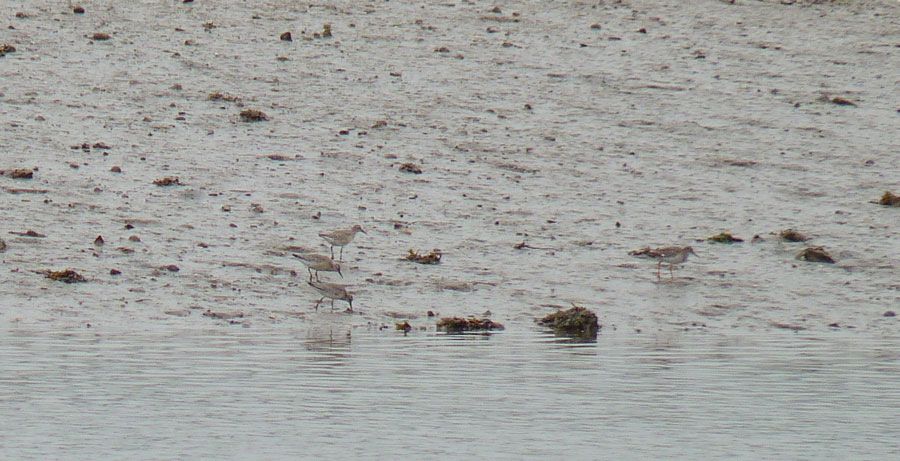
Knot is one of the last 'pretty much guaranteed' species to fall on my 2013 patch year list attempt. It fell on Tuesday morning, and as you can maybe tell from the post title, there were three of them (which I think is my single highest count for the Axe!)...

A Redshank leading the Knot along the Estuary.
 
Waders have been fantastic - and it's looking ever better now a bit more water is coming on to Black Hole Marsh.  Dunlin have been numbering just less than 50 (48 Wed, 46 today), Ringed Plovers 30ish, literally millions of Curlew Sands (most often about ten), two juv Little Ringed Plovers and a lovely juv Little Stint. Sadly the two Spotted Redshank didn't hang around at all.

The most focused rarity hunter would be best just sitting in the Island Hide all day - but I've got year ticks to find, so have been covering some ground (when I've been able too anyway!).  There's got to be a Wryneck around here somewhere...

I went up to Beer Head later than usual yesterday, I got there at 9ish, and stayed for an hour and a bit. At first it looked dead, but around the Sheepwalk there were birds all over the place! It was clear why too, because there were flies everywhere, which meant pretty much all the birds were sat out flycatching and showing really well - not always close though.

Garden Warblers
Spotted Flycatcher

In all I had three Spot Flies, three Garden Warbler, three Whitethroat, at least eight Blackcap, a handful of Chiffs/Willow, two Wheatear and overhead singles of Grey Wagtail and most unusually, Greenshank!

It really felt like an Ickey was going to pop out at any point. If it did, it was after I left...

Thursday, 8 August 2013

Summer Meets Winter

Within a few minutes this morning I saw four Wigeon and a Cuckoo!  Not two species that go together very often...

Obviously the star bird of the morning was the Cuckoo. I wanted to have a good count up of all the waders at high tide today (see below for totals), but this was interrupted when Ian Mc saw a Cuckoo at Black Hole Marsh. This is a species I thought I'd blown for the year list as I missed out on calling spring birds.

I spent about an hour looking for this bloody bird - but my back up plan worked in the end. It was last seen when Sue Smith saw it land in trees beside the tram way, but it immediately vanished. Knowing autumn Cuckoos are incredibly lazy I waited, and waited, and waited... for the first tram of the day to come up from Seaton.  Sure enough as the tram came through (the bright pink one too!) out popped the Cuckoo.  It flew from tree to tree in front of the tram, before flying across Colyford Common and landing (distantly) on some overhead wires...

An epic Patch Year Tick!

After a few minutes it took off and flew towards Stafford Marsh, when I lost it. As I write this it's not been seen again, but I wouldn't be surprised if it hangs around for a while - juv Cuckoos often do.

I've already mentioned the Wigeon, there were four of them on Black Hole Marsh with 6+ Teal.  We don't usually get Wigeon until late August/early September, so these can certainly be called early returners.

Now for the waders.  Black Hole Marsh is still superb for wading birds, but there were a few bits on Colyford Marsh too. Totals being; one Wood Sandpiper (Colyford), one Ruff, two Greenshank, three Little Ringed Plover (one BHM, two west over), ten Lapwing, 12 Green Sands, 20 Ringed Plover and 42 Dunlin.

Earlier today (at 5:45 to be precise!) I went up to Beer Head - I must be mad!!! Apart from half a dozen Willow Warblers my notebook remained empty, so here's another scenic shot...

My favourite one yet

Thursday, 25 July 2013

Shearwater Success

My perseverance with the sea earned me a year tick this morning.

I was planning to sea watch 6-7am, but just couldn't get up. So I had to settle for a later and shorter sea watch, 08:30 - 09:00.

And the end of my very first scan three Shearwaters flew in from the east, immediately recognisably as Balearic Shearwaters. Finally!!! They flew west across the bay, and as many species do, started heading more south west when they got to straight out.  

As this had happened within the first sweep, I immediately sent a text around as I thought I'd hit on a decent passage, I was wrong! No more Shearwaters passed, and the best of the rest were singles of adult Med and first-summer Common Gulls

Black Hole Marsh 08:00 - 08:25 showed yet again not much new. Green Sandpipers up to four, Dunlin down to four, with 12 Common Sand, 10 Blackwits, two Greenshank, two Teal and a Lapwing. Am pleased to report the Green Sands were quite vocal, so will hopefully get them on the house list soon :-).

Won't have much/any birding time now for the rest of the week and the weekend, so roll on August!  August means the start of the main autumn passerine migration - surely it's got to be better than last year...