Pages

Tuesday, 27 October 2020

A Cracking Casp (with familiar bling!)

Well I ended my last post saying how lucky I was to work beside the Axe Estuary, and at 09:30 morning whilst sat at my desk I found an absolute corker of a first-winter Caspian Gull.  

This was my first view of it during a heavy rain storm, viewed through my office window which desperately needs a clean...


There really is no mistaking that brilliant white rounded head (on a first-winter gull), small eye, narrow bill, plain looking wing coverts, grey mantle and black tertials.  Not to mention those long pink legs!  It was in with a group of c40 gulls, which typically for rough weather included a high proportion of Great Black-backs.

Over the next hour I noticed many of the gulls were leaving as the weather improved, but gladly the Casp stayed put.  It stayed until 11:30 in fact when there were only about 15 gulls left in the flock. 

I had to nip out for a bit at 10:30, so took the opportunity to grab some outdoor photos in the improved weather...


What an absolute corker! And it was only at this stage I realised it was in fact colour-ringed...


Yellow 'XLTC' immediately rang a bell. 

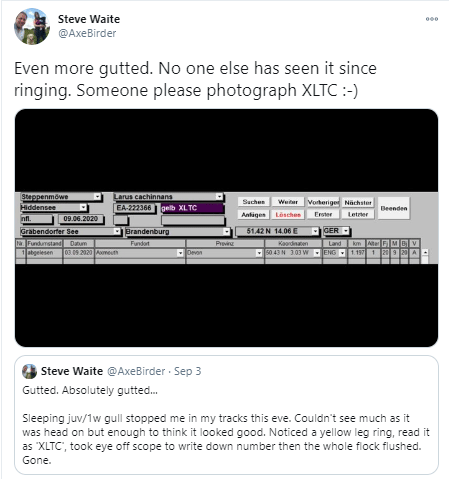
Take a look at THIS blog post from 8th Sept, which tells a tale from the 3rd when I locked onto a interesting looking yellow-colour ringed sleeping gull from the Tower Hide.  I read it's ring, which was XLTC, but then the whole flock of gulls took off and that was it.  Gone.  And was made even worse when a search of the web showed it was ringed as a Caspian Gull, although this didn't mean it was a Casp because yellow-coloured ringed Casps can often be of mixed parentage (affectionally known as German-muck!).  I emailed the ringer asking for any photos or to be informed of any re-sightings, and sent this tweet out in desperation.  I wanted to know what XLTC actually looked like.


But it didn't work no one saw it, well, until me today! Almost two months later and it's back on the Axe, and shown itself to be a sublime Caspian Gull.  Far from 'German-muck!'.

At 11:30 after a few wing stretches, it took off and flew south out to sea with two young Great Black-backs.  Here's the moment it finally left, when I completely jammed this underwing shot...


What a result.  Today was a good day at work :-)


Saturday, 24 October 2020

Good Gull Day

Typical conditions and date for a decent 'grounding' of large Gulls on the Axe today, and I wasn't disappointed!  I was so pleased to be off work today so I could get the most from it.

There's been plenty of water around so not so much has been on the river, with most action coming from the large gull flock resting in the field just south of Black Hole Marsh for most of the day.  The highlight came just after 2pm when a first-winter Caspian Gull made itself know....albeit briefly!

It was such a crisp bird that despite it's briefness, and the fact I didn't even get the chance to point my camera at it, I am 'having it'.  Potentially the first non-photographed Axe Casp ever (if it makes the DBRC grade that is!).  It was asleep when my scope stopped on it, showing a contrasting white head, neck shawl, plain greater coverts and black tertials.   I stayed on it until it finally popped its head out revealing just what I was hoping, a white head, long narrow dark bill, small eye.  However, literally five seconds later it took flight and disappeared off to the north west at a hell of a speed.  Am pleased to say in flight it looked just as I wanted it to as well, although sadly failed to see its underwing.

My Casp tally for the day was actually 1.5, as for the whole day a Caspian-hybrid has been present too. I saw it early this morning, early afternoon and again at last knockings.  A long-winged and long-billed bird with a contrasty face and very striking tail pattern, but very Herring Gull-like coverts and scapulars.  Here's a few pics...


Been a good showing of Yellow-legged Gulls today, with three in total all spending time in the gull flock south of Black Hole. A pristine adult, large second-winter and a first-winter.  Take a look below for a dreadful and distant photo of the adult (two left of the Crow along the back row, compare mantle tone with the adult Herring Gull on the right)...


I haven't seen the Pink-footed Goose for a few days so think it may have finally left us.  Here's my best shots of it from the 17th, although I last saw it on the 18th from a tram!


Had a couple of other decent 'work birds' lately too.  The biggest surprise being on 13th when I glanced out of my office window, which is alongside the lower Estuary, to see a Great White Egret flop in and land along the Estuary right by the main road!  It stayed just long enough for me to lift my phone up and take a snap, before flying off...


On 18th I had a single Cattle Egret from a tram, flying around over the track just south of Colyford Common hide.  It's such a pain having to work right in the heart of the Axe Valley....


Sunday, 4 October 2020

House Martin Influx

The last couple of days have shown incredible numbers of House Martins on the patch, presumably trapped on this side of the English Channel by the heavy rain.  What a spectacle it has produced...

Yesterday hundreds were feeding along the sea front, with plenty more over town including a small flock feeding in my housing estate just before dusk.  And when I woke up this morning, this is what greeted me...


As you can see they are almost all juveniles.  Amazing to see such impressive numbers from my back garden, what an event to witness!  I had to go to work shortly afterwards, but several hundred were feeding in the river valley for most of today.

Turns out this was part of a big influx/movement of House Martins along the south coast over the past couple of days.  The numbers involved in total must be completely mind blowing, my twitter feed has been full of messages like this since yesterday...


Sadly today a few casualties have been picked up, suggesting finding food has been a problem for them during this recent rain.  Am pleased to say there does seem to be far fewer around this evening, which hopefully means many have been able to carry on with their autumn migration today.  


Friday, 2 October 2020

Pintail and Pink-foot still

Today's strong north easterly wind coupled with intense rain brought a nice little influx of wildfowl to the Axe.

I can't ever recall seeing a double-figured flock of Pintail here, so when a single juv/female that flew up river past Tower Hide double-backed round to tag on to a flock of nine flying north, I was a bit surprised to say the least!   The ten spent about five minutes flying around before appearing to drop down near Bridge Marsh.  A look here about twenty minutes later revealed just one Pintail (with Clive later seeing nine which makes sense!) along with three imm Shoveler and about 100+ Teal.

I had another look around mid afternoon, when the sun decided to come out for a bit.  12 Dunlin and three Bar-tailed Godwits were on the Estuary, along with one of the Pintail and a surprise reappearance by the Pink-footed Goose. It was sat on the waters edge with a small gang of Canada Geese just north of Coronation Corner.  Great to see it's still with us, and so pleased to see it in the day light!


What a great bird!

When we get these odd grey geese or winter swans on the Axe, outside of cold snaps, they usually do one of two things.  They either move on rapidly (sometimes within minutes or by the next morning) or they join up with their local cousins (Canada Geese or Mute Swan) and basically turn into one of them.  For example the Axe's only Greenland White-fronted Goose, although spending just one day here, went on to spend the whole of that winter in Devon with the roving Canada Goose flock.  So seeing as though this bird has been with us for five days now, I'd say there's a good chance it will be staying in the area for a little while longer!


Monday, 28 September 2020

Pink-footed Goose

The perfect antidote to my recent bloggers block - a patch lifer!

Following the incredible three patch ticks during the first half of 2020 (American Herring Gull, Blyth's Reed Warbler and Rose-coloured Starling) this evening as the light fell, my fourth patch lifer of 2020 happened...

This Pink-footed Goose, which in the rapidly fading light looked all the world to be an adult, was first found by Tim Wright from Colyford Common hide at around 6pm today.  Finally I was able to get out at 7pm and from the Bridge Marsh gateway was delighted to see it was still present...


We have huge numbers of Canada Geese around at the moment, so it was interesting to see it sticking with a small group of Teal.  There was also a Green Sandpiper on the same pool (look in front of the Goose in the above photo) plus my first Redwing of the autumn flew over which was a bonus. Not a bad mini-trip out in an otherwise work filled day!  

I thought it would be worth trying a video as I knew all my photos would be awful considering the near-darkness...


I seem to recall there's at least one historic Pink-foot record on the Axe, but this is the first since I've been birding here that's for sure.  It's a rare bird in the county too, although there has been a flurry of records over the past tens years with sightings as close as the Otter (three feeding in stubble in 2011) and several sightings on the the Exe with the most recent being early 2018.  At least one has also been living with a west/mid Devon Canada Goose flocks for yonks (I've seen it at Roadford and Fernworthy!) plus there have been some recent records from North Devon and Lundy too.

I have always thought it just doesn't make sense why they are the rarest grey goose in Devon though, when they are by far and away the most numerous species of wild grey goose in the UK (I don't include Greylag in that!).  They just don't seem to move in cold snaps like White-fronts and Tundra Beans do, presumably because these birds originate more from the near continent?  

My 262nd species of bird for the Axe patch :-)

Tuesday, 8 September 2020

A Galling Gull

I wandered into the Tower Hide early evening on the 3rd and was greeted by the very pleasant sight of a mass gathering of large gulls resting on the shingle opposite.  And even more pleasantly, virtually the first gull I raised my bins at was this first-winter Yellow-legged...


I just couldn't take my eyes or camera off of it, and spent ages papping away and gawping at all those lovely replaced scapular feather. But then I remembered there were another 300+ gulls to look at..

I swung around to the left, started scanning and almost immediately spied an interestingly looking clean and pale fronted juv/1w large gull asleep in the flock.  I grabbed my scope but due to the angle of the bird this didn't help much at all, it was asleep with its head tucked in facing directly towards me. Still though, for whatever reason thoughts of Caspian Gull were already in my mind, it just looked leggy and strikingly clean breasted and pale.  I then noticed it was bearing a yellow-colour ring...

It was an easy read, XLTC. I read it again a couple of times to be sure and then took my eye off the scope to write the code down. What happened next wasn't in the script.

Every single one of the 300+ gulls took to the air, with roughly half of them flying off.  Despite further scanning the yellow-ringed gull was gone. And four days later I haven't seen it again. What's even worse is we never saw what actually flushed the gulls, making it an even more frustrating turn of events.  

To my absolute horror, looking up the ringing scheme later that evening showed it had been rung in Germany in a Caspian Gull colony!  My email to the ringing scheme coordinator included a plea for any pics or other sightings of it - but there had been none since it was ringed as a grey fluffy chick on 9th June 2020... 


It's important to note that although it was ringed as a Caspian Gull, in that part of the world hybrids are a real problem and a lot of the gull colonies are now a complete jumble of DNA .  This in my eyes makes it even more important that someone else sees and ideally photographs XTLC! I need to know what it is.

Please, someone, put me out of my misery...

Wednesday, 2 September 2020

It's beginning to feel a lot like Autumn

There's a distinct chill in the air in the early mornings now, not that they are very early anymore!

I know us birders talk about autumn from about mid June when we see the first returning Common Sandpipers, but it is now starting to feel like autumn 'proper' in all aspects of the natural world.  Even the trees are starting to turn.


I spent this autumnal morning on Black Hole Marsh, and the place was once again jam packed with wading birds and Teal.  76 of the latter to be precise.

The bulk of the wading birds as usual were Black-tailed Godwits (70+), Dunlin (60), Redshank and Common Sandpipers (9).  With quality provided by two Knot (lower pic), two Curlew Sandpipers (top two pics) and two Little Stints (middle two pics).  All six of these being juveniles.


To complete the sightings from this morning, a couple of Yellow Wags flew over with a Willow Warbler in nearby scrub.  And to complete my sightings from today, I was thrilled to be in the right place at the right time to watch an Osprey fly low south east over Seaton and off out to sea.  My third within the past few weeks, and my third whilst at work!

Considering the numbers present in the UK at the moment, I think we will be seeing many more Curlew Sands over the next few weeks.  If I remember rightly 14 is my personal best on the Axe at once - be nice to beat that!

Sunday, 30 August 2020

Axe Cliff

Having not written a blog post for two weeks, in one of the busiest birding months of the year, I have allowed it to get to the stage that I have so much to blog about I have no idea where to start! 

The two Ospreys maybe? The mass of wading birds using Black Hole Marsh? How about the (mostly unsuccessful) seawatching of late? Agggghhh just too much possible content! So I shall simplify, which is what my brain wants and just talk about this morning, in which I enjoyed my first visit of the autumn to Axe Cliff.

It was cold, very very cold.  And am sure the harsh north wind didn't help reveal all the birds that were present, but there were clearly birds about. Wheatears topped the chart at 16, including a nice mix of males (top) and females (below)...


A couple of grounded Tree Pipits were nice to see, and my first migrant Meadow Pipit of the autumn made it into my notebook.  Six Yellow Wags flew straight over west, but three of the five alba Wagtails that were heading the same way landed - not that that helped with their ID in anyway! 

For me to call an autumn White Wagtail I need to see a strikingly pale mantle and a importantly a pale rump, but I do think I'm over cautious and probably let many intermediate-looking birds slip the net.  As I didn't see this birds rump it remains an alba Wagtail, although the cleanish flanks do make me wonder...


The bushes weren't busy at all, although they were being blown all over the place so I couldn't be sure. Just a few Chiffchaff and one Willow Warbler were all I could see.  Surprise of the visit goes to a single Snipe that flew over north.

Just before work I had time for a quick glance over Black Hole Marsh. In keeping with the cold theme a juvenile Pintail was feeding on the marsh, amongst an obvious increase in Teal numbers. Still plenty of wading birds about too, which I will fill you in about on a later post.


Do check back for more soon.  Well once I figure out what I want to blog about that is!

Friday, 14 August 2020

Black Hole Marsh Update and Common Dolphins

I can't believe it's been about twenty days since my last blog post! Apologies for this, especially when it's been so busy out there in the birding world. I have been getting out as much as possible, just always been running out of time to blog about it afterwards.  

In this post as the title indicates I want to update you all with the happenings on Black Hole Marsh since my last post about the wading birds here on 20th July.  It really has been excellent, and right now is looking as good as it ever does so do come and visit if you get the chance.

Following the early juvenile Wood Sand I blogged about on 17th July, over the past ten-ish days up to two more juveniles have been present, although there seems to be just one now.  One of them in particularly was really showy, hence the obscene amount of photographs below. They are such a charismatic species packed full of charm it's a real struggle not to aim the camera at them..


It's been a good late summer/early autumn for Greenshank, with six on 17th July my highest count.  I noted the first juvenile on 1st August, with the early date suggesting it may be of Scottish origin.  A really cracking example of a juv too, looking strikingly paler than all the recent adults...


The first juvenile Ruff was on the marsh on 10th, with two a couple of days later.  Again, how fresh and bright does it look in its brand new baby feathers...


And the most recent addition to the Black Hole crowd is a Little Stint first found by Derek Carter on 12th.  Surprisingly it was also a juvenile - another example of what I believe to be an early date for a juv wading bird. 2020 really is proving the year of early juvenile waders, which hopefully is a sign they've had a good breeding season.  

As you can probably tell from my pics though, the two times I've seen it it hasn't been particularly close...


Whilst on the subject of juvenile wading birds, I always look forward to seeing my first juv Black-tailed Godwit of the year.  This year that was on 4th August, but it wasn't the first of a flurry - I have only seen one more since!


Not that there's anything wrong with summer adult Black-tailed Godwits, so richly coloured...


Other bits and bobs on the marsh have included up to 51 Dunlin, 25 Teal, 20 Common Sandpipers, nine Ringed Plover, four Green Sandpipers, four Snipe and my first Yellow Wagtail of the autumn on 5th August.  The lingering juvenile Marsh Harrier is still around too, although can be surprisingly sporadic in its' appearances.

I'll finish this blog post on a different topic.  Yesterday morning before work I spent fifteen minutes sat on Seaton Beach with Jess and Harry, and as we wandered down to the shore I mentioned that the flat sea looked good for cetacean spotting.  About five seconds later I was showing Jess two distant Dolphins out in the bay, including one frequently breaching - pirouettes and everything!  Unfortunately though they were too distant to ID and I couldn't get any other local birders on to them.

So I was dead chuffed to find a video of them on a local Facebook page today, clearly shot at the same time we were watching them from dry land.  Here's a screen shot from the video, showing they were my second ever Common Dolphins here...


And here's a link to the actual video, which is well worth a watch: https://www.facebook.com/watch/?v=321669915550419.