A New Year post without a review of the previous year! What kind of bird blog is this?
Don't worry I'm not ripping up the birding blog rule book just yet, I am writing a review post it is just incomplete. And just to tease you all, so that hopefully you do bother to come back to check it out, it's not just a review of 2020....
Anyway to today, New Years Day (yes we've finally got rid of 2020!) and a freezing cold one it was too! -5c when I left home this morning, and still only zero degrees at 10:30am! The ice remained all day on most of our water bodies, but the hard frost made for some stunning sights. A real pleasure to spend so much time out on the patch today...
Although I didn't keep a tally of species, the variety considering the date was really impressive. Had I had all day and kept count I think 100 would have been possible with some effort and the much needed slice of luck.
I'm still not sure whether a freeze on the day of a bird count is a good or bad thing, yes it can produce some cold weather oddities, but it often also changes the behaviour of the birds you've 'had your eye on' in the lead up to the big day. A good example of that is the Avocet that has been around for over a week now, spending most its time on Black Hole Marsh. Black Hole Marsh was a block of ice today, alas no sign of the Avocet. In fact the only birds on Black Hole were small numbers of Lapwing roosting on the frost covered islands...
My bird of the day was the Jack Snipe from the Discovery hut. Up to two have been showing here off and on for almost a month now, but this is the first time I have connected. And what views, probably some of my best ever Jack Snipe views in fact...
And then I saw why I have probably missed them on the previous couple of occasions I have tried, because Jack soon settled down and blended superbly into his surroundings...
Only scroll down when you've found him...
Glady before he did settle down, I managed a quick video. Good to see something still dancing even though the New Year celebrations had ended...
A couple of Snipe were showing well too, with this one in particular begging to be snapped...
The lingering Marsh Harrier, seven Greylag Geese, Greenshank and Dunlin were all present over the course of the day, although the Cattle Egrets didn't hang around at all! I watched two fly north out of roost just before sunset, and didn't see them again.
Seafield Gardens produced several Blackcap and two Black Redstart, but the sea was not as productive as I was hoping, mostly due to the morning sea mist hampering viewing. Gannets, both common species of auk, four Great Crested Grebes and about ten Red-throated Divers were as good as it got this morning. A last look out there before dark however showed a drake Gadwall with the loafing Wigeon flock, can you spy it?
Other species that can be tricky on a given day, like Peregrine, Water Rail, Kingfisher and Cetti's Warbler were all rather conspicuous today. Cetti's in particular, with two singing males and another two calling birds. There were plenty of gulls around too, really good numbers of big ones, although they didn't include anything better than four Lesser Black-backed Gulls. The small gulls harboured nothing better than two adult Meds...
And to finish this post off, although remaining unphotographed, the bird that was just pipped by the Jack Snipe as bird of the day. A gorgeous male Firecrest, picking insects off the lower branches of a frost stricken Holm Oak at Seaton Hole, shortly after sunrise. Not only was it stunning to look at, as all Firecrests are, but the determination within that bird to survive was just so palpable. A real moment to treasure, and a stark reminder that although weather conditions like this may look so beautiful to our eye, can be deadly for the wildlife that lives among it.
Really enjoyed being out and about on patch today, and I hope you have enjoyed reading about it.
Been over a month since my last blog post, and a lot has happened within the local birding scene in that time...
Best of all without doubt being a stunning first-winter, well technically juvenile, Glaucous Gull found by Clive on the Estuary on 5th. It's arrival during not typical big gull weather here, along with the fact it remained on the Estuary for a good few hours, had me hopeful it would linger as I wasn't able to see it at the time. And gladly it did, although it is proving very erratic in its appearance. It was next seen on 9th when it was viewable for basically the whole afternoon, but I didn't see it until 19th when Clive once again picked it up mid morning.
My views weren't the best, but what an absolute unit...
We are so lucky this striking and stunning gull has decided to call the Axe it's home for the time being. It's only my fourth Glauc ever on the Axe, my first since January 2014! Yes I have missed a few in the time I've birded here, but they are far more infrequent than Iceland Gulls, of which I have seen around seventeen (including three together!).
If I had to rank my Glaucous Gulls on the Axe, this one comes in a very close second to the only other Glauc I've seen in the second-winter period of the year (12th Nov 2010). White-winged gulls usually appear here in the first five months of the year, very rarely in the last seven.
Considering what's been going on in the rest of the country, we have been on high alert for unusual geese. We've had some, just not quite the species anyone was really hoping for! On 1st December three Egyptian Geese spent a short while on Bridge Marsh...
And for several weeks now, a group of seven Greylag Geese have been in the valley...
Note the pale one...
An individual which allows us to place this flock as being at West Bay (near Bridport) on 26th November...
It's been nice to have a lingering Marsh Harrier too, a first-winter bird that can often be seen hunting over Colyford Marsh. It's been with us for over a month now. Up to three Cattle Egrets seem to be wintering with us too, although are often only seen around dawn and dusk. Black Restarts have been more sporadic in their appearance here this winter, although there are at least four different individuals wintering in Seaton. I've only managed to see the male once though, on 21st November...
Been all about the Glauc for me though. What. A. Bird.
I was hoping the wind and rain of the last few days might have stirred something up, a wreck of Leach's Petrels or Grey Phals maybe? But it didn't happen - which is good news for the Petrels and Phalaropes!
However this afternoon at Seaton Hole a young male Eider was feeding just offshore, and may only have been there due to the rough seas. Eider shouldn't really be a rare bird around here, and it never used to be, but this was my first on patch since early 2011! For some reason they have become so much rarer off the south coast of Devon within the last decade, although this is the third record for us in the last 12 months with both Phil and Ian having seen flybys whilst sea watching.
Of course I have been giving the gulls as much time as I've been able too during the recent storm, with two Yellow-legged Gulls being the highlight. A stunning but distant adult yesterday (back on looking right)...
And this classic second-winter this afternoon...
Would very much appreciate more wind and rain please! It's turning into a cracking good gull autumn, but something with white-wing tips next would be good (and bigger than a Med Gull!).
This post has been due for a week, as it was the day before 'lockdown two' that I had chance to nip over to Somerset to visit Apex park at Burham-on-sea. And the reason...
Incredibly the hand-fed flock of Greylag and Canada Geese, along with the usual assortment of Mallards, Moorhens and various gulls, which spend day upon day at the local favoured duck feeding spot, have been joined by two more species of geese. A first-winter Tundra Bean Goose, which is a scarce bird in the south west usually only associated with cold weather spells, and two first-winter Eurasian White-fronted Geese. Even more incredibly, although I suppose not all that surprising given they are young birds and have simply adopted the behaviour of the flock, they are as tame as everything else...
In the above photo, left to right that's a Euro White-front, Greylag and Bean Goose. You can see the second White-front behind the Greylag.
Clearly Harry has still got lots to learn, as he wasn't anywhere near as excited as I was at being this close to a Bean Goose! I actually took grain out of his hand so that I can say I have fed one.
Here's some close ups of the Bean...
And one of the two White-fronts...
And both species together...
A really unique opportunity to get such close views and study these two species of wild geese. I could have stayed all day but Harry had other ideas!
Well I ended my last post saying how lucky I was to work beside the Axe Estuary, and at 09:30 morning whilst sat at my desk I found an absolute corker of a first-winter Caspian Gull.
This was my first view of it during a heavy rain storm, viewed through my office window which desperately needs a clean...
There really is no mistaking that brilliant white rounded head (on a first-winter gull), small eye, narrow bill, plain looking wing coverts, grey mantle and black tertials. Not to mention those long pink legs! It was in with a group of c40 gulls, which typically for rough weather included a high proportion of Great Black-backs.
Over the next hour I noticed many of the gulls were leaving as the weather improved, but gladly the Casp stayed put. It stayed until 11:30 in fact when there were only about 15 gulls left in the flock.
I had to nip out for a bit at 10:30, so took the opportunity to grab some outdoor photos in the improved weather...
What an absolute corker! And it was only at this stage I realised it was in fact colour-ringed...
Yellow 'XLTC' immediately rang a bell.
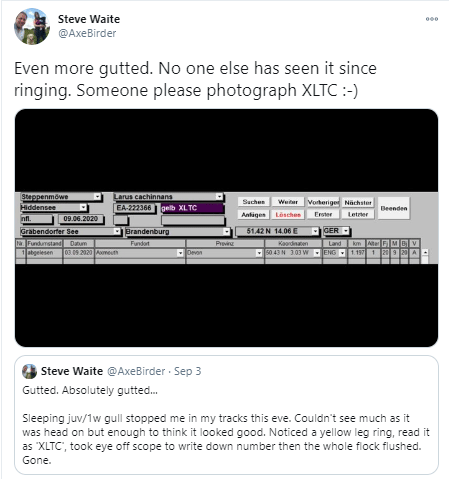
Take a look at THIS blog post from 8th Sept, which tells a tale from the 3rd when I locked onto a interesting looking yellow-colour ringed sleeping gull from the Tower Hide. I read it's ring, which was XLTC, but then the whole flock of gulls took off and that was it. Gone. And was made even worse when a search of the web showed it was ringed as a Caspian Gull, although this didn't mean it was a Casp because yellow-coloured ringed Casps can often be of mixed parentage (affectionally known as German-muck!). I emailed the ringer asking for any photos or to be informed of any re-sightings, and sent this tweet out in desperation. I wanted to know what XLTC actually looked like.
But it didn't work no one saw it, well, until me today! Almost two months later and it's back on the Axe, and shown itself to be a sublime Caspian Gull. Far from 'German-muck!'.
At 11:30 after a few wing stretches, it took off and flew south out to sea with two young Great Black-backs. Here's the moment it finally left, when I completely jammed this underwing shot...
Typical conditions and date for a decent 'grounding' of large Gulls on the Axe today, and I wasn't disappointed! I was so pleased to be off work today so I could get the most from it.
There's been plenty of water around so not so much has been on the river, with most action coming from the large gull flock resting in the field just south of Black Hole Marsh for most of the day. The highlight came just after 2pm when a first-winter Caspian Gull made itself know....albeit briefly!
It was such a crisp bird that despite it's briefness, and the fact I didn't even get the chance to point my camera at it, I am 'having it'. Potentially the first non-photographed Axe Casp ever (if it makes the DBRC grade that is!). It was asleep when my scope stopped on it, showing a contrasting white head, neck shawl, plain greater coverts and black tertials. I stayed on it until it finally popped its head out revealing just what I was hoping, a white head, long narrow dark bill, small eye. However, literally five seconds later it took flight and disappeared off to the north west at a hell of a speed. Am pleased to say in flight it looked just as I wanted it to as well, although sadly failed to see its underwing.
My Casp tally for the day was actually 1.5, as for the whole day a Caspian-hybrid has been present too. I saw it early this morning, early afternoon and again at last knockings. A long-winged and long-billed bird with a contrasty face and very striking tail pattern, but very Herring Gull-like coverts and scapulars. Here's a few pics...
Been a good showing of Yellow-legged Gulls today, with three in total all spending time in the gull flock south of Black Hole. A pristine adult, large second-winter and a first-winter. Take a look below for a dreadful and distant photo of the adult (two left of the Crow along the back row, compare mantle tone with the adult Herring Gull on the right)...
I haven't seen the Pink-footed Goose for a few days so think it may have finally left us. Here's my best shots of it from the 17th, although I last saw it on the 18th from a tram!
Had a couple of other decent 'work birds' lately too. The biggest surprise being on 13th when I glanced out of my office window, which is alongside the lower Estuary, to see a Great White Egret flop in and land along the Estuary right by the main road! It stayed just long enough for me to lift my phone up and take a snap, before flying off...
On 18th I had a single Cattle Egret from a tram, flying around over the track just south of Colyford Common hide. It's such a pain having to work right in the heart of the Axe Valley....
The last couple of days have shown incredible numbers of House Martins on the patch, presumably trapped on this side of the English Channel by the heavy rain. What a spectacle it has produced...
Yesterday hundreds were feeding along the sea front, with plenty more over town including a small flock feeding in my housing estate just before dusk. And when I woke up this morning, this is what greeted me...
As you can see they are almost all juveniles. Amazing to see such impressive numbers from my back garden, what an event to witness! I had to go to work shortly afterwards, but several hundred were feeding in the river valley for most of today.
Turns out this was part of a big influx/movement of House Martins along the south coast over the past couple of days. The numbers involved in total must be completely mind blowing, my twitter feed has been full of messages like this since yesterday...
Sadly today a few casualties have been picked up, suggesting finding food has been a problem for them during this recent rain. Am pleased to say there does seem to be far fewer around this evening, which hopefully means many have been able to carry on with their autumn migration today.
Today's strong north easterly wind coupled with intense rain brought a nice little influx of wildfowl to the Axe.
I can't ever recall seeing a double-figured flock of Pintail here, so when a single juv/female that flew up river past Tower Hide double-backed round to tag on to a flock of nine flying north, I was a bit surprised to say the least! The ten spent about five minutes flying around before appearing to drop down near Bridge Marsh. A look here about twenty minutes later revealed just one Pintail (with Clive later seeing nine which makes sense!) along with three imm Shoveler and about 100+ Teal.
I had another look around mid afternoon, when the sun decided to come out for a bit. 12 Dunlin and three Bar-tailed Godwits were on the Estuary, along with one of the Pintail and a surprise reappearance by the Pink-footed Goose. It was sat on the waters edge with a small gang of Canada Geese just north of Coronation Corner. Great to see it's still with us, and so pleased to see it in the day light!
What a great bird!
When we get these odd grey geese or winter swans on the Axe, outside of cold snaps, they usually do one of two things. They either move on rapidly (sometimes within minutes or by the next morning) or they join up with their local cousins (Canada Geese or Mute Swan) and basically turn into one of them. For example the Axe's only Greenland White-fronted Goose, although spending just one day here, went on to spend the whole of that winter in Devon with the roving Canada Goose flock. So seeing as though this bird has been with us for five days now, I'd say there's a good chance it will be staying in the area for a little while longer!