Pages

Showing posts with label vis mig. Show all posts

Saturday, 19 October 2019

Vis Mig Mini Watch

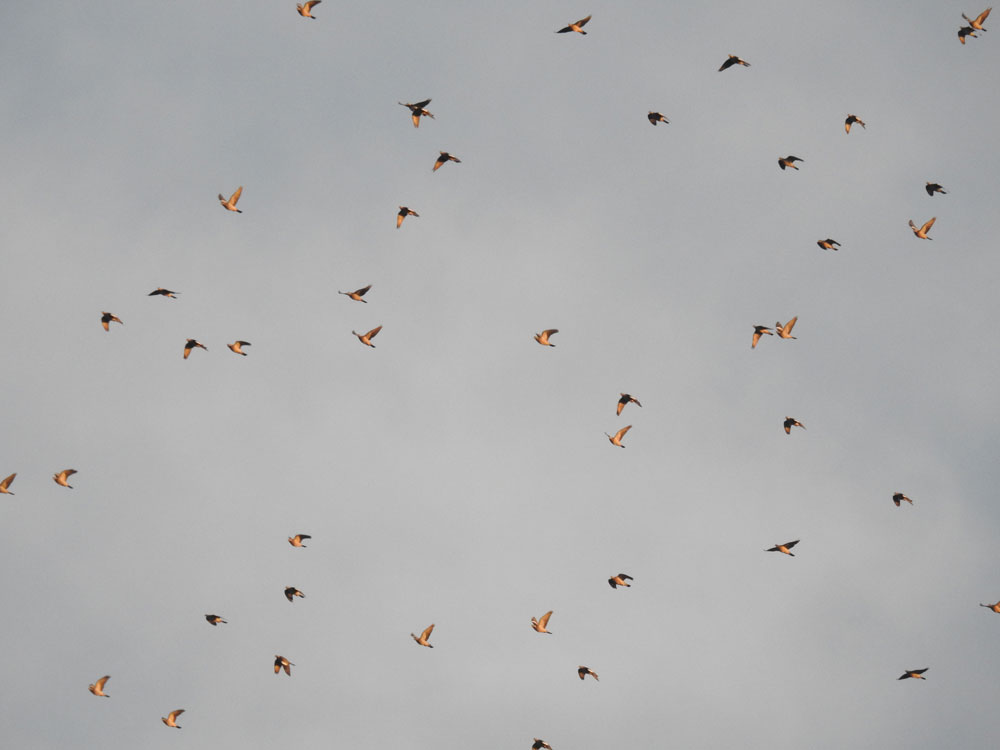
This morning was one of those mornings that I really could have done with all the time in the world! A lovely start to the day encouraged a flurry of westwards visible migration, which am sure given more coverage would have produced a scarcity or two.

All I was able to do was a 15 minute watch from Mum and Dad's front garden at the west end of Seaton from 08:20, and then a half-hour watch at 9am from my second favourite vis mig watch point on patch, Beer Stables.

Looking east over Seaton towards Axe Cliff from Beer Stables. The great thing about this site is you can see birds coming from miles off!

Watching over this 45 minute period gave me totals of;

3 Lapwing
1 Golden Plover
4 Stock Dove
390 Jackdaw (biggest single flock 220 birds)
2 Crow
7 Magpie (!!)
70 Starling
48 Skylark
85 Meadow Pipit
26 alba Wagtail (one flock of 14)
5 Grey Wagtail 
94 Chaffinch
18 Goldfinch
12 Linnet
1 Greenfinch
8 Siskin
5 Reed Bunting

I can't tell you how much I wished I was up Axe Cliff for the whole morning - although saying that many of the larger birds seemed to be passing inland of me at Beer, so would probably have been completely missed from the cliff edge. Actually what I really wish is that we had a proper vis mig pinch point here on the Axe patch, but we don't... or I've not found it yet anyway!  

Jackdaws

More Jackdaws!

Vis-migging Magpies!

Over the last few days I have been checking the usual haunts when I can, like the Estuary for example - especially considering how many large gulls we've had gracing us lately.  Sadly nothing in them worth writing about since my last Yellow-legged and the half Caspian-thing.

Seaton Hole was really birdie about a week ago, several Chiffs, Goldcrests and Blackcaps, with the same selection although in smaller numbers present there today. On Tuesday however when I went there it was oddly quiet, but I soon worked out why...

Sat out proud

Stunning male Sparrowhawk

...and again!

And for the last time I promise... just look at that eye!

Delightful to get such a prolonged, relaxed and close view of our second commonest raptor on patch. They maybe common, but views like this don't come by often. 

Wednesday, 19 September 2018

Autumn Moves On

Thought it was high time I wrote a few more words here. I am getting out now and then just not finding the time to blog about it.

I suppose the biggest news is we are well and truly in September....and don't we know it!  Meadow Pipits streaming over with fewer and fewer Tree Pipits, Yellow Wagtail vis mig replaced by Grey Wagtails and alba Wagtails, Chiffchaffs taking over from Willow Warblers as the most common phyllosc in the bushes. Autumn has well and truly moved on to the next phase, which I think of as the 'middle phase'...

Wheatear Axe Cliff - 14/8/18


The Estuary has seen a run of good birds this month, with four Spotted Redshanks together on the 1st being an amazing local sight. Osprey, Ruff, Turnstone, Wood Sandpiper have all been seen by others, with Cattle Egrets being frequently seen over the last couple of days, in fact Mark Dobinson had ten on Seaton Marshes this morning!

I was hoping to get a look at the sea this morning considering the rough weather, but only had time to muster a couple of quick scans of the gulls on the Estuary.  Proved worthwhile though as there were a couple of first-winter Yellow-legged Gulls in with them, one in the morning and one early afternoon. I didn't have a camera to hand for bird two but the first allowed some pics...

The bird on the left, nice pale headed individual

A flash of its tail


Hope to see some of the Cattle Egrets soon!  They may be getting commoner but I always enjoy seeing them.


Sunday, 26 August 2018

A Flavour of August

As can be guessed by my subdued social media and blogging presence of late, it's been a busy few weeks! August is one of my favourite birding months of the year, so with a window of opportunity to get out towards the end of the month, I took it...

The birders who've been getting out to Beer Head this month have been well rewarded, with good numbers of common migrants (including a few Pied Flies) and a bonus Wryneck found by Bun on Wednesday 22nd.  I knew Beer Head would be busy with birders on Saturday morning, and following a glimpse of some decent vis mig during a dog walk on the edge of Colyton on Friday morning (five Tree Pipits and six Yellow Wags flew west in a ten minute period), and the fact Saturday morning saw a cloud-less dawn, Axe Cliff lured me...

The view over Seaton from Axe Cliff


I was up here 06:00-08:15 and saw; 

44 Yellow Wagtail (all west, including two groups of ten)
7 Tree Pipit (all singles, west)
1 Wheatear
1 Redstart (a cracking male)
3 Whitethroat
5 Willow Warbler

So not loads of birds by a long way, but it filled me with so much joy. The joy of autumn birding.

After this I headed down to Black Hole Marsh, another venue that has done well this month, although unlike Beer Head hasn't offered any real patch scarcities. The second Spotted Redshank of the month (with a third found today!) had been found the day before, and showed well around the Island Hide whilst I was there. Exceptionally well...


As you can see it's a juvenile - and an incredibly fresh one at that! I don't think I've ever seen one so young, rewind just a few weeks and it was probably stumbling around a damp Arctic taiga landscape peeping at its mother for food!  Beautiful. Absolutely beautiful.

Also on view were a couple of juvenile Little Ringed Plovers, c25 Dunlin, a Green Sand and a Greenshank.

Won't keep you waiting as long for the next blog post I promise!

Saturday, 28 October 2017

When Wood Pigeons Become Cool

I'm going to kick this blog post off with a video. Make sure you turn the volume up so you can hear their wing beats...


Yesterday proved a major Wood Pigeon day for us, with James Mc seeing somewhere between 30 and 50 thousand pass through (I really must buy him a notebook!) though sadly I only managed to witness about twenty minutes of this. But today, with clear skies forecasted for the first few hours of the day, I wasn't going to miss round two. James joined me for an Axe Cliff vis mig watch 08:00 - 10:00.

There were fewer Wood Pigeons today (for us anyway) with probably about 15,000 seen flying west. Still, many of them passed really low over our heads, or just in front of us below the cliff edge. As the morning went on flocks started passing higher both out to sea and inland, so we probably missed thousands!  I tried to capture their magic on camera but it's never the same...


Although this would have proved enough excitement, there was plenty more to be seen this morning.  After three busy nights of thrush passage, it was good to finally see more about in daylight hours. There were almost constantly ones and twos of Blackbirds, Song Thrush and Redwing taking off or dropping in, along with my first three Fieldfare of the year west. Pity the four Ring Ouzel James saw here yesterday weren't still about, or some more, but hey ho.

I stupidly forgot my notebook this morning, so the higher counts are more like guesstimates, but this is roughly what would have gone into my notebook (west unless stated); 

3 Lapwing 
7 Golden Plover (a five and two singles)
15,000 Wood Pigeon
50 Stock Dove (probably a gross undercount!)
6 Rook
200 Jackdaw 
140 Starling 
70 Skylark (most of these were inland of us so we probably missed more than we saw)
70 Blackbird (total includes both settled and migrating birds)
40 Song Thrush (total includes both settled and migrating birds)
45 Redwing (flying in all directions!)
3 Fieldfare
10 alba Wagtail
50 Meadow Pipit
70 Chaffinch
3 Brambling (all singles)
80 Linnet
15 Siskin
1 Redpoll 
6 Bullfinch
25 Reed Bunting


With all these passing migrants the predators were having a field day. Two Peregrines were almost constantly having a go at the Pigeon flocks, plus we saw three different Sparrowhawk...


Sadly the fields at Axe Cliff are a shadow of their former self. Since they've been ploughed, flattened and replanted this year with winter crops, they're proving completely unattractive to ground feeding birds. In past years today would have also shown hundreds of larks, pipits and finches feeding in the fields, adding another exciting element to birding here, but today absolutely nothing. I really can't believe Yellowhammers are hanging on, but they are...


After Axe Cliff I had a 15 minute look over the valley. A Great White Egret had flown west past Abbotsbury earlier in the morning, and by my reckoning was due to drop in on the Axe any minute. Sadly though, having now missed five here this year (Bob Longhorn found another on Black Hole Marsh yesterday, which stayed 45 minutes), this bird decided to completely bypass us and flew up the Exe instead. Typical! The other bird I was hopeful for was Glossy Ibis, as yesterday saw something of an influx of these into the UK. Despite checking all the visible ditches and scrapes, no luck. Guess what Sue Murphy found on Colyford Marsh late this afternoon though, yes, our first Glossy Ibis of 2017. I had the right idea - just picked the wrong time!

A few days ago it was nice to see a Cattle Egret still with us. Or was, I haven't seen it since! It was feeding with a few Little Egrets near the cattle on Bridge Marsh on Wednesday...


Am really looking forward to some more vis migging, hopefully there's a few more sessions left in this autumn. The question is though will a Hawfinch reward my efforts?  Only time will tell...

Saturday, 7 October 2017

Axe Cliff Vis Migging and Harvest Moon

This blog post is a day late, but wow yesterday morning was so so enjoyable. Under beautiful blue skies and in the cool early morning autumn air it was exhilarating watching an impressive westward passage of passerines over Axe Cliff.

The view from my favourite vis migging watch point on patch


I usually count absolutely everything I see whilst vis migging, with a notebook in my pocket and clickers hanging off anything and everything they can. But yesterday morning due to the lack of wind, birds were flying past on countless different lines, which basically made counting impossible.  Although most the finches were passing just off the cliff edge, there were flocks of bird passing a quarter of a mile out to sea, and even more up to half an mile inland! There really were thousands of birds though, it was an epic watch with the most numerous species (in order) being; Meadow Pipit, Linnet, Chaffinch, alba Wagtail, Goldfinch, Skylark and Greenfinch. The species I counted included; 25 Siskin, 21 Reed Bunting, 6 Starling, 2 Grey Wagtail, 2 Dunnock and a Great Spotted Woodpecker.

The Great Spotted Woodpecker should really read ex Great Spotted Woodpecker, sad but it did give me one of my vis migging life highlights. I heard a swoosh, and out of no where an adult Peregrine powered into a Great Spotted Woodpecker (that I hadn't seen previously) right in front of my face! The noise of the Peregrine stoop was incredible, but then came the thud, followed by a squawk from the Woodpecker and then a explosion of black and white feathers that slowly floated to the ground.  Amazing. Sadly though both lost out. The Peregrine dropped its prey deep into the undergrowth and could not retrieve, and the Woodpecker would not have survived.

Although overhead was super busy, the fields at Axe Cliff were unusually quiet with a couple of Stonechat and a couple of briefly grounded Reed Buntings the best.

Stonechat


There was a bit more movement down the cliff edge though, with a trickle of Goldcrests and the odd Chiffchaff making their way west through the vegetation. Sadly no Yellow-browed Warblers.

A quick look over the valley afterwards produced a lovely juvenile Marsh Harrier over Colyford Marsh that circled up and rapidly flew off north.  Today, although  I haven't been out, a Cattle Egret and an adult Yellow-legged Gull have been seen from the Tower Hide, along with a report of a Bittern. Gripping.

In a rapid change of topic, I'm sure you all are aware by now that Thursday night of last week gave us a spectacular display of the Harvest Moon. I took a few photos at around 11pm, and as I missed the moon rise, took one of the 'moon set' at Axe Cliff in the morning. All photos with the ever impressive Nikon P900...


What I found even more impressive came the following night, with an almost full moon lighting up a sky full of clouds. Amazingly the following photo was taken from my back door at 10:30pm...


Saturday, 8 July 2017

Early Vis Mig

Taking a baby out early in the morning does have it's benefits. This was 04:45 today...

Looking north up the Axe Estuary from Axmouth Harbour


Today saw the first steady passage of Swifts and Sand Martins through the patch of the autumn, with 34 and 19 respectively flying west offshore in a 40 minute period from 6am.  I saw more Sand Martins passing through off Beer Head late morning so I do think it was a sustained movement.  Also whilst at the sea front this morning five Med Gulls flew west (3 ad, 2 juvs) among a sporadic passage of Black-headed Gulls. If I stayed longer no doubt I would have matched Dawlish Warren's total of twenty by 8am.

I saw a further three Meds on the Estuary mid afternoon, two adults and the lingering dull first-summer (which is often the southern most gull on the Estuary).  Gutted to have missed our first juv Yellow-legged Gull of the year that Ian Mc saw a bit later in the day, but no doubt I'll see many over the next few months.

Black Hole Marsh at 5am was lovely and peaceful, with quite a few waders on the diminishing water levels.  Still nothing surprising here as yet this autumn, just the routine fare, but it is still very early days. Among an increase in numbers of Common Sands were three Green Sands (all adults). An adult Little Ringed Plover was probably the bird Ian Mc had yesterday, but also looked suspiciously like the first of the autumn here back on 1st July. Otherwise there were 22 Redshank, two Blackwits and an adult Water Rail.  

Three Green and a Common Sand

Two of the Green Sands


Having missed out on finding our last three rare waders (Least Sand - Tim Wright, Baird's Sand - Phil Abbott, Semi-P Sand Peter/Phil Abbott) I think it's high time I found another decent wading bird this year (and I don't count Pecs, I have seen more of them on patch than Cuckoos!).  Hopefully the early morning baby walks will do the trick eventually...


Wednesday, 26 October 2016

Fog It

The weather has not been too kind to us so far this week. Monday was a complete wash out, Tuesday we were fogged out for most of the day, and even today there was still a layer of fog in the valley at dawn - although at least this morning the higher ground was clear...

The river valley from Beer Head


There has been a few scarcities about though. The Canada Goose flock on Colyford Marsh continues to host a Barnacle Goose, and since Monday a first-winter Dark-bellied Brent Goose too. Have seen up to 14 Dunlin on the river, with three Grey Plover still, a Knot and yesterday Dad had an Avocet on Black Hole Marsh. Gull numbers are low but with the Black-heads I've seen two Med Gulls recently (an ad and a first-winter). Also yesterday, I came across my first patch Black Redstart of the autumn, a nice first-winter male at Axmouth Yacht Club.

The trees and bushes are certainly harboring more Goldcrests than the last few weeks, but Chiffchaffs have suddenly become harder to find. It looks like they've all grouped together at the traditional sites (Lower Bruckland Ponds, Seaton Marshes) and are less evenly distributed.  There was quite an amazing sight yesterday as up to 3000 Starling were feeding on flying insects in the river valley - I spent ages checking through them but it wasn't easy! Quite a spectacle though.

This morning Beer Head did feel quite good, it was definitely the best morning so far this autumn for Chaffinch passage, but with the light winds they were flying in all directions and many were really high so they were pretty much uncountable.  Not many other finches were going over though, and a Mistle Thrush, a Reed Bunting and two Lapwing were the only oddities. The bushes seemed overall quiet but there were clearly more Song Thrushes, Blackbirds and Robins about.

Weather looks good for the next few mornings, so let's see if I can uncover something nice like a Bluetail.  If I don't it won't be through lack of trying...

Tuesday, 6 October 2015

The Birds

It's time to review what the birding has been like on the Axe over the last month or so, and what I've seen...

I'll start back when I first became laptop-less, in late August.  The Baird's Sand proved a one day wonder on Black Hole Marsh, but the Wood Sands lingered.  Although big numbers were only present for a couple of days, there were between five and 14 for the next few weeks - still amazing numbers when talking about Wood Sands!  What proved as amazing as the numbers were the views they were offering...


Personally I think there's not many places better for seeing wading birds up close in the UK than Black Hole Marsh.  Just look at that Wood Sand in the photo above, it couldn't be closer to the Island Hide!

We had quite a few juv Little Stints over the course of August/September, never more than two at a time, but we probably had about seven or so over the course of the autumn.  Curlew Sands though have proved scarce this autumn, and all we managed were a couple of juveniles on 24th Aug...

A front view and a back view! Both are Curlew Sands I promise

Otherwise we had good numbers of Ruff (up to double figures) and the odd single Knot, Turnstone, etc...

Knot

Black Hole Marsh really came good on 30th/31st Aug. Late on 30th a patch first and Devon mega appeared in front of Tim Wright, a Citrine Wagtail! (the grim details and a photo here).  Sadly after barely a minute it flew off and was never seen again. Gutting.  The following morning birders searching for the rare waggy turned up a cracking Spotted Crake and a Wryneck - on fire!!!  I didn't see any of the three rarities, but so happy for the chaps that did and very pleased for the patch. A Bittern was seen on Colyford Marsh by many on 8th Sept, but since then Black Hole and Colyford Marsh have remained rarity-free zones. 

Over on the Estuary  it's been fairly quiet.  The small wader flock from Black Hole Marsh could often be seen here at low tide, and good numbers of gulls on 21st Sept included 180+ Great Black-backed Gulls and a lovely first-winter Yellow-legged Gull.  I saw my first Wigeon of the autumn on 24th Aug (it was actually on the sea), but from mid Sept numbers have been building, there are probably about 80-100 present now.  A nice surprise this morning were two Pintail on Colyford Marsh scrape, my first ones this year. Unusually a Razorbill has been present for a good few weeks on the Estuary, often on the river as far north as the Tower Hide. Bit of an odd sight.

Back to the sea, and an evening walk along Branscombe Beach with Jess and Honey on 29th Aug showed there were large numbers of Gannets offshore (despite no wind at all), and thousands of whitebait washed up on the beach.  

I was interviewed by BBC Radio Devon about this, not quite the 'freak phenomenon' they were hoping for though!

Because of this, the next morning I spent a few hours at Spot On Kiosk, and was rewarded with lots and lots of birds. Most of these were feeding gulls and Gannets, but I did see c35 Manxies and at least six Balearic Shearwaters, a couple of which were lingering and feeding offshore.  A Greenshank in-off was a bonus too, and vis mig over the beach included three species of wagtail for the first time this autumn (Pied, Grey and Yellow).

A bird ringing update will be in another post (once I have IMPR up and running again), but I have spent a fair bit of time at Beer Head, and have had some good mornings there without really seeing anything that special. You don't always need rare birds to have a good day.

The 1st Sept was a pretty good morning up there, in two hours I logged 25 Yellow Wags, one Grey Wag, two Tree Pipit, eight Wheatear, two Redstart, three Spot Flies and a late Swift.

The best day for me though was 17th Sept. Up to the day before I'd seen just a handful of migrant Meadow Pipits, but it was bursting with them!  I left the head 3.5 hours after arriving, and had counted at least 750 Mipits, some flying straight through, but most landing among the long grass in large flocks briefly before continuing on west.  It felt so so good for a rare pipit, but sadly it never happened.  The bushes were just as busy as the fields, with good numbers of Chiffchaffs and Blackcaps, what will probably prove to be my last Willow Warbler and Redstart of the year and a single Spot Fly.

A beautifully well marked juv Spotted Flycatcher

More recently, the 30th Sept was a windy morning, but hirundines were streaming through in their thousands at Beer Head, all going east. In with them plenty of Meadow Pipits, a few finches and on the land a Wheatear and a Spot Fly.

The best day for vis mig variety was even more recently, on 3rd Oct. I was up there ringing and it was fairly foggy, but birds were piling through north.  Several large flocks of Linnets, Goldfinches and Siskins, almost continual Chaffinches and Meadow Pipits, numerous Pied and Grey Wags, the biggest movement of Skylark of the autumn so far (35+), a couple of Redpolls, singles of Reed Bunting and Yellowhammer, and best of all at least two Crossbill. If only the bushes were as busy!  I did see a Firecrest, but sadly didn't catch it...

The only notable birds I've seen since the 3rd were this morning's Pintail that I've already mentioned, and a Firecrest in the middle of Colyton during a dog walk on Sunday morning.

It feels good to be up to date, so from now on as I see I will post, yes regular blog posts will resume.  And I look forward to compiling the bird ringing post too, that will probably come early next week.

Sunday, 20 September 2015

Siskins

I figured I needed to put something bird related up here before I lose all my readers! It's going to have to be brief though I'm afraid...

For me one of the most stand out features of this autumns migration (so far) has been Siskins...

Male Siskin

This really has been an exceptional autumn for migrating Siskins. I noted the first 'vis mig' Siskins in late August, which is early, and ever since numbers have been on the up. I am not exaggerating when I say every time I've gone outside in the last couple of weeks - whether it's been birding, dog walking, going to work - I have heard Siskin.  Even had some over Watford and Egham last Saturday when Jess and I spent the day further east than usual.  I've not actually seen all that many as they have mostly been passing over high, but numbers like this so early in the season may be a good sign for the remainder of the autumn. Hopefully other irruptive Scandinavian species won't be far behind them...

Tuesday, 18 November 2014

Winter Woes

I've been walking the dog around Axmouth harbour pretty much daily for the last three weeks, hoping for maybe a storm-driven Grey Phal, or Little Auk, the patches first Spotted Sand (yes I think big - although we are somewhat over due one!), Snow Buntings or even just a Black Red. Well none of the scarcities/rarities in that list ever materialised, and it took until Sunday just gone for a Black Red to finally appear...


The following day there were two here, along with a late Wheatear on Seaton Beach.  Although no Spotted Sandpiper, it seems as though one of it's commoner cousins is going to over winter with us...


Am so glad to say that thrush numbers have increased.  Last Thursday and Friday I saw several flocks of Redwings around the patch, including a group whizzing about the estate I live in.  And I saw my first Fieldfare of the winter on Friday, with small numbers in Colyford (less than ten).

Have to say though, it has been a very poor autumn for many species of birds, especially finches.  It has to be the worst autumn for year for Siskins, I've had less than ten on vis mig this whole autumn, but in previous autumns I often see over a 100 in a morning. I've not had any true 'vis mig' Redpolls (just one in a woodland where they might breed) and I have still not seen/heard a Brambling.  Even Chaffinch numbers were way way down this autumn - and no Crossbills either.  I reckon there's still stacks of food in Scandinavia, and if something drastic doesn't happen weather wise, I think it's going to be a quiet winter down here in the south west.

Tuesday, 4 November 2014

Pigeon Passage

This morning it finally felt like autumn!  I stepped out the back door just after 6am and was greeted by a distinct chill and a beautifully crystal clear starry sky. A little later, just after the sun rose over Beer Head, it looked and felt equally as autumnal....


I knew the bushes were going to be quiet, but I was hoping for some good vis mig. Well, Pigeons certainly didn't disappoint.  Whilst here, and birding at other sites later in the morning, I had just over 8,000 Wood Pigeons fly west.  Some of the flocks were obviously spooked by something, and came tumbling down from high and continued flying west only just above head height.  Love hearing the 'woosh' followed by the sound of their powerful wing beats...


There were quite a few Stock Doves mixed in, and the odd flock of Jackdaw too.  It's a real shame cloud and rain came in just after 9:30, as it could have been a really big day for them. 

Forgetting the Pigeons, the vis mig was disappointing, with not that many smaller birds moving - although this could have been because they were passing ultra high due to the clear skies and light winds.  I suppose the highlight was a high flying very vocal Bullfinch going west - don't tend to see that many of these on vis mig. Otherwise it was just relatively small numbers of Skylarks, Linnets, Chaffinches, Reed Buntings, alba Wagtails and Meadow Pipits.

I did have a good 'vis mig' bird on Sunday, during a dog walk with Jess.  Whilst walking along Harbour Road in Seaton (the road just inland and running parallel with the sea front), the gulls went up and for a change I could immediately see why - a Kite!  Sadly it was just a Red Kite, but still great to see as winter records remain pretty scarce in Devon.  It flew almost directly above us as it followed the road east, then when it got to the Estuary began to spiral up before I lost it as it circled over Axe Cliff.  My rapid right hand meant the texts got out whilst I was still watching it, and amazingly Bun managed to see it from Seaton Hole!

I'll finish this post with a couple of off-patch photos.  We took the dog to Stover CP last Saturday, and I was pleased to see a pair of Mandarins in one of the arms of the main lake...