Pages

Showing posts with label thrushes. Show all posts

Saturday, 2 February 2019

Unreal Cold Weather Movement - 1st February

Winter can be a bit of a long, slow and sometimes dull season for the patch birder, this winter especially so on the Axe. There's not been much other than the usual fare so far, and numbers in general have been pretty poor.  But like any patch birder, whispers of snow in the forecast early last week raised my excitement levels, and Thursday night delivered a fine but widespread covering of the white-stuff...

Looking west over the valley


Major snow events often deliver some impressive bird movements on/over the Axe, but I really wasn't expecting much when I woke up on Friday morning.  It was only a fine covering of snow, it wasn't country-wide and I knew it wasn't going to be in any way a prolonged spell of cold. 

I spent the first hour of the day looking out from the house and garden, and what I saw seemed to confirm my thoughts; a couple of small groups of Lapwing, one Golden Plover and a flock of 15 Redwing flew over.  I then had a look around the Estuary, and other than a group of about 40 Fieldfare on Bridge Marsh - nothing else was where it isn't usually...


But then I went to the seafront....  and saw the most mind-blowing bird movement I have ever witnessed in my entire life. Just take a look at these two short videos. Make them full screen and turn the sound up...


Thousands upon thousands of thrushes!

I wish I could have just stayed there all day, but the only way I could quantify this movement in any way was by counting 'Portland-style' (a selection of 'sample counts').  Between 10:00 and 15:00 I carried out one 15 minute count, one ten minute count, two five minute counts and three two minute counts.  The last one at 15:00 showed that the passage had slowed a bit, but all previous counts gave an absolutely astonishing figure of between 400-500 thrushes passing PER MINUTE! Huge flocks were passing over, almost constantly - gaps often of only 20-30 seconds between flocks.  This statistic is staggering on its own, but when it's multiplied up it becomes really mind destroying.... Even if we take the lowest figure, 400, this suggests that somewhere in the region of 120,000 thrushes flew over Seaton on 1st February! As staggering as this number is, I am certain it's  an under estimation, especially as they were clearly passing in these numbers prior to 10am, and I've included nothing that may have passed after 15:00.  

Looking at the species break down, Redwings were by far the most abundant species, with an estimation of 80% of the all thrushes seen/heard being this species. This would make the Redwing day total somewhere in the region of 96,000! Unreal.  I did hear the occasional Song Thrush call emitting from the chaos and Fieldfare made up the remaining 20%.

James Mc at Lyme was also seeing this passage, as was Dan over at Sidmouth and Kev in Beer.  What I can't believe though is that was it.  No reports of this massive movement west of Sidmouth, in fact Dawlish Warren reported virtually no thrush movement at all! And the only reports east of us were from Portland where up to 10.000 Redwing were seen to leave north west over Ferrybridge (http://www.portlandbirdobs.com/2019/02/1st-february.html).  What on earth is that about!? Where did they all come from and where did they all go!?

Skylark were also moving in good numbers (I noted a couple of hundred, so 1000+ probably passed during the day), with a calling Woodlark over Seafield Garden at 10:45 being a nice highlight. Kev had a second one over Beer an hour or so later.  I also logged a couple of small flocks of Lapwing and the odd Linnet, Chaffinch and Siskin, but in general variety was poor and it was all about thrushes and Skylarks

As I'm typing this my mind is still blown to be honest.  Feels almost a bit like space, involving numbers that only people like Brian Cox can truly comprehend.  Just so so so many birds. 

About mid afternoon I had another look around the valley, and by now ground was starting to thaw and birds were congregating in these spots.  The slope just to the east of the Estuary was like a rolling carpet of Redwing, 500+ birds here (at the same time as the passage was still  happening over the seafront by the way!).  Bridge Marsh also showed lots of thrushes along with a flock of 60+ Skylark.  Then just up the road, the field north of Colyford WTW was again full of thrushes, a flock of Skylark, 300+ Lapwing and c60 Golden Plover.  Here's a few pics...

Redwings
One of the above Redwing!
Fieldfare
Skylarks
A Skylark
Meadow Pipit
Golden Plover with a Lapwing background


Best of all about this amazing influx of birds was that none of them looked to be struggling in any obvious way.  Everything I saw on the ground appeared to be finding plenty of food, and all the birds passing overhead were flying strongly and with purpose - not something weak birds can do.  It was really nice to witness a cold weather movement without feeling that sadness usually associated with snowy spells. I am really surprised this relatively small amount of snow caused such a drastic response from the birds - we had far less snow than last Feb/March but way more overhead passage.  Do they know something that we don't? 

And now to today...

The weather this morning (2nd) was completely different.  Still pretty cold, but crystal clear blue skies and most of the snow had melted away.  There were still lots of birds about, with thrushes flying around everywhere, but they were flying in all directions.  It was nice to catch up with two waders on the Estuary that Phil saw the previous day, a Bar-tailed Godwit and this Avocet...

Avocet and Black-headed Gull
Got to love an Avocet in flight!


There were also 47 Dunlin here which isn't a bad mid-winter count for us.  And that's it for this somewhat mammoth blog post.  Truly unforgettable stuff though.

Tuesday, 6 November 2018

Late Little Stint

I jumped into action the other day, when Phil made a surprise discovery of an apparent Little Stint on Black Hole Marsh. He didn't have his telescope or camera with him, so considering the late date (31st Oct) I just had to check it out.....

Phil's impressions were dead right, it was a Little Stint.  The only one we've had this year so it was well worth the effort, although aiming my camera at it probably wasn't as the light was dreadful...

Little Stint


A lone Lesser Redpoll flew over Black Hole during my short visit there, and as well as the stint, on Black Hole there was a male Shoveler and a Greenshank.

This evening I dashed out after work to try and catch up with a tern sp. that was seen on the Estuary mid afternoon.  It was virtually dark when I made it over there so wasn't surprised to miss it, although there was just enough light left to see a redhead Goosander fly down river at about 5pm.

Earlier today it was great to see numerous Redwings and Song Thrushes bombing around my housing estate at dawn, easily the best arrival of thrushes so far this autumn - but hardly surprising given the numbers calling overhead during the previous night. 

Good news on the Cetti's Warbler front.  The snow of last winter knocked out all our local Cetti's Warblers, well singing males at least, there may have been one or two females still hanging on.  In the past it's taken years to get numbers of this species back on the Axe after cold weather wipe-outs, but within the last two weeks alone I've noted two at Lower Bruckland Ponds and two around Black Hole Marsh, then yesterday morning the Axe Estuary Ringing Group ringed four around Stafford Marsh (see HERE). Excellent news indeed.

A Cetti's Warbler struggling in the snow and ice - taken on 2nd March this year

Sunday, 18 March 2018

More Snow!

Like many other places in the south west today, it's been snowing here in Seaton from dawn until dusk. One snow event in a year is exceptional enough for us, two is unprecedented! 

The view from my bedroom window late this afternoon


The heavy snow didn't start until about mid morning, and it was amazing to see how quickly the birds reacted to this. Just proves they really do need to be able to feed constantly, and as soon as they realise they can't, sitting it out just isn't an option. They have to move.

I could do nothing more than have sporadic looks outside today, but these have shown incredible numbers of Fieldfare and Redwing flying west, thousands upon thousands, along with several hundred Starling and Golden Plover and smaller numbers of Skylark, Meadow Pipit, Pied Wagtail, Chaffinch plus a single Reed Bunting.  All seen from the centre of town. Incredible scenes.

The passage did seem to dry up mid afternoon, and unlike the last snow event, apart from a few Meadow Pipits there doesn't seem to be many birds struggling for food in gardens. Not a single Redwing in the road I live in late this afternoon, compared to about 500 two weeks ago! So although as things stand, this cold weather period doesn't look to be as severe on birds as the last, the timing is probably a bit worse.

Some local birds will have started nesting now, especially Blackbirds. Disaster for all these early breeders. And then there's the early arriving migrants, small numbers of Wheatears, Sand Martins and Chiffchaffs have already arrived in the UK after a long migration - and they now have to face this. There have been several reports of struggling Chiffchaffs today in particular, and late this afternoon I was deeply saddened to find this in the corner of a carpark in town...

Dead Chiffchaff
Sorry mate, you didn't quite make it


This beautiful Chiffchaff probably spent the last week or so traveling hundreds and hundreds of miles as it migrated back towards it's breeding grounds somewhere in the UK. All the obstacles it would have had to overcome, all the energy it would have used up. And all for this. Lying dead in the snow in Seaton. So so sad.

Saturday, 25 November 2017

Hawfinch Hotspot and Patch Update

Having not seen any more Hawfinch on patch since my Colyton duo earlier in the month, I've been keen to get to Shute where James Mc found 3+ birds in the Churchyard a couple of weeks ago. Shute is only a couple of miles outside the Axe patch, which makes the fact we've not had any more here even more frustrating!

I spent a couple of hours wandering around the lanes of Shute on Thursday morning and heard/saw 10-15 birds, including groups of five and four.  I didn't have any in the Churchyard at all, and my god they could be elusive little blighters - it's a good job they were so vocal!   Most views were similar to this...


But this more distant bird perched up nicely for a few minutes...


There's plenty of Yew, Hornbeam and Field Maple around Shute and most birds seemed quite mobile, but I've highlighted on the map below where I saw most of mine. They are still being seen around the Church as well so don't walk past here without checking the Yews carefully.  I can't stress enough how useful it is to know the various different Hawfinch calls before visiting, particularly the 'seep' call. It's an unobtrusive and subtle sound, but distinctive once learned - they're still not particularity easy to pin down though even when they are calling!


Back to the patch, and I'll quickly summarise my patch highlights over the past week or so...

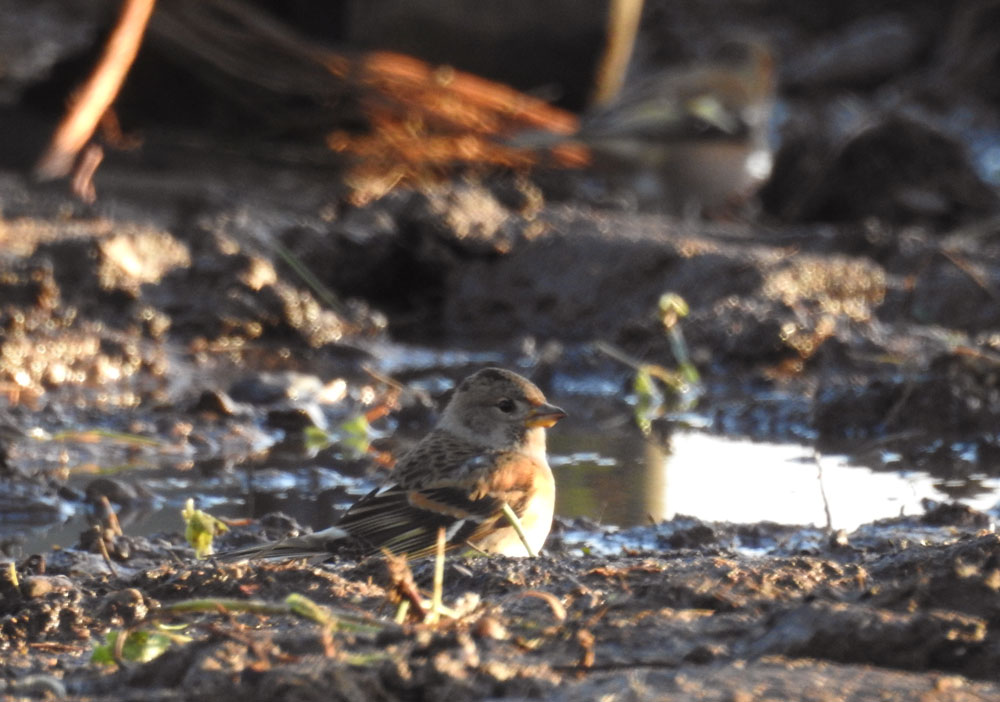
I had two Brambling with a large flock of Chaffinch at Stafford Cross back on 14th Nov, and a return visit on Thursday morning showed there were at least five now present...

Female Brambling
Male Brambling


I saw another Brambling yesterday, along Clay Lane in Colyton. This afternoon, a Facebook message from a visitor from London, Mark Knivett, reporting two Black Redstarts feeding along the cliff edge on the West Walk, reminded me of this lovely first-winter male Black Red I had along Trevelyan Road on 16th Nov...


It's proving to be an absolutely stonking autumn/early winter for thrushes around here. So SO many Redwing about, in other years we often don't get good numbers of grounded winter thrushes until after Christmas...

Redwing


And I think that's it from me for today, so I shall bid you all a good night...

Seaton Beach looking towards Beer Head on the evening of 17th Nov.


Wednesday, 8 November 2017

Thrushes, Yellow-legged Gulls and more Vis Mig

Monday didn't give that me much time out, but I did grab an hours wander along the footpath running through Allhallows (a large ex-private school in Rousdon) with Hawfinch in mind.  Looks really good for them here, but none during my visit. It was nice to see heaps of thrushes though, including ten Mistle Thrush and plenty of settled Fieldfare and Redwing...

Fieldfare


Tuesday was a completely different day. Rain, wind and more rain. This meant the Estuary gulls got my attention, and at 2pm the 300 Great Black-backed Gulls and 45+ Lesser Black-backed Gulls (including some cracking intermedius) were accompanied by two Yellow-legged Gulls, a second-winter and an adult...

Second-winter Yellow-legged Gull (middle bird)
Adult Yellow-legged Gull (on right, with a Great Black-backed)
Both Yellow-legged Gulls, the adult looks small here but it wasn't


As you can see the adult was very clean headed, and a somewhat cute-looking bird, two features that meant my initial thought was Caspian Gull when I spotted it. Sadly this didn't go beyond an initial thought as it soon became apparent it was a Yellow-legged. Oh what I would do for an adult Casp here...

This morning the sun was out again, so Axe Cliff was the obvious place to go. Richard P joined me and we spent an hour or so on the cliff-edge before the westerly passage dried up. Amazed there were no Pigeons, maybe they've all gone through now? What vis mig there was included;

1 Grey Heron
1 Mistle Thrush 
20 Skylark
3 alba Wagtail
60 Meadow Pipit
139 Chaffinch
1 Redpoll
10 Linnet
1 Greenfinch
2 Bulfinch
1 Reed Bunting

A vis mig Grey Heron!
Incoming Grey Heron with Seaton Hole as a backdrop

Sunday, 5 November 2017

Hawfinches

Aren't birds amazing. We've only ever had Hawfinch wintering on patch once, that was during the first few months of 2006. Now guess where I found two (eagerly anticipated) Hawfinches today - exactly the same tree that I saw my first patch Hawfinch back in 2006!

Hawfinch records are few and far between around the Axe. As well as the wintering birds mentioned above (two until late Feb '06, increasing to three and then five before they departed in mid March) there's been four other patch records before today. Two of these were of single birds seen for one day a piece in a private garden in another part of Colyton, with the other two thankfully being in front of my eyes. In 2010 early in the morning of 27th October I watched two Hawfinch fly north up the river valley from the gateway north of Axmouth, and then on 3rd November a single bird flew west during a vis mig watch at Beer Stables. 

With the current invasion I had a feeling the best chance of a settled one here was probably where the Colyton birds wintered, there's plenty of field maple in this area which is one of their favoured food sources. This morning was my third time of trying Burnards Field Road within the past two weeks, and it was third time lucky as on arrival two hefty finches were sat on top of a... well the bare tree. Success! First patch Hawfinches since Nov 2010. I fired off a couple of record shots...


I'm glad I got these pics because soon after both birds dived down into trees behind and disappeared (just like the 2006 birds often did!).  I sent a text out but a couple of minutes later there was suddenly an explosion of Hawfinch calls (that lovely soft seep) and they both flew up out of the trees and off low to the south east. Such a shame they flew so soon, but it's always a treat to see this species in flight. Annoyingly I don't think they've been seen again, but would not bet against them or others coming back here.

These cherry stone-crackers were a great finale to a good couple of hours out this morning, when I spent my time whizzing round the patch at breakneck speed checking as many spots as possible. Redwings were far more evident today with small numbers everywhere, the most being at Lower Bruckland Ponds where 12 Fieldfare were also present, along with eight Chiffchaffs in the willows around the top pond. A Lesser Redpoll was feeding with a small flock of Chaffinch on the Borrow Pit, and I was surprised to see the Bridge Marsh Cattle Egret had been joined by a friend, now two present...


So a lovely morning was had. And it wasn't a bad sunrise either...


Saturday, 28 October 2017

When Wood Pigeons Become Cool

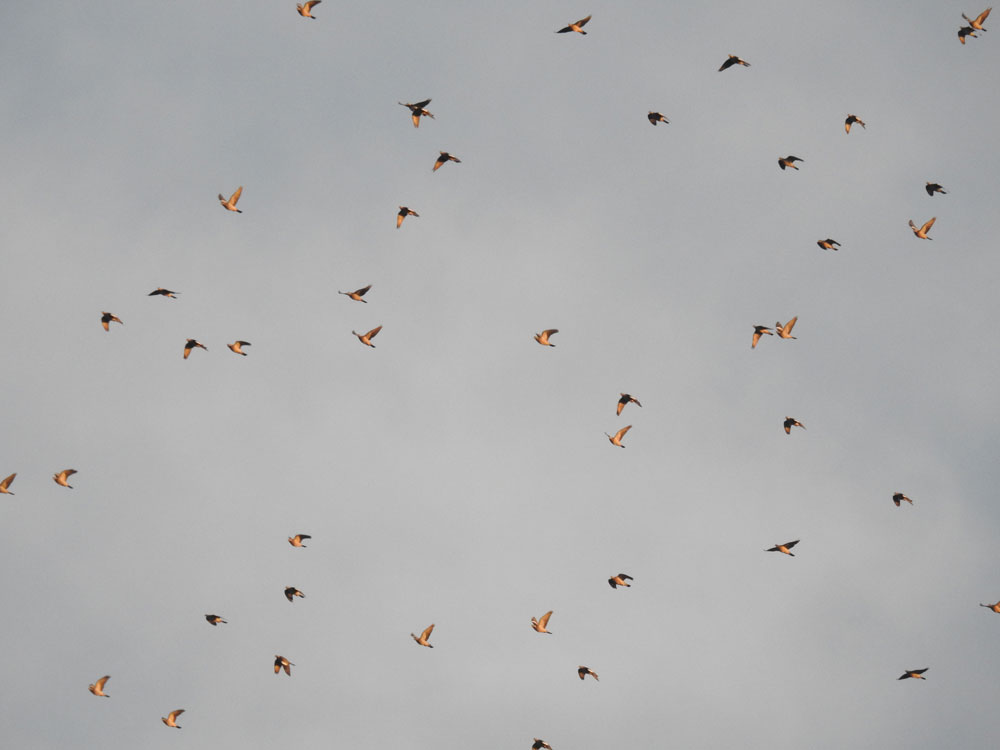
I'm going to kick this blog post off with a video. Make sure you turn the volume up so you can hear their wing beats...


Yesterday proved a major Wood Pigeon day for us, with James Mc seeing somewhere between 30 and 50 thousand pass through (I really must buy him a notebook!) though sadly I only managed to witness about twenty minutes of this. But today, with clear skies forecasted for the first few hours of the day, I wasn't going to miss round two. James joined me for an Axe Cliff vis mig watch 08:00 - 10:00.

There were fewer Wood Pigeons today (for us anyway) with probably about 15,000 seen flying west. Still, many of them passed really low over our heads, or just in front of us below the cliff edge. As the morning went on flocks started passing higher both out to sea and inland, so we probably missed thousands!  I tried to capture their magic on camera but it's never the same...


Although this would have proved enough excitement, there was plenty more to be seen this morning.  After three busy nights of thrush passage, it was good to finally see more about in daylight hours. There were almost constantly ones and twos of Blackbirds, Song Thrush and Redwing taking off or dropping in, along with my first three Fieldfare of the year west. Pity the four Ring Ouzel James saw here yesterday weren't still about, or some more, but hey ho.

I stupidly forgot my notebook this morning, so the higher counts are more like guesstimates, but this is roughly what would have gone into my notebook (west unless stated); 

3 Lapwing 
7 Golden Plover (a five and two singles)
15,000 Wood Pigeon
50 Stock Dove (probably a gross undercount!)
6 Rook
200 Jackdaw 
140 Starling 
70 Skylark (most of these were inland of us so we probably missed more than we saw)
70 Blackbird (total includes both settled and migrating birds)
40 Song Thrush (total includes both settled and migrating birds)
45 Redwing (flying in all directions!)
3 Fieldfare
10 alba Wagtail
50 Meadow Pipit
70 Chaffinch
3 Brambling (all singles)
80 Linnet
15 Siskin
1 Redpoll 
6 Bullfinch
25 Reed Bunting


With all these passing migrants the predators were having a field day. Two Peregrines were almost constantly having a go at the Pigeon flocks, plus we saw three different Sparrowhawk...


Sadly the fields at Axe Cliff are a shadow of their former self. Since they've been ploughed, flattened and replanted this year with winter crops, they're proving completely unattractive to ground feeding birds. In past years today would have also shown hundreds of larks, pipits and finches feeding in the fields, adding another exciting element to birding here, but today absolutely nothing. I really can't believe Yellowhammers are hanging on, but they are...


After Axe Cliff I had a 15 minute look over the valley. A Great White Egret had flown west past Abbotsbury earlier in the morning, and by my reckoning was due to drop in on the Axe any minute. Sadly though, having now missed five here this year (Bob Longhorn found another on Black Hole Marsh yesterday, which stayed 45 minutes), this bird decided to completely bypass us and flew up the Exe instead. Typical! The other bird I was hopeful for was Glossy Ibis, as yesterday saw something of an influx of these into the UK. Despite checking all the visible ditches and scrapes, no luck. Guess what Sue Murphy found on Colyford Marsh late this afternoon though, yes, our first Glossy Ibis of 2017. I had the right idea - just picked the wrong time!

A few days ago it was nice to see a Cattle Egret still with us. Or was, I haven't seen it since! It was feeding with a few Little Egrets near the cattle on Bridge Marsh on Wednesday...


Am really looking forward to some more vis migging, hopefully there's a few more sessions left in this autumn. The question is though will a Hawfinch reward my efforts?  Only time will tell...

Thursday, 19 November 2015

Not About Gulls!

Despite my best efforts I haven't seen any more interesting gulls on the Estuary, so I can assure all that this blog post is a gull-free zone...

It's been rather wet and windy this week, and last week, well for the whole of November to be honest! I've not been able to do any bird ringing because of this, but I have still had a dog to walk (and gulls to check!).

This is proving to be one of my best ever autumns on patch for winter thrushes (despite the mild weather!). Every time I go out I'm seeing Redwings, and more often than not Fieldfares too (saw 45+ two days ago) and I don't just mean fly overs which is the usual way we see them in the autumn. In most other years I don't see many winter thrushes settled around here until Christmas time, so it really is notable. And whilst on the subject of thrushes, I should mention here the house tick I had on 12th with four Mistle Thrush from my kitchen window.

Black Redstarts keep popping up in front of me too.  After seeing a male and two female-types at Axmouth Yacht Club on 4th Nov, I had three female-types here on 11th (with none in between, so all three could have been new birds?). Away from here I had a female-type in the main car park in Beer on 9th, and about two hours ago was treated to my third ever from my house, another female-type just a few roofs down.

Female-type Black Redstart at Axe Yacht Club on 11th.

The Glossy Ibis is still about, we went down to just one bird several weeks ago, and it's currently spending most its time on the first lagoon on the right through the first gate at Seaton Marshes 

Something that for me has been lacking this month, and this autumn, is Wood Pigeons.  I missed the biggest morning of passage, but have seen some flocks flying west. They've not had the ideal weather window to move en masse though, instead they've been trickling through in less than perfect conditions. Oh what I would do for a cold, still and sunny morning!

Wood Pigeons migrating over Axmouth Harbour.