Pages

Saturday, 28 October 2017

When Wood Pigeons Become Cool

I'm going to kick this blog post off with a video. Make sure you turn the volume up so you can hear their wing beats...


Yesterday proved a major Wood Pigeon day for us, with James Mc seeing somewhere between 30 and 50 thousand pass through (I really must buy him a notebook!) though sadly I only managed to witness about twenty minutes of this. But today, with clear skies forecasted for the first few hours of the day, I wasn't going to miss round two. James joined me for an Axe Cliff vis mig watch 08:00 - 10:00.

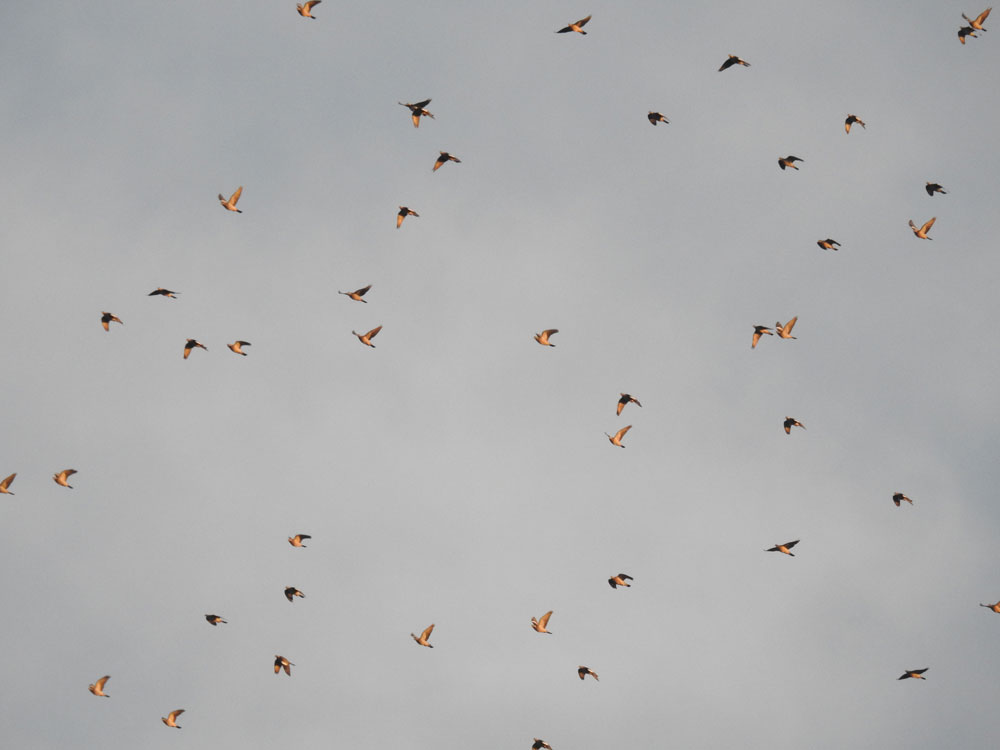
There were fewer Wood Pigeons today (for us anyway) with probably about 15,000 seen flying west. Still, many of them passed really low over our heads, or just in front of us below the cliff edge. As the morning went on flocks started passing higher both out to sea and inland, so we probably missed thousands!  I tried to capture their magic on camera but it's never the same...


Although this would have proved enough excitement, there was plenty more to be seen this morning.  After three busy nights of thrush passage, it was good to finally see more about in daylight hours. There were almost constantly ones and twos of Blackbirds, Song Thrush and Redwing taking off or dropping in, along with my first three Fieldfare of the year west. Pity the four Ring Ouzel James saw here yesterday weren't still about, or some more, but hey ho.

I stupidly forgot my notebook this morning, so the higher counts are more like guesstimates, but this is roughly what would have gone into my notebook (west unless stated); 

3 Lapwing 
7 Golden Plover (a five and two singles)
15,000 Wood Pigeon
50 Stock Dove (probably a gross undercount!)
6 Rook
200 Jackdaw 
140 Starling 
70 Skylark (most of these were inland of us so we probably missed more than we saw)
70 Blackbird (total includes both settled and migrating birds)
40 Song Thrush (total includes both settled and migrating birds)
45 Redwing (flying in all directions!)
3 Fieldfare
10 alba Wagtail
50 Meadow Pipit
70 Chaffinch
3 Brambling (all singles)
80 Linnet
15 Siskin
1 Redpoll 
6 Bullfinch
25 Reed Bunting


With all these passing migrants the predators were having a field day. Two Peregrines were almost constantly having a go at the Pigeon flocks, plus we saw three different Sparrowhawk...


Sadly the fields at Axe Cliff are a shadow of their former self. Since they've been ploughed, flattened and replanted this year with winter crops, they're proving completely unattractive to ground feeding birds. In past years today would have also shown hundreds of larks, pipits and finches feeding in the fields, adding another exciting element to birding here, but today absolutely nothing. I really can't believe Yellowhammers are hanging on, but they are...


After Axe Cliff I had a 15 minute look over the valley. A Great White Egret had flown west past Abbotsbury earlier in the morning, and by my reckoning was due to drop in on the Axe any minute. Sadly though, having now missed five here this year (Bob Longhorn found another on Black Hole Marsh yesterday, which stayed 45 minutes), this bird decided to completely bypass us and flew up the Exe instead. Typical! The other bird I was hopeful for was Glossy Ibis, as yesterday saw something of an influx of these into the UK. Despite checking all the visible ditches and scrapes, no luck. Guess what Sue Murphy found on Colyford Marsh late this afternoon though, yes, our first Glossy Ibis of 2017. I had the right idea - just picked the wrong time!

A few days ago it was nice to see a Cattle Egret still with us. Or was, I haven't seen it since! It was feeding with a few Little Egrets near the cattle on Bridge Marsh on Wednesday...


Am really looking forward to some more vis migging, hopefully there's a few more sessions left in this autumn. The question is though will a Hawfinch reward my efforts?  Only time will tell...

Saturday, 21 October 2017

More Stormy Weather

Cracking weather here last night and today, big seas, strong south west wind and plenty of passing showers.  I gave the sea as much time as I could, but sadly no Leach's Petrels came past when I was looking. There were plenty of Gannets out there this morning moving west, along with a lone Shearwater sp. (looked Balearic but mega distant) a few Kittiwake and Auk sp. and one Common Scoter

A nice bonus was a Sanderling that flew around with three Ringed Plover for a short while before pitching down briefly on the beach...


I've also spent time today checking the gulls on the Estuary, there were excellent numbers of Great Black-backed Gulls but nothing better in with them. I suppose the highlight was this first-winter presumed intermedius Lesser Black-backed Gull. Although the photo is pretty bad (taken in strong sunlight) it does shows how fresh this bird looked. It basically looked like it had only just come out of the nest, by now a first-winter graellsii should be far more worn than this...


Thursday, 19 October 2017

That's More Like It!

Well Ophelia has come and gone, but in birding terms delivered nothing. She didn't bring any American land birds or waders, and didn't even drag up that many sea birds on her journey - bit or an ornithological flop really. But since then things have picked up...

The last week has seen an exceptional arrival of Firecrest across south Devon and Dorset, well some parts of south Devon and Dorset! Portland recorded an unprecedented 150+ on Sunday, with probably just as many around Prawle/Start/Soar. But other places (Dawlish Warren, Exmouth, here) recorded none on the very same day!  Pleasingly they have started trickling through here now, I had my first at Spring Head, Axmouth on Monday afternoon, with another on Tuesday up by Axe Cliff Golf Course car park. Dad had six at Beer Head also on Tuesday, and Bun another in Beer village. Such smart birds.

A quick look along the beach to see what Ophelia had left us revealed just six Ringed Plover, a Little Stint (presumably the lingering bird) and a whole load more Man o' War.

Looking east along Seaton Beach on Tuesday morning


Wednesday gave us a nice double, although sadly one of which I missed.  Our Reserves Officer James Chubb saw a Great White Egret on Colyford Common (which had previously been at Abbotsbury Swannery), but it soon took flight and headed off south west. So proving to be as brief a visitor as the other two recorded here this year. Drat.  What followed cheered me up though...

Yellow-browed Warblers have proved much scarcer this autumn than recent years, presumably solely because we've not had the easterly winds of the previous few autumns. So, stepping out my front door early afternoon, I was really surprised to hear one call from trees just up the road - my third from the garden! I didn't have great views of it, but Tim White clearly did an hour or so later as he managed THIS fab picture of it - always such smart birds and always great to see/hear.

The drizzle and completely still conditions of last night saw (well heard!) an excellent nocturnal passage of Redwing and Song Thrush overhead, which gave me high hopes for this morning.  But those hopes have not really been lived up too (as usual!), although it did feel really good out there. There was one lovely highlight though...

As I drove over the lower Axe bridge into Seaton, I was amazed to see a flock of six Avocet fly across in front of the car! A really mega-sized flock by Axe standards.  I watched them fly upriver, they then circled around a bit before seeming to drop down on Black Hole Marsh. So I went around for another gander...


And that brings me and this blog up to date! So good to feel proper autumn excitement - we are a go...


Saturday, 14 October 2017

Man o' War

With no urgent bird news to write about, all I've got to report is incredible numbers of Portuguese man o' war washed up on Seaton Beach. I wouldn't be surprised if a walk along the whole length of the beach revealed a three figure count today, with one or two every ten or so feet...


Stunning looking things! Pity to see such big numbers involved though.

In the bird world autumn has clearly moved on. Goldcrests seem to be everywhere now, and I saw my second Redpoll of the autumn this afternoon.  The Estuary has offered me nothing better in recent days than singles of Little Stint and Bar-tailed Godwit, a couple of Med Gulls and seven Ringed Plover.  I wonder if this so-called hurricane will blow anything more interesting in...
 

Monday, 9 October 2017

Cattle Egret

An early morning walk down to Seaton Marshes would have proved quiet were it not for the recent Cattle Egret. It was showing well from the hide with the cattle on the reserve itself, although the cattle didn't seem to like it very much and often charged it away!


Saturday, 7 October 2017

Axe Cliff Vis Migging and Harvest Moon

This blog post is a day late, but wow yesterday morning was so so enjoyable. Under beautiful blue skies and in the cool early morning autumn air it was exhilarating watching an impressive westward passage of passerines over Axe Cliff.

The view from my favourite vis migging watch point on patch


I usually count absolutely everything I see whilst vis migging, with a notebook in my pocket and clickers hanging off anything and everything they can. But yesterday morning due to the lack of wind, birds were flying past on countless different lines, which basically made counting impossible.  Although most the finches were passing just off the cliff edge, there were flocks of bird passing a quarter of a mile out to sea, and even more up to half an mile inland! There really were thousands of birds though, it was an epic watch with the most numerous species (in order) being; Meadow Pipit, Linnet, Chaffinch, alba Wagtail, Goldfinch, Skylark and Greenfinch. The species I counted included; 25 Siskin, 21 Reed Bunting, 6 Starling, 2 Grey Wagtail, 2 Dunnock and a Great Spotted Woodpecker.

The Great Spotted Woodpecker should really read ex Great Spotted Woodpecker, sad but it did give me one of my vis migging life highlights. I heard a swoosh, and out of no where an adult Peregrine powered into a Great Spotted Woodpecker (that I hadn't seen previously) right in front of my face! The noise of the Peregrine stoop was incredible, but then came the thud, followed by a squawk from the Woodpecker and then a explosion of black and white feathers that slowly floated to the ground.  Amazing. Sadly though both lost out. The Peregrine dropped its prey deep into the undergrowth and could not retrieve, and the Woodpecker would not have survived.

Although overhead was super busy, the fields at Axe Cliff were unusually quiet with a couple of Stonechat and a couple of briefly grounded Reed Buntings the best.

Stonechat


There was a bit more movement down the cliff edge though, with a trickle of Goldcrests and the odd Chiffchaff making their way west through the vegetation. Sadly no Yellow-browed Warblers.

A quick look over the valley afterwards produced a lovely juvenile Marsh Harrier over Colyford Marsh that circled up and rapidly flew off north.  Today, although  I haven't been out, a Cattle Egret and an adult Yellow-legged Gull have been seen from the Tower Hide, along with a report of a Bittern. Gripping.

In a rapid change of topic, I'm sure you all are aware by now that Thursday night of last week gave us a spectacular display of the Harvest Moon. I took a few photos at around 11pm, and as I missed the moon rise, took one of the 'moon set' at Axe Cliff in the morning. All photos with the ever impressive Nikon P900...


What I found even more impressive came the following night, with an almost full moon lighting up a sky full of clouds. Amazingly the following photo was taken from my back door at 10:30pm...


Thursday, 28 September 2017

Ruff Influx and Spoonbill

Today is the first day this week that I've managed any time out birding on patch. And that's with the whole week off work!  I managed two looks along the Estuary at mid tide (early morning and mid afternoon) and an early afternoon visit to Black Hole Marsh.  It was quite a fruitful day really with my totals being; 

42 Wigeon
50+ Teal
1 Spoonbill
7 Ringed Plover
2 Dunlin
1 Curlew Sandpiper
1 Little Stint
19 Ruff
1 Bar-tailed Godwit
2 Green Sandpiper
5 Common Sandpiper
1 Spotted Redshank
3 Greenshank

There's two stand outs on that list, Spoonbill and the exceptional Ruff count.  The Spoonbill was completely jammy as I saw it with my naked eye from the kitchen window flying south west away from Black Hole Marsh. Doubt soon crept in with such a brief and distant naked eye only view, but sure enough when I went down to Black Hole an hour later... "there was a Spoonbill here about an hour ago, didn't stay long though and flew off towards the Estuary". Presumably this was also the bird that dropped in briefly at Abbotsbury today.

As for the Ruff. Wow. Just wow. I had at least ten early morning on Black Hole Marsh, Dad had 14 mid morning and when I went down there early afternoon there was an incredible 19 on view. All were juveniles, and they were mostly hanging out in two flocks of seven with the rest loosely dotted around.  Not sure if this is a record count for the patch, I highly doubt it as 'back in the day' am sure Phil saw loads together at times, but my previous highest single count here is of 17. Can't remember the date off hand but it was in the winter during a very cold snap with lots of snow and ice around.

Six of the 19 Ruff on Black Hole Marsh this afternoon


The Spotted Redshank was the lingering juvenile on Colyford Scrape, and the Curlew Sandpiper (juv), Ringed Plovers and my highest count so far this autumn of Wigeon were all along the Estuary this morning.

In other news, it's that time of year when I need to edit my mini-bio to the right of this page, and increase my age by one. Though to be honest life is going by so quick it feels like I'm changing this at least three times a year!  At the age of 32, well, I can't even begin to explain just how happy and content I am with life, it would take pages and pages of text. But the source of it all is simple...

My world

Saturday, 23 September 2017

More Grey Phalarope

Although the Grey Phalarope remains on Black Hole Marsh, I've only managed another five minutes with it. That was on Thursday afternoon just as the sun came out...


What a great bird! It's no surprise that it is proving so popular with photographers as it is showing so so well.

Also reported today a new juv Little Stint, and I've seen lots of lovely pictures on Twitter of three juvenile Ruff feeding together on Colyford Common, two males and a female.

Thursday, 21 September 2017

Grey Phalarope

Considering it has very much been a Grey Phalarope autumn on the south coast of the UK this year (with for example eight together at Abbotsbury Swannery last week!) one was always on the cards here, but it's taken longer than I expected.

I was absolutely delighted the first-winter Grey Phalarope Phil found on Black Hole Marsh last night stayed for me to enjoy early this morning. As you can see it showed exceptionally well in the dull and sometimes wet conditions right by the entrance to the Island Hide...


This was when it was at its furthest...

Showing well!

First-winter Grey Phalarope with Dunlin


If the weather brightens up a bit and the bird stays around, there's going to be some proper nice pics of it. What a stunner.

I was amazed to learn this was a patch life tick for Tim Wright, but thinking about it they have been really scarce here in recent years. These are my last three records of Grey Phalarope for the patch (click on the date to take you to the corresponding blog post);

9/11/10 - one in flight off the sea front before flying high upriver. Subsequent searching for it resulted in the discovery of our first and only patch Long-billed Dowitcher!
5/10/10 - one on Black Hole Marsh all afternoon and evening.
5/10/08 - one on Colyford Marsh scrape all day (third record of Grey Phal that year).

I'm pretty sure Ian Mc has seen one during a sea watch since my last 2010 individual, but it's certainly been a while since one in the valley!

Tuesday, 19 September 2017

Patch Update

This won't take long. Well it can't to be honest as I've got to go....

Our first Little Stint of the autumn appeared mid morning today on Black Hole Marsh, found by Clive (it wasn't there at 9am!). Also present two Ruff (a second juvenile joined the lingering bird yesterday morning - present at first on Colyford Marsh but now both are on Black Hole), the juvenile Curlew Sandpiper (for its fourth day) along with small numbers of Greenshank, Green and Common Sandpipers, 26 Dunlin and seven Ringed Plover.  The Spotted Redshank wasn't on Colyford Scrape this morning, but this is where it has been most days.

Here's some (poor) pics of the star birds...

Juvenile Little Stint - it remained distant but no doubting this one!

Dreadful pic of the juv Curlew Sandpiper

Ruff number one

Ruff number two - with a Snipe in the early morning sun on Colyford Marsh. Why wasn't it a Buff-breast!?

Juvenile Spotted Redshank


And that's that.  I'll leave you with the view from Colyford Common hide early yesterday, the sun rising over the Axe Valley on a lovely mid September morning...


Sunday, 17 September 2017

Black-tailed Godwits

As promised a few posts back...

There are three sub species of Black-tailed Godwit Limosa limosa in the world. L. l. melanuroides, which breeds in eastern Russia, Siberia, China and Mongolia, has never been recorded in the UK so we can forget about that one, leaving us with these two...

The Icelandic Black-tailed Godwit (L. l. islandica) breeds mostly in Iceland, but also the Faeroe Islands along with a few pairs in Scotland. The majority winter in the UK, Ireland, France and Holland.

The small number of Continental or European Black-tailed Godwit (L. l. limosa) that breed in the UK (East Anglia) are at the western limit of their breeding range, with most breeding in western and central Europe to central Asia and west Russia. They winter around the Mediterranean and as far south as the west coast of North Africa, mostly Senegal.

So to summarise the above information, it would seem that islandica is an abundant winter visitor to the UK, whereas limosa is a very rare breeding bird and probably a fairly scarce passage migrant. And this is what the case seems to be on the Axe Estuary, through my observations and the on going Black-tailed Godwit colour-ringing project undertaken by the Axe Estuary Ringing Group. In fact I can't say I've ever seen/noticed a limosa here before.

Separating the two sub species is far from easy though, especially in winter plumage when on plumage they are identical.  Spring birds in breeding plumage are do-able, as are fresh autumn juveniles, and this is why I have been paying extra attention to our Black-tailed Godwit flocks this autumn as they've contained a high proportion of juvenile birds. Everything I've seen though has  looked fine for islandica, well until last Saturday morning...

A small flock (c12 birds) of juvenile islandicas have been feeding on Colyford Common at high tide over the past couple of weeks, but last Saturday morning (9th Sept) one bird really stood out and stood up! Bingo, surely my first limosa...

Juvenile/first-winter L. l. limosa on the left and juvenile  L. l. islandica on the right


The structural differences are pretty striking in the above photo. Longer necked, bigger headed, longer billed with a broader bill base and longer legged (noticeably the tibia).

Sadly the L. l. limosa at the back is out of focus in this shot


Check out the bill size difference!

L. l. limosa at the front


The above photo shows the neck difference nicely. All the islandica in the flock lacked any sort of neck bulge when they held their heads tight to their body, whereas the limosa always showed a noticeable bulge along the lower edge of the neck. Presumably this is simply down to the fact it's a larger bird with a longer neck?

L. l. limosa at the front


Looking at the actual plumage of the bird, I'm not sure how useful this is as there was so much variation in moult and wear within all the Godwits in this group. But I'm sure it's not a coincidence this was the palest and blandest bird in the flock, lacking any orange tones to the head, neck or mantle - just a buff wash. This fits well with the literature for the limosa as they are far less colourful as juveniles than the often almost bright orange islandica. Just a pity it wasn't a month earlier though when they'd all be in much fresher plumage.

It's also worth mentioning that when the flock took to the air, the size difference was just as notable in flight. It was always easy to see which one the limosa was even if you couldn't see any plumage features.

Because all I've got for sub species specific identification of this bird is structural differences, and no real plumage traits, I reckon that means I can do no more with it that write this blog post. This limosa Black-tailed Godwit would (on paper) be the first record of this sub species for Devon, and for me to submit this as a county first I would need all the boxes ticked, not just a few. Annoying yes, but when it comes to bird ID I am strict. Oh well, at least I've got a blog post out of it!

If you're after your own limosa it's very important to remember that overall size and bill length varies between sexes (and maybe age?) in Godwits like most other wading birds, so be aware that islandica will show a variety of bill lengths and body sizes. As with many things, a direct comparison makes it so much easier so it's best to study Godwit flocks, lone birds will always be tricky unless they show a particularly striking plumage.

And here's some useful links on the subject:

Birding Frontiers
http://birdingfrontiers.com/2011/07/15/more-on-continental-black-tailed-godwits/

Northumberland & Tyneside Bird Club
http://www.ntbc.org.uk/wp-content/uploads/2013/06/Black-tailed-Godwits.pdf

Handbook of the birds of the world
http://www.hbw.com/species/black-tailed-godwit-limosa-limosa

Thursday, 14 September 2017

More Least Sandpiper and Update

Following on from my last post, thanks to Richard Phillips (@cork_head) some more photos of the Axe Least Sandpiper from 7/9/17 have materialised. These were also taken when the bird was on Colyford Scrape, so the distance and light means the quality is again dodgy, but what some of these pics show well is the general colour of the bird (quite fawny brown), along with pale legs...

(c) Richard Phillips


Thanks Richard! The second one in particular  I think will prove very useful and help with the BBRC submission.

Now time for a brief summary of the bits and bobs I've seen on patch lately, with my second and the Axe's third Osprey of the autumn yesterday afternoon - thanks to texts from Ian Mc and James Chubb.   Phil had our second Osprey of the autumn fly straight down the Estuary and out to sea last Sunday, the day after our first Osprey left us. Also on Sunday Phil found a juvenile Spotted Redshank (amazingly our first since Nov 2013!) which remained until Tuesday at least when it was feeding on Colyford Scrape during the afternoon.  A lone juvenile  Bar-tailed Godwit has been kicking around as well for a few days now, often feeding at the bottom end of the Estuary as they usually do here...

Bar-tailed Godwit


Despite all the recent wind and rain the sea has been really disappointing. I am amazed we haven't even managed a Grey Phalarope, let alone a Leach's Petrel or Sabine's Gull. Very disappointing.  The only slightly notable thing that I've seen whilst looking over the waves was a very early Great Northern Diver that flew west on the morning of Saturday 9th. I even managed a picture, just...

Really impressed with the P900 on this one, it was miles out! Love the feet on flying GNDs


Black Hole Marsh is looking good again now, with wading birds staying on the marsh feeding even at low tide. There's still plenty of time for goodies, and with an amazing trio of American waders just along the coast at Weymouth/Portland, we have to be in with a chance of some more...