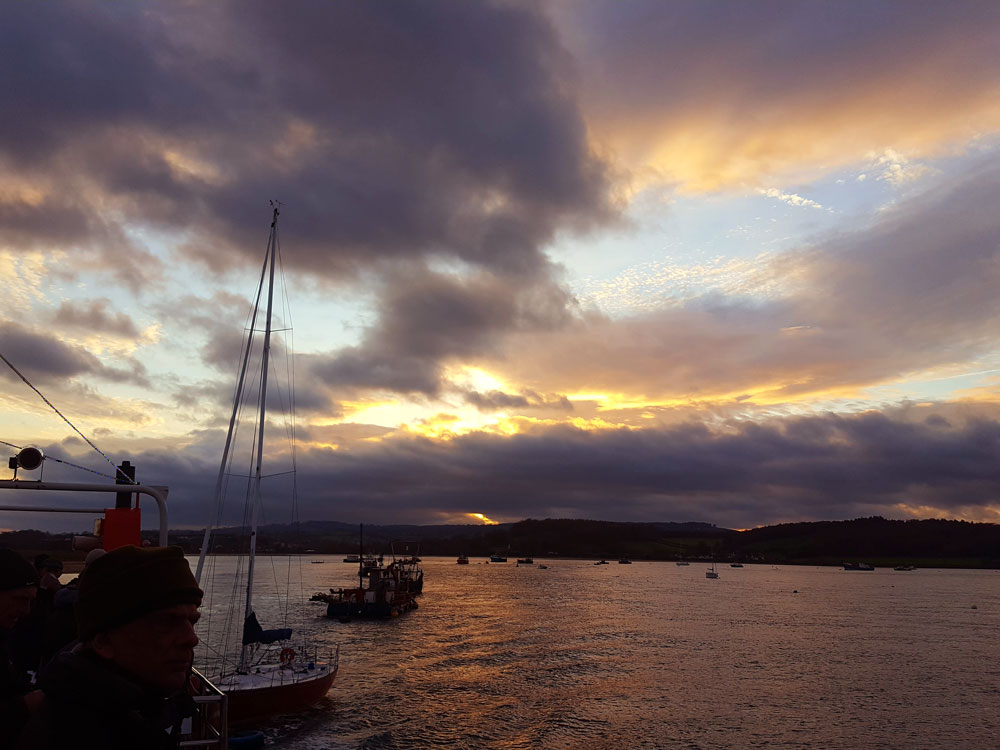
Spring 2020 will go down as my worst in history for seawatching in Seaton Bay.
You'd have thought being in the midst of a global pandemic, and a forced lockdown limiting all outdoor activity, would be the main contributing factor right? Wrong. It's all about the weather - and it's been completely pants for seawatching all spring with way too much north wind and nowhere near enough cloud or rain. Just look at sites like Portland that have had daily coverage all spring and how many Pomarine Skuas they've reported, very few. Look at all the skua species in fact, there's not even been a good Arctic or Bonxie day. So ironically lockdown probably didn't make a blind bit of difference to the seawatching story here this spring, there was nothing to miss.
Yesterday offered one final (half) chance for some spring sea action. Although it wasn't overly windy it was from a south westerly direction, backed up with a decent coverage of cloud just not enough of the wet stuff. I set my alarm for 5am and watched 05:25 - 08:25 from the Spot On Kiosk. I was joined by Phil for a chunk of it- at a distance greater than 2 meters of course I only really wanted him there to open up the Kiosk but he didn't get the hints!
Anyway, back to the seawatch and although there were no skuas, at times it was actually quite busy even if it were just the commoner species. In the three hours I was there I noted (west unless stated);
Great Northern Diver 1 at 08:15 Diver sp. 1e Gannet 155w, 13e Manx Shearwater 2 Auk sp. 68w, 3e (c70/30 Razorbill/Guillemot) Common Scoter 28w, 25e Black-headed Gull 3 Common Gull 2 Kittiwake 11 Sanderling 2 (flew in and landed on beach) Swift 3
Highlight of the watch for me, two Sanderling on the beach
Love how they just melt into the pebbles! Nice to get a pale one and a red one.
The biggest single flock of Common Scoter recorded - 19 west
Although not taken yesterday, this Great Northern Diver flew close past the seafront during a beach wander in late April...
I know it doesn't look close but for us it was - full breeding plumage too!
Fingers crossed I can get my skua fix in the autumn...
The beautiful blue sky this morning tempted me over to Branscombe, so I could catch up with the Firecrest that's been wintering around the Water Treatment Works. It took about three seconds to find, and I enjoyed it for the best part of half an hour, showing exceptionally well at times...
After about twenty minutes, suddenly there were two male Firecrests in front of me! They had a brief stand off and chase around, then split up, with the second bird feeding around the entrance gate to the WTW. Often ON the entrance gate in fact...
Also around the WTW, 10+ Goldcrest, two Chiffchaff and this Treecreeper (never an easy species to photograph)...
No visit to Branscombe is complete without a sea scan. There were quite a few auks out there this morning, along with a lone Great Northern Diver, three Red-throated Divers and rather unusually, five Teal.
A couple of visits to some woodland near Colyton over the past week has shown Woodcock on both occasions, four and three. I also had at least three Crossbill here the other day, which is more than notable. Nice to see and hear male Siskin song-flighting too.
And lastly, yesterday as I was driving along the A3052 between Seaton and Beer, a flock of 18-20 Golden Plover flew past going the opposite way. They seemed to land near Stafford Cross where Ian Mc had 15 today. Heaps of Lapwing around there too.
On Saturday just gone, I was thrilled to join my Dad on a Stuart Line Cruise up the Exe Estuary, which set off from Exmouth at 1pm. Dad has led some of these winter trips for many years now, and I always like to try and get on at least one a winter.
With no telescopes on the Stuart Line Cruise, it's a great place to test out binoculars and get a true feel of their capabilities and limits. So no better place than this to try out the Nikon EDG's that were sent to me to try out earlier in the week...
The light remained nice and flat throughout the three hour cruise, there was no wind and plenty of birds - a fantastic trip!
On the lower part of the Estuary, hundreds and hundreds of Brent Geese proved a spectacle, along with good numbers of Shag, and in the deeper water here two Great Northern and a surprise Red-throated Diver (rare in the river), the resident Slavonian Grebe, only a few Red-breasted Mergansers (still lots of these to arrive) and a very distant Long-tailed Duck, which was way way off to the east north of Mudbanks.
Red-throated Diver
Slavonian Grebe with a typical Exe back drop
The ultra distant Long-tailed Duck, only identifiable thanks to the amazing zoom on the P900!
As we travelled up the Estuary towards Topsham, the usual change in species occurred with Avocet, Dunlin, Curlew and Black-tailed Godwit becoming the most numerous species. A flock of c230 GoldenPlover roosting on the mud were nice to see, along with good numbers of Lapwing among the usual smaller numbers of Grey Plover, Greenshank, Bar-tailed Godwit, Knot and a lovely little flock of 30 Sanderling. There were also impressive numbers of wildfowl present, mostly around the Clyst area with thousands of Wigeon and probably well over a hundred Pintail. Three Kingfishers pleased the punters on the boat, as always.
It was nice to see three Common Seal on the trip, including a small youngster. Two allowed their photographs to be taken...
And what about the binoculars? Well I was really impressed. Superb image quality and light levels, which I have come to expect with Nikon products now. They were a really comfortable pair of binoculars too with a thick neck strap, and for me they're the perfect size allowing a good solid grip to keep them steady, an important attribute in optics when boat birding. They allowed me to pick out all three divers on the trip, and I doubt I would have spotted the Long-tailed Duck at all had I been using other optics. It honestly was a dot, but through the EDG's it did at least look like a Long-tailed Duck-shaped dot! It's these small differences that can sometimes make all the difference when birding.
First of all, thanks to everyone who's made kind comments about the article I've written for the November edition of Birdwatch magazine. I was thrilled to be given the opportunity to pen a three page article all about birding the Axe Estuary and Seaton Wetlands during the winter months. I was even more delighted in the fact the Axe had been given so much magazine space! If you want to read it, when you're next in a Newsagents look for this front cover...
It's worth paying the price for the Sibe Blue Robin story and photos alone!
I've just got a few odd sightings to report from the last few days on patch, not that I've done much birding...
Last Thursday I had several sightings and 'soundings' of a Brambling bombing around where I live. Never saw it perched, but it was clearly perching somewhere.
The following morning (Friday) I saw my first Black Redstart of the autumn, with a female-type on roofs along Beach Road, Seaton. Offshore were big numbers of gulls, Kittiwakes and Gannets feeding, although mostly far out.
Sunday morning a calm sea revealed a lovely Great Northern Diver at first off Seaton, then off Seaton Hole. It came quite close inshore at times, but the light made photography tricky...
And today, my best sighting was of thirty Golden Plover with Lapwing in the usual fields alongside the A3052 by the Honiton turn-off. Sadly no small grey ones among them. There seemed to be a few birds moving this morning, from the back garden I had a few Chaffinch and Redwing, and a flock of six Fieldfare NW.
Hopefully I'll manage to get out a bit more during the remainder of the week.
Following on from my last post, thanks to Richard Phillips (@cork_head) some more photos of the Axe Least Sandpiper from 7/9/17 have materialised. These were also taken when the bird was on Colyford Scrape, so the distance and light means the quality is again dodgy, but what some of these pics show well is the general colour of the bird (quite fawny brown), along with pale legs...
(c) Richard Phillips
(c) Richard Phillips
(c) Richard Phillips
(c) Richard Phillips
Thanks Richard! The second one in particular I think will prove very useful and help with the BBRC submission.
Now time for a brief summary of the bits and bobs I've seen on patch lately, with my second and the Axe's third Osprey of the autumn yesterday afternoon - thanks to texts from Ian Mc and James Chubb. Phil had our second Osprey of the autumn fly straight down the Estuary and out to sea last Sunday, the day after our first Osprey left us. Also on Sunday Phil found a juvenile Spotted Redshank (amazingly our first since Nov 2013!) which remained until Tuesday at least when it was feeding on Colyford Scrape during the afternoon. A lone juvenile Bar-tailed Godwit has been kicking around as well for a few days now, often feeding at the bottom end of the Estuary as they usually do here...
Bar-tailed Godwit
Despite all the recent wind and rain the sea has been really disappointing. I am amazed we haven't even managed a Grey Phalarope, let alone a Leach's Petrel or Sabine's Gull. Very disappointing. The only slightly notable thing that I've seen whilst looking over the waves was a very early Great Northern Diver that flew west on the morning of Saturday 9th. I even managed a picture, just...
Really impressed with the P900 on this one, it was miles out! Love the feet on flying GNDs
Black Hole Marsh is looking good again now, with wading birds staying on the marsh feeding even at low tide. There's still plenty of time for goodies, and with an amazing trio of American waders just along the coast at Weymouth/Portland, we have to be in with a chance of some more...
As the date gets nearer to the 13th (mini-Waite due date!) I am trying to get as much sleep as possible, so this morning with no wind to tempt me out I thought I'd sleep in. So pleased I didn't in the end though!
Dan J from Sidmouth texted me at about 06:20 to say he'd just had two distant Skua sp. east. Knowing there were at least two skuas in the bay was more than enough to get me up! 06:50 - 07:50 from the Spot On Kiosk produced (flew east unless stated);
11 Common Scoter
2 Great Northern Diver (see below!)
7 Manx Shearwater
2 Balearic Shearwater (east with 4 Kitts at 07:38)
1 Pomarine Skua (GET IN!!!!)
4 Kittiwake
Three major talking points in the above list. And of course I'll start with the Pom. After five Arctic and two Great Skuas this spring, what a joy to finally see a Pom. Always a rare bird here. It was a stonking fully spooned pale-phased adult, and flew east at 07:10. I've had them closer but it was close enough to see all plumage details and that impressive spoon! It was nice to watch it chase a Manxie around for half a minute or so too, always amazes me how different a skuas casual migrating flight action is compared with their flight action when in full chase mode, and how quickly they switch modes.
The Balearic Shearwaters were a real surprise, a proper rare spring bird on the patch, and I'd say Devon. It's usually mid summer onward when they appear - but sometimes we don't get many at all in the whole year. However by a long long way the smartest bird(s) of the watch were the two Great Northern Divers. OH MY WORD. Annually we see GND's flying west past here in spring, often they are in summer plumage but usually are distant. Not only were today's two both in full summer plumage, but they were also both settled on the water not that far out. Each time I scanned over them I couldn't help myself from stopping and having another gawp - incredible patterns and colours on these amazing plumaged birds. I've no pics I'm afraid as the sea was too lumpy, but flipping heck I won't forget these two beasts for a while. Absolutely stunning birds. And they stayed there for the whole hour.
After the sea watch a quick tour of the valley sites showed a singing Willow Warbler on the Borrow Pit (my first on patch this month!) and on Black Hole Marsh our fourth Avocet of the spring. It was rather oddly upended like a feeding duck so this is the only photo you are getting...
I promise that is an Avocet!
Before today I've done well missing patch year ticks recently. Last night Sidmouth Clive had a Cuckoo fly towards Seaton Marshes from Black Hole Marsh, but there was no further sign of it. And on Tuesday a Ring-necked Parakeet was seen by three different people in three different places in Axmouth during the course of the day. Ok I know that's a bit plastic but for me it would be not only a year tick, but a full fat patch tick too! That's presuming it didn't have any dodgy rings or any other anomalies.
It's been so nice to see the local breeding birds doing so well in this pleasant weather. I am seeing lots of fledglings about, and many adult birds being busy...
Song Thrush Black Hole Marsh
Sedge Warbler Black Hole Marsh
And I keep seeing Hares up Axe Cliff, with two up there on Tuesday morning...
A Hare up close for a change!
And I think that's about it for this post. Well except for the breaking news from the bookmakers that the odds have been slashed for baby Waite being named Pomarine...
I was hoping to be able to call this post 'The Ton', but I've been stuck on 99 species for 2017 Patchwork Challenge since Sunday morning, when a lone Great Northern Diver flew distantly west past the sea front.
I have found my increased effort on the sea this year really interesting. Every day I'm seeing good numbers of Razorbills, Gannets, along with a few Red-throated Divers and Kittiwakes. Most days I see at least a couple of Common Scoter too, but sometimes more. What really interests me are the seemingly random spikes of passage. For example all last week I didn't see a single Brent Goose, except for Thursday morning when 32 flew west in three flocks, including my first 3+ Pale-bellied Brents of the year. That's 32 Brents that would have gone through unnoticed if I wasn't sea watching.
This morning was a beautiful one, but viewing conditions were tricky with haze and bad light. There didn't seem to be much moving anyway, unlike yesterday morning when a gentle south easterly breeze was enough to get some pretty decent passage going. Sadly I only had about twenty minutes, but Richard (known to fellow tweeters as @cork_head) spent far longer sea watching and noted good numbers of Common Scoter, a few Brents and several Red-throated Divers. I was there long enough though to completely ruin my day...
Soon after my arrival I picked up four Common Scoter flying distantly west. I had followed them in the scope for some time when they were caught up by three smaller ducks also flying west. Despite the distance I was pretty happy they were Goldeneye, a cracking patch year tick, but after watching them for a short while something didn't sit right with me. The shape of the white in wing of the male just didn't see right, I could never recall seeing such a distinctive 'oval' of white on a Goldeneye before. And it was just as they were heading away that the thought of Smew entered my head.... I tweeted and texted birders further west but sadly nothing came of it.
I can't tell you how much I wish I had picked them up sooner/they had been closer/I'd looked more at the females. Even if they were 'just' Goldeneye it's a good year tick missed, but I have a feeling I let an absolutely stonking year tick go by....
Back to this morning and I haven't seen much despite a lot of wandering around in this lovely still and sunny weather, except for the Cattle Egret still in situ at Colcombe Farm in Colyton. I have to say I'm amazed it is still alone (except for its Little cousins). I was expecting to have a small flock of Cattle Egrets here by now, but maybe they are still to come? It's coming into roost at Axmouth at about 17:00 now, when I first found it on 11th December it came in at 16:20 which just shows how much lighter the evenings are getting :-). I have to be honest and say thoughts of spring are already entering my head space, even more so after seeing these Snowdrops last week...
Being out more is making me notice much more about the local birding scene, which is nice. Stood at Black Hole Marsh until well after dusk the other night (dipping Barn Owls!) showed three roosts. The Starlings have been roosting on Colyford Marsh all winter and number several thousand. Pied Wagtails are roosting on a small island in front of the Island Hide, but best of all are the several hundred Redwings currently roosting behind 'Walters Mound'. It's interesting that Redwings arrive to roost quite unlike Starlings and Pied Wagtails, the latter often sit up before going down, and we all know what Starlings get up to in the sky before bed. But the Redwings come in much later when it is almost completely dark, and they zip in low at speed often in decent sized flocks.
Being out so much has also shown me what species of birds are having a good winter. The current winners include Cetti's Warbler (I've seen/heard eight different individuals here so far this year, and haven't been to Colyford Common once), Water Rail (squeals everywhere!), Chiffchaff, Goldcrest and Bullfinch. Man there are loads of Bullies about! It's not such a good winter for other species of finch though, which I suppose isn't a surprise after last autumn which was so poor for finch vis mig. This year I'm yet to see Siskin, Redpoll or Brambling, and not just on my PWC patch, anywhere in East Devon! Other surprising gaps on my PWC year list are Nuthatch, Blackcap and Barn Owl. Hopefully 'the ton' isn't far away...
May is my favourite month for sea watching without a doubt. Everything is in fresh spring plumage and the variety of what can fly past is as good as it gets (skuas, terns, shearwaters, divers, wildfowl, waders, etc) and we often do get a good blow at some point during the month. I love it!
But this can cause problems.... Birders know just how painful it can be when you are tied up with 'daily life' and there is a bird or are birds you want to see. It could be a rare, a movement or fall and you're stuck at work/in the middle of a shopping trip/have the kids for the day - I'm sure we've all been there. Now I'm very lucky, first of all Jess is very understanding, and has now learned it is always best for everyone if I just go. But I am sensible about it, and I can cope with missing most things now except for 1/ a patch tick and 2/ may sea watching. Although with sea watching you can kind of predict what you are going to see, there is just something so magic about watching birds migrating over the sea as they head to their breeding grounds. I find it so SO hard to leave/ignore a busy spring sea.
The weather looked good for Monday 2nd May, not great but good enough, so I watched from the Spot On Kiosk on Seaton seafront 05:55-08:20 and 14:00-15:00 and saw;
4Great Northern Diver (1 s/pl e, 2 s/pl w and 1 w/pl on the sea)
1Black-throated Diver (w s/pl w)
16 Pale-bellied Brent Geese (w in one flock at 06:08)
31 Common Scoter (all w, biggest flock was seven)
122 Manx Shearwater (40 in morning and 72 in afternoon, all west)
1 Great Skua (w at 07:45, Dan J had it past Sidmouth just under half an hour later)
2 Arctic Skua (2 d/ph hassled gulls then flew e at 06:30, they were later seen past West Bay and possibly the same two through Chesil Cove at 07:50 per John Down)
4 Kittiwake
6 Sandwich Tern (two groups of three w)
2 Whimbrel
2 Ringed Plover (two singles w along beach)
4 Sanderling (two two's w with Dunlin)
210 Dunlin (a very impressive movement with flocks of up to 40 flying w, they dried up by 8am)
So although I have had much better May sea watches, there was a real nice variety and some decent movement. The skuas were the first one's I've seen on patch for almost 18 months (missed the few we had last year) and the Dunlin movement was really quite spectacular. It's just a pity there wasn't a bit more rain about because then the waders would have come on to the beach and up the river valley instead of just passing.
I didn't manage to video any of the real goodies, but here's the Brents, a Whimbrel and a Fulmar...
The relatively new phenomenon that is the spring Pale-bellied Brent migration is fantastic. We don't get flocks of geese down here in this small valley, so it is about as 'Norfolk' as birding can get for us. The flock past the sea front was great, but I had an even better sight that evening...
The girls and I were enjoying a wander around Lyme Regis, and just after we arrived I noticed on twitter a flock of c60 Pale-bellied Brents were flying around over Weymouth (Julian Thomas) and then flew west through Portland Harbour. I knew they were coming so kept one eye on the sea, but I actually nearly missed them because of this.... They left west from Weymouth at 17:13 and at 18:05 I was suddenly aware of Brents calling. I turned around and was greeted with the beautiful sight and sound of 70 Pale-bellied Brents flying rapidly west between us (on the end of the Cobb) and the town. It's a short clip, but just listen to that sound!! (and not my wife asking if it's a ship or a boat!)...
A quick calculation indicates they were traveling at about 28mph - love being able to work things like this out! I fired off a quick text to let the other patch birders know that there were heading for Seaton, and Tim Wright managed to make it down to the sea front just in time to see them/some of them pass by.
I would really love to know where these Brents come from, maybe Holland or France? They only seem to appear at around Portland, fly west along our part of the coast then always seem to settle on the Exe Estuary for the rest of that day. It is such a predictable passage now that it clearly is a movement of birds from a regular wintering site to their breeding grounds, presumably in Canada. AMAZING!
Isn't the weather looking promising for the next week. Not for sea watching, but it's looking good for some rare herons, warblers, maybe something better... and surely a tan!?
Had a great hour at Branscombe this morning with Bun, looking for divers and hoping for something more. Well the something more never appeared (except for one Mute Swan, four Canada Geese and 18 Common Scoter) but the divers were absolutely fab!
We were surprised to say the least when we realised the group of three divers we spied soon after our arrival were all Black-throateds! I know, it sounds so stringy, the number of mis ID'd Black-throated Divers reported is frankly frightening, and even though I was looking at them, my County Recorder head just wasn't having it... but they were!! I knew I had to get some photos to prove we weren't having a funny five minutes, it's just a shame the birds were about a mile away...
And you thought my LRP photos were bad!!! They were always gradually drifting west but remained in a tight flock, at first just resting on the sea but later diving quite frequently.
Thankfully these weren't the only divers that we saw, there were also two Great Northerns and at least four Red-throats (including one in summer plumage).
The only other birdie highlight of the day was my first Swallow of the year that leisurely made its way north over Bridge Marsh late morning.
I often find March a month of frustration when it comes to birding. You feel like you've turned the corner from winter to spring, but nothing actually happens... and that's exactly what is going on at the moment. Usually though there is an obvious reason why nothing is happening (snow, a blasting cold northerly wind, storms on the migration routes, etc) but at the moment there seems to be no apparent reason. Every day a check of BirdGuides shows an almost complete void of early spring migrants which just seems really odd, yes there's been the odd Sand Martin, LRP, Garganey, plus a bit of obvious spring stringing - but way short of what I have been expecting. Really hope things pick up soon.
Despite the lack of any spring migrants elsewhere, I did give Beer Head a wander late morning yesterday but came up with nothing more than five Stonechat...
I've included this photo more for the blue sky!
It's not just the summer migrants in short supply, with a new moon this week I've been expecting some wader passage on the Estuary (maybe an Avocet, Barwit, Ringo or Grey Plover?) but I've seen absolutely nothing new.
The sea has also been dire, mind you it has been dire all winter. We usually have double-figure counts of Great Crested Grebe here, but three has been my max count all winter, and there only seems to be one left now. These, along with Cormorants and Shags, are the only species of sea birds I've seen settled on the sea in Seaton Bay ALL winter! Dreadful. I did have another look this morning, but after seeing nothing except, surprise surprise, one Great Crested Grebe, I decided to give Branscombe a look...
Finally some birds! Although many were off to the west (with five being too far away to positively ID) there were divers. 12 Red-throated and three Great Northerns to be precise. The second closest of all of them was a stunning full summer plumage Red-throat - what a treat! Also 10+ distant auks on the sea but nothing else. There was nothing really moving over the sea at all, so two Common Scoter east and a flock of 15 west were notable indeed.
Once I had given the sea the attention I felt it required, I wandered up to the sewage works. Several Goldcrests, a green Chiffy and an absolute stunner of a tristis Siberian Chiffchaff - a real pallid grey bird - greeted me. Sadly it was never close enough for pics, but you should know by now that never stops me...
Awful pic, but not a hint of green or yellow anywhere!
I didn't need any convincing yesterday to go and see the Pallas's Warbler currently over wintering at Portesham in Dorset. Pallas's are my favourite of the 'regular' sibes, I saw several at Spurn and Dunge in the early 00's - some exceptionally well. But in the ten subsequent years of birding this patch I have seen just one, that was in 2007 and for about twenty seconds! So it was high time I saw another, even though seeing what in my head is a late autumn specialty, in March, could well play havoc with my inbuilt birding body clock!
It was actually dead easy. James Mc and I parked up in Portesham shortly before 10am, casually strolled up to where we thought we should go, and there it was...
Count the head stripes - that's a seven-striped sprite alright
Showing it's Wood Warbler-like white underparts
The yellow tones to the face also reminded me of Wood Warbler colours. Often looked bull-headed too.
In coming - I just love those stripes!
Check out it's arse! Surprised I managed this with my bridge camera.
What a stunning bird, and mind blowing views. No stiff necks looking at tree tops, it spent virtually the whole time feeding at eye level, and for the twenty minutes we were there it remained in view for about 17 of those. It was so easy to follow as all the trees and bushes were completely bare, and it shared the surrounding cover with only a couple of Robins, Dunnocks, one Goldcrest and a Chiffchaff (which looked huge compared to it!). It really seemed to love this bush, the first bush on the right...
It did move into the small copse to the west and across the track south of this bush. But it did seem to like this bush, there were plenty of small flies buzzing around it which may have explained why.
The rump really is amazing. It is virtually impossible to see when perched, but the moment it flies it's like a light bulb. It's even obvious when you just glimpse it flitting about with your naked eye at a distance.
My advice to anyone thinking of going for this bird, go.
Here's a few short videos that I'm sure will tempt even the most stubborn...
I can confirm to you all that without doubt seeing a Pallas's Warbler is an excellent cure for the winter birding blues - almost as much as a male Northern Wheatear (they can't come soon enough!).
As we were Portland way, I couldn't leave without some diver and grebe action, so we headed to Sandsfoot Castle for a quick scan over a nice calm Portland Harbour...
Looking south to Portland
This proved a very worthwhile stop, as a scan from the Sailing Academy, and through some builders fencing a little way back east along the road, showed a pretty decent selection. For us fairly loyal patch birders, Red-breasted Mergansers are exciting enough as they are scarce on our patches, it was great watching the males displaying.
My previous visits here have shown the Black-necked Grebes to be in one or two pretty tight flocks, but today the 12+ present were spread out everywhere; a four, a few pairs and singles. Most were in or coming into summer plumage which was nice, unlike the four Slavonian Grebes - three of these were in winter plumage with the fourth just starting to get dusky down the front. There were stacks of Great Crested Grebes too, all of these were in the far north east corner of the harbour (where one of the Slavs was, another was towards Ferrybridge with two together in the middle of the harbour).
Four Great Northern Divers were all spread out singletons, but the closest diver was a stunning Black-throated Diver. It was quite a hefty one to be honest, looked quite thick-necked and bulky, so am pretty sure it's the one that was showing well from the southern shore of the harbour over the last couple of days. Sadly my photos aren't quite as good as Pete's...
A blurry phone-scoped Black-throated Diver in awful light!
One fat bird!!
With work looming it was time to head back west. But on the way home we called in at Abbotsbury for a look over the Swannery...
The light wasn't too bad when I took this, but the sun soon came out which made viewing more difficult
We were really impressed with the amount of wildfowl here, heaps and heaps of Pintail in particular. All the Pochard were sat out on the bank probably wondering where their lunch was - no wonder they are so rare here now, they are clearly getting lazy! In contrast the Tufties were busy getting their own grub out on the water, and among these were the the two wintering Long-tailed Ducks and at least one and a half Scaup. I say one and a half because I know there's a hybrid ScaupxTuftie here, and I couldn't rule this out on one of the birds - probably because it was the hybrid.
As ever it's not just the birds that make a twitch, but the company. James M is an ace twitching partner as we are both as laid back and relaxed about it as each other - and neither of us actually like twitching! Especially the crowds. We really are bad twitchers, and will only twitch a bird if the chance of seeing it is up around the 100% mark, plus there has to be other birds around to see as well. In general we also have a similar taste in birds and what we think is worth going to see, well that's with the exception of big white things. James seems to think all egrets may as well be Little Egrets (just smaller or bigger versions), and all swans are Mute Swans just with different coloured bills...
I had an early alarm set for this morning, the forecast was promising wind, rain and cloud so I just had to try a sea watch.
Up until about 07:50 the conditions were pretty good. Although the wind was never that strong it was coming from the south west which is our best direction for sea watching, and with it were a few passing showers that always help to bring birds closer in. Sadly just before 8 we had a substantial downfall that for some reason killed the wind right off and the sea practically went flat. Still, I held out to make it a three hour watch.
05:55-08:55 produced (all west unless stated):
15 Pale-bellied Brent Goose (one flock)
2 Gadwall (pair at 08:10)
17 Common Scoter (10w, 7e)
9 Great Nortern Diver
1 Black-throated Diver (w/pl landed on sea half way across bay, but never saw it again)
1 diver sp.
92 Gannet (some flew east but there did seem to be a general westerly passage)
406 Manx Shearwater (a decent count, including several flocks of 40+ birds)
16 Whimbrel
1+ Ringed Plover (heard only)
1 Sanderling (came in then flew west)
15 Kittiwake (12w, 3e)
11 Razorbill
I have to say I was disappointed not to get a Skua (made even more so by the fact James Mc had two single Bonxies off Lyme Regis, one of which went west but never made it to me), but I love a sea watch that gives a nice variety of species, and this one certainly did. So all in all I was happy with my haul.