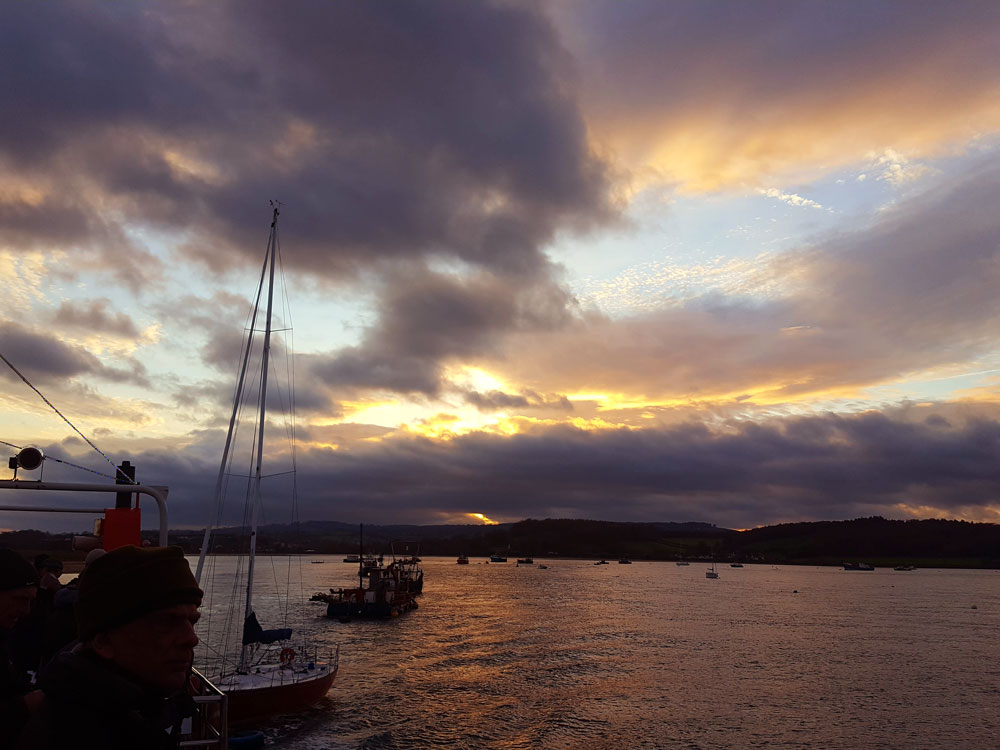
On Saturday just gone, I was thrilled to join my Dad on a Stuart Line Cruise up the Exe Estuary, which set off from Exmouth at 1pm. Dad has led some of these winter trips for many years now, and I always like to try and get on at least one a winter.
With no telescopes on the Stuart Line Cruise, it's a great place to test out binoculars and get a true feel of their capabilities and limits. So no better place than this to try out the Nikon EDG's that were sent to me to try out earlier in the week...
The light remained nice and flat throughout the three hour cruise, there was no wind and plenty of birds - a fantastic trip!
On the lower part of the Estuary, hundreds and hundreds of Brent Geese proved a spectacle, along with good numbers of Shag, and in the deeper water here two Great Northern and a surprise Red-throated Diver (rare in the river), the resident Slavonian Grebe, only a few Red-breasted Mergansers (still lots of these to arrive) and a very distant Long-tailed Duck, which was way way off to the east north of Mudbanks.
Red-throated Diver
Slavonian Grebe with a typical Exe back drop
The ultra distant Long-tailed Duck, only identifiable thanks to the amazing zoom on the P900!
As we travelled up the Estuary towards Topsham, the usual change in species occurred with Avocet, Dunlin, Curlew and Black-tailed Godwit becoming the most numerous species. A flock of c230 GoldenPlover roosting on the mud were nice to see, along with good numbers of Lapwing among the usual smaller numbers of Grey Plover, Greenshank, Bar-tailed Godwit, Knot and a lovely little flock of 30 Sanderling. There were also impressive numbers of wildfowl present, mostly around the Clyst area with thousands of Wigeon and probably well over a hundred Pintail. Three Kingfishers pleased the punters on the boat, as always.
It was nice to see three Common Seal on the trip, including a small youngster. Two allowed their photographs to be taken...
And what about the binoculars? Well I was really impressed. Superb image quality and light levels, which I have come to expect with Nikon products now. They were a really comfortable pair of binoculars too with a thick neck strap, and for me they're the perfect size allowing a good solid grip to keep them steady, an important attribute in optics when boat birding. They allowed me to pick out all three divers on the trip, and I doubt I would have spotted the Long-tailed Duck at all had I been using other optics. It honestly was a dot, but through the EDG's it did at least look like a Long-tailed Duck-shaped dot! It's these small differences that can sometimes make all the difference when birding.
I didn't need any convincing yesterday to go and see the Pallas's Warbler currently over wintering at Portesham in Dorset. Pallas's are my favourite of the 'regular' sibes, I saw several at Spurn and Dunge in the early 00's - some exceptionally well. But in the ten subsequent years of birding this patch I have seen just one, that was in 2007 and for about twenty seconds! So it was high time I saw another, even though seeing what in my head is a late autumn specialty, in March, could well play havoc with my inbuilt birding body clock!
It was actually dead easy. James Mc and I parked up in Portesham shortly before 10am, casually strolled up to where we thought we should go, and there it was...
Count the head stripes - that's a seven-striped sprite alright
Showing it's Wood Warbler-like white underparts
The yellow tones to the face also reminded me of Wood Warbler colours. Often looked bull-headed too.
In coming - I just love those stripes!
Check out it's arse! Surprised I managed this with my bridge camera.
What a stunning bird, and mind blowing views. No stiff necks looking at tree tops, it spent virtually the whole time feeding at eye level, and for the twenty minutes we were there it remained in view for about 17 of those. It was so easy to follow as all the trees and bushes were completely bare, and it shared the surrounding cover with only a couple of Robins, Dunnocks, one Goldcrest and a Chiffchaff (which looked huge compared to it!). It really seemed to love this bush, the first bush on the right...
It did move into the small copse to the west and across the track south of this bush. But it did seem to like this bush, there were plenty of small flies buzzing around it which may have explained why.
The rump really is amazing. It is virtually impossible to see when perched, but the moment it flies it's like a light bulb. It's even obvious when you just glimpse it flitting about with your naked eye at a distance.
My advice to anyone thinking of going for this bird, go.
Here's a few short videos that I'm sure will tempt even the most stubborn...
I can confirm to you all that without doubt seeing a Pallas's Warbler is an excellent cure for the winter birding blues - almost as much as a male Northern Wheatear (they can't come soon enough!).
As we were Portland way, I couldn't leave without some diver and grebe action, so we headed to Sandsfoot Castle for a quick scan over a nice calm Portland Harbour...
Looking south to Portland
This proved a very worthwhile stop, as a scan from the Sailing Academy, and through some builders fencing a little way back east along the road, showed a pretty decent selection. For us fairly loyal patch birders, Red-breasted Mergansers are exciting enough as they are scarce on our patches, it was great watching the males displaying.
My previous visits here have shown the Black-necked Grebes to be in one or two pretty tight flocks, but today the 12+ present were spread out everywhere; a four, a few pairs and singles. Most were in or coming into summer plumage which was nice, unlike the four Slavonian Grebes - three of these were in winter plumage with the fourth just starting to get dusky down the front. There were stacks of Great Crested Grebes too, all of these were in the far north east corner of the harbour (where one of the Slavs was, another was towards Ferrybridge with two together in the middle of the harbour).
Four Great Northern Divers were all spread out singletons, but the closest diver was a stunning Black-throated Diver. It was quite a hefty one to be honest, looked quite thick-necked and bulky, so am pretty sure it's the one that was showing well from the southern shore of the harbour over the last couple of days. Sadly my photos aren't quite as good as Pete's...
A blurry phone-scoped Black-throated Diver in awful light!
One fat bird!!
With work looming it was time to head back west. But on the way home we called in at Abbotsbury for a look over the Swannery...
The light wasn't too bad when I took this, but the sun soon came out which made viewing more difficult
We were really impressed with the amount of wildfowl here, heaps and heaps of Pintail in particular. All the Pochard were sat out on the bank probably wondering where their lunch was - no wonder they are so rare here now, they are clearly getting lazy! In contrast the Tufties were busy getting their own grub out on the water, and among these were the the two wintering Long-tailed Ducks and at least one and a half Scaup. I say one and a half because I know there's a hybrid ScaupxTuftie here, and I couldn't rule this out on one of the birds - probably because it was the hybrid.
As ever it's not just the birds that make a twitch, but the company. James M is an ace twitching partner as we are both as laid back and relaxed about it as each other - and neither of us actually like twitching! Especially the crowds. We really are bad twitchers, and will only twitch a bird if the chance of seeing it is up around the 100% mark, plus there has to be other birds around to see as well. In general we also have a similar taste in birds and what we think is worth going to see, well that's with the exception of big white things. James seems to think all egrets may as well be Little Egrets (just smaller or bigger versions), and all swans are Mute Swans just with different coloured bills...
First of all, I have to say thank you so much for all the comments, emails, texts and tweets in response to my previous post. I do have more to say, but I'm not going to. It's time to draw a line under it...
We have been blessed with flat calm seas for a few days, and decent cloud cover making conditions ideal for sea scanning. Bird wise though there has been very little on the sea, with species you'd expect to see several of (Great Crested Grebe, Common Scoter, Cormorant, Shag) few and far between, or totally absent. Thankfully though the last few days have seen a bit of quality appear!
I haven't seen Long-tailed Duck here for six years, and before that I'm pretty sure I've seen just one other. So you can imagine my thrill when I picked up two feeding in the bay off the Spot On Kiosk yesterday morning. Both are immature/female-types, but beyond that I've never been too confident at ageing/sexing distant non-adult male LTD's. One was considerably whiter than the other - and if I had to place bets I'd say they were both female's, and ad and an imm. Most pleasing is that they seem settled, and are still out there feeding this morning. Also yesterday a drake Red-breasted Merganser flew around the bay for a while which was nice, as was my first settled Great Northern Diver of this winter.
This morning I gave Branscombe its second look of the week, and had two more settled Great Northern Divers, along with a fly by Red-throat. There were way more Kittiwakes and auks off here than in Seaton Bay, so hopefully regular visits here will turn something up. A snoop around the sewage works here earlier in the week showed four Chiffchaffs and good numbers of the expected species - sadly no Yellow-browed or Dusky.
Tuesday morning I undertook my usual woodland bird survey near Colyton. Nice to see my first four Woodcock of the winter, along with a couple of Fieldfare, 10 Redwing and a fly over Golden Plover. All very wintry!
There is a very winter feel to the birding scene now, vis mig appears to have all but stopped and the hopes of a late autumn rarity seem far flung. Before it did end I gave Beer Head probably it's last visit of the year, on the 15th. It was nice to see a few Wood Pigeons flying over NE, only 1350, but it was my biggest passage of the year (which is terrible!).
On the ground, four Song Thrush, three Redwing and a Chiffchaff were expected, but a late Wheatear not so...
Looks a bit more exciting in this picture than it actually was - always just a Northern sadly.
So there you have it, autumn 2013 done. And now we are into the last phase of the year - the last phase of my year listing year. Long-tailed Duck was my 188th species for the year, which is a notable number as its the first guess from Steve's 2013 Patch Year Listing Competition. Here's a reminder of who guessed what I'd end the year on...
188 - Andrew 189 - Karen 190 - Phil 191 - Julia 192 - Bun 193 - John O' Sullivan 194 - Col 195 - 'Corky' 196 - Dave H 197 - Jonny 198 - Skev 199 - Tim White 200 - Gav
201 - Sue Murphy 202 - Catharine 203 - Sue Smith
So Andrew, if the year was to end now, you would be the winner. But I'm afraid it doesn't, and I'm sure there's at least a few more year ticks in it...
After breakfast, we loaded up the trusty Corsa and said farewell to Glenan Lodge at about 9am. I can highly recommend this B and B, it is good value, the rooms are very comfortable and the breakfast very yummy!!
We all wanted one last look at a summer plumaged Black-throated Diver, so this was the first port of call. It didn't take us long to find a pair of these stunners showing very well indeed...
Just stunning!
Also on the loch were a summer plumaged Red-throated Diver and a pair of Wigeon. Yet again Red Grouse were all around us!
We then headed north (yes I know - even further away from home!), and soon stumbled upon a surprise male Black Grouse...
It appeared to be displaying to itself - unless there was a female hiding somewhere nearby?
After about 50 minutes driving, we'd reached Nairn where we wanted to do a bit of sea watching from...
Looking north from the harbour car park at Nairn
It didn't take long to pick up three Long-tailed Ducks, several Eider, Goldeneye, Red-breasted Merganser and Sandwich Tern - then a fine summer plumaged Red-necked Grebe appeared out of nowhere.
A Goldeneye flashing!!
Also here, there were at least 50 Turnstone, a couple of Ringed Plover and a Hooded Crow.
We took to the road again, and headed around the coast (for over two hours!) to Rattray Head - this is where a King Eider had been reported on a couple of days within the past week. Whilst driving here, a singing Corn Bunting and several Yellowhammers were 'trip ticks'.
We got to Rattray - then began to drive out to the head. We hadn't gone far before I just HAD to pull in...
Grey = Geese
There were thousands and thousands of Pink-footed Geese feeding in road side fields, what a sight!! A look through them revealed a couple of sandy brown leucistic Pink-feet, and singles of Greylag and Barnacle Geese.
On the other side of the road was a huge Ley - this had plenty of diving ducks and Great Crested Grebes on. A couple more Corn Buntings were singing here too, though remained annoyingly invisible!
We eventually got to the car park at the end of the track, and walked out over the sand dunes past a flock of over 200 stunning mostly summer plumaged Golden Plover.
Rattray Head beach and lighthouse
There was no sign of the hoped for King Eider, but there was just so much to look at it was fantastic! On the beach were Sanderling, Redshank and a surprise Ruff. About 100 Eider were loafing about just offshore, and behind them AT LEAST 210 Great Northern Divers!! Also 6+ Red-throated Divers, and auks were constantly flying past north, with a few Kittiwakes and Gannets also noted.
A quick check of Birdguides on my Blackberry showed that the/a King Eider had been seen on the Monday just gone on the Ythan Estuary. As this was south of where we were, and on the way back home, we thought we may as well stop off here...
A quick check of the Estuary from a few stopping places on the A975 showed the Estuary was heaving with birds. Pintail was the only bird added to the trip list here, but if we had more time to look closer I'm sure we would have unearthed a few more 'trip ticks'.
We arrived at the golf club car park, and made our way to the mouth of the Estuary. The sight and sound was just absolutely spectacular as several hundred Eider were 'loafing about like Mallards at Radipole!'...
Stunning!
There was no sign of the drake King Eider - much to our annoyance - but another bonus here was the impressive seal colony...
There were loads of them!
Here's a short video too...
if you turn the volume up you can hear the Eider calling
The time was now 17:00 - and we still had an at least 11 hour car journey ahead of us to get home!!! We followed the Sat Nav (which all week had been a god send), and it took us right through Aberdeen City Centre at rush hour!!!!
We finally came out the other side of Aberdeen and began headed purposefully south. Apart from a quick fuel stop, and an hour's stop at a Little Chef near Sterling (where I ate the nicest burger EVER!) we made good progress.
We got back to Bristol at about 3am, and I got back home to Seaton for just before 5am.... I was bloody shattered!!!
I had such an enjoyable five days, in which time we clocked up 115 species of birds, saw some great mammals, stunning scenery and most of all, had a cracking good laugh! I'd like to take this opportunity to thank Bun, Nick and Karen for their company, and everyone who gave us 'gen' to ensure we got the most out of our trip.
From the moment I took this photo on the Farr Pass, I knew this was the photo I'd finish this review with. Thank you Scotland for such an enjoyable birding break....
The 'Famous Grouse'
Well I hope you have enjoyed reading my rather drawn out trip report!? I'm pleased to announce that normal service will now be resumed on Axe Birding...
Apologies for the lack of blog posts - when I've been on this laptop within the last few days I've had much more important things to think about! I have been updating the Devon Birding Blog when I could though.
So, I hope you are ready to read one monster blog post covering the last FOUR days! It is worth reading as I have seen lots of nice stuff. The best day was today, and that's right at the end. So you may as well read the rest of the rubbish between that and this....
MONDAY
Spent the first couple of hours of light at Colyford Common - it was freezing! Three Ruff flew low north west over at 8am, and amongst the frost were one Water and 11 Rock Pipits and a Green Sandpiper.
A look along the A3052 revealed 13 Golden Plovers (one by the pig fields, 12 beside Boshill Cross). All day small flock of Lapwing were flying south down the valley and presumably out to sea.
A good look along the Estuary and over Colyford and Seaton Marshes produced wildfowl totals of: 12 Brent Geese (the same flock as a couple of weeks ago), c450 Wigeon, 380 Teal (a good count for us), 11 Shoveler and six Gadwall...
Four drakes - Gadwall aren't common here
Shoveler on ice from Seaton Hide
Two adult Med Gulls were on the Estuary and a look at Lower Bruckland Ponds showed no unusual ducks, but a Cetti's Warbler was my first ever there.
Tuesday
This was a day of limited birding for me. First thing I had to carry out my monthly bird survey in private woodland near Colyton. I was surprised to see quite a bit of snow still on the ground (bearing in mind we hadn't had any at all in Seaton!)...
There were even some light snow showers
I flushed four Woodcock during my walk round, which was nice! Even nicer though was a lovely flock of ten Lesser Redpolls.
Small flocks of these just oooooze with character - I love 'em!
I returned home, and stayed here for a good while. Early afternoon though a text from Dad tempted me out down to the Estuary to see three Goosanders...
The same three Gav saw on the sea the previous day maybe?
Whilst here, out of nowhere, this appeared....
...a sleeping adult Spoonbill! For much better pics of it click HERE
Later, a further check of the Estuary produced five lovely Ruff just north of Coronation Corner, four Med Gulls and a 'weirdo' Gull. At first I thought my 'weirdo' Gull was a LBBGxHerring, but it may just be a weird yellow-legged Herring Gull. I took this photo at 16:15; it was almost dark, with an exposure time of 1/4!...
Its legs were yellow - just not bright yellow like an adult YLG. Also note slightly darker mantle shade, slighter size and intense head streaking
Tuesday didn't end well! The alarm at work wouldn't set, so I didn't get out of there until 23:30!
Wednesday
Up for work at 7am, then after a short three hour shift a sweep of the Estuary showed a Knot and the Spoonbill still. I then returned home to bury myself in my laptop once more! I really should have had a kip - 'cuz I was knackered and was due back at work at 17:00. Yes - a lovely split shift!
I got fed up with my laptop, so mid afternoon had another look about. Couldn't find anything different - well that was until I had a look at the small flock of Swans opposite Stedcombe House at 16:00. There sat an adult Bewick's Swan...
Nice!
At first I presumed it was the same bird we had last winter - that often frequented the same spot. But its bill pattern gave the game away - quite different from last winter's bird. Here's a closer pic of today's bird, with a head shot of last winter's bird cut and pasted in...
See, quite different; and it's even obvious on photos as crap as these!!
Today - what a day!!
I woke up to this...
White out!!!
Our road was an ice rink - so I knew I couldn't go out in my car. As I was tucking into my Cheerios, out the front room windows I noticed a small flock of Lapwings fly west. So I kitted myself up and headed out...to the front garden!
Bloody hell it was BRILLIANT! When I started I really didn't think I was going to witness a cold weather movement on the scale that I did!! I watched and counted 08:40 - 12:00.
Most of the birds were flying west, except thrushes and Starlings which were mostly flying north east. So if I haven't put a direction after a species assume this is the way it was going.
I can see the sea from my place, and I could see ducks flying over it. But I only counted ducks which were obviously flying over land - this gave me two garden ticks!! Ok, so this is what I saw....
22 Shelduck 140 Wigeon (50 north) 21 Teal (6 north) 4 Shoveler (in with a flock of Shelduck - garden tick!) 6 Tufted Duck (a mega garden tick, 3 of each sex; they flew west but soon came back east) 1,453Lapwing (the largest single flock was of 70 birds - a well impressive passage) 1 Golden Plover 1 Curlew 30 Common Snipe (a few of these flew north, have only ever seen a couple of these from the garden before today!) 1 Redshank (flew north - second record for the garden) 5 Buzzard (all singles - and all were properly 'on the move') 2 Kestrel 90 Wood Pigeon 1 Mistle Thrush 63 Fieldfare 259 Redwing 86 Starling 1,154 Skylark (biggest flock was of 230 birds - saw even more later in the day as well!) 14 Meadow Pipit 40 Linnet
There were probably loads more finches involved in this movement, but separating 'vis mig' birds to birds moving from garden to garden from where I watched is almost impossible.
Well what a morning! I really wasn't expecting that!! Here's a couple of pics...
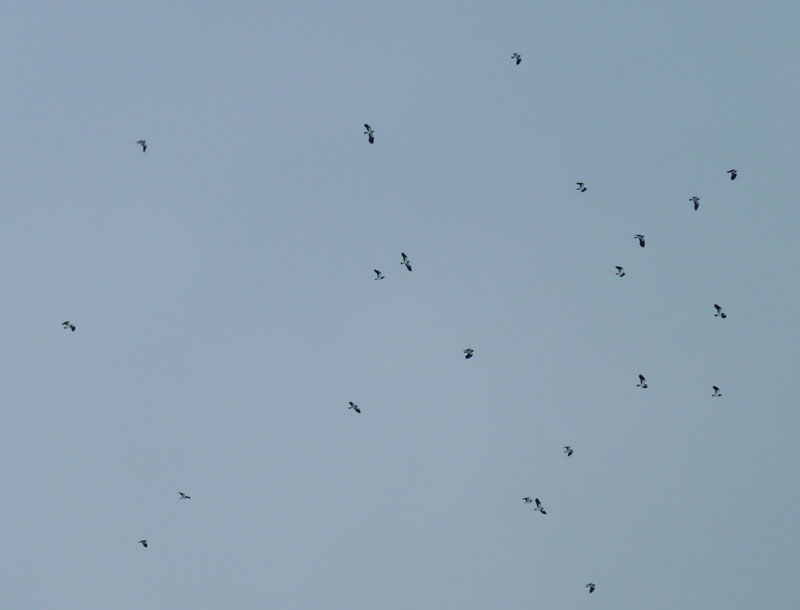
Lapwing flocks
Snipe
After lunch, I gambled and got in my car! Thankfully I made it in one piece to the sea front, and spent 13:35 - 14:35 looking out to sea.
First of all, Skylarks were still moving. During this watch, and during the rest of the day I counted another 930 over west - with several flocks well out sea. For me then, that makes a day total of 2,084Skylarks west - epic!!!!
Now to the sea, and it was clear wildfowl were also well on the move. On the sea there was a large flock of Wigeon, Teal with a few Gadwall. Now and then though, some would leave this flock and fly upriver, but also several flocks came in from the south and the east and joined them.
Wildfowl quality came in the form of three Eider on the sea (1 immature drake) and a nice flock of 16 Pochard and three Tufted Duck which flew in from the south, then west, then east, then west, then east, then finally away west...
Any fresh water diving duck is a rarity here!
Further interest over the same came from seven Red-throated Divers (4 on the sea and 3 west) and 12 Great Crested Grebes (easily my highest count so far this winter).
It was very hard to tear myself away from this action - but I did and took a look along the Estuary. A female Tufted Duck and 40 Dunlin being the only note worthy birds.
Had a nice surprise at the Farm Gate though. Funnily enough I was scoping up the field were Gav had just found a few Woodlark, when I suddenly realised I could hear Woodlarks! Two flew low north (and slightly west) over Norcombe's field - result! I wonder if these two and Gav's are from the wintering population that normally resides in the stubble fields above Axmouth.
A quick stop up the road showed the Bewick's Swan was still present with our flock of 12 BrentGeese.
Seaton Marshes was pretty much my last port of call - and the lagoon was smothered in ducks! Nothing out of the ordinary though. There wasn't much on the Borrow Pit either, but a single Grey Plover flew over heading north east. Ian Mc had seen one earlier on the Estuary, but as this had come from the direction of the town I presume it was another.
So what an excellent day indeed! Phew! Now time to ruin it and go to work. I do have one last picture for you though, taken during my visit to Seaton Marshes...
He was searching non stop for food!
Well I hope you enjoyed reading this mammoth post! I wonder what tomorrow will bring....