Pages

Showing posts with label little stint. Show all posts

Friday, 14 August 2020

Black Hole Marsh Update and Common Dolphins

I can't believe it's been about twenty days since my last blog post! Apologies for this, especially when it's been so busy out there in the birding world. I have been getting out as much as possible, just always been running out of time to blog about it afterwards.  

In this post as the title indicates I want to update you all with the happenings on Black Hole Marsh since my last post about the wading birds here on 20th July.  It really has been excellent, and right now is looking as good as it ever does so do come and visit if you get the chance.

Following the early juvenile Wood Sand I blogged about on 17th July, over the past ten-ish days up to two more juveniles have been present, although there seems to be just one now.  One of them in particularly was really showy, hence the obscene amount of photographs below. They are such a charismatic species packed full of charm it's a real struggle not to aim the camera at them..


It's been a good late summer/early autumn for Greenshank, with six on 17th July my highest count.  I noted the first juvenile on 1st August, with the early date suggesting it may be of Scottish origin.  A really cracking example of a juv too, looking strikingly paler than all the recent adults...


The first juvenile Ruff was on the marsh on 10th, with two a couple of days later.  Again, how fresh and bright does it look in its brand new baby feathers...


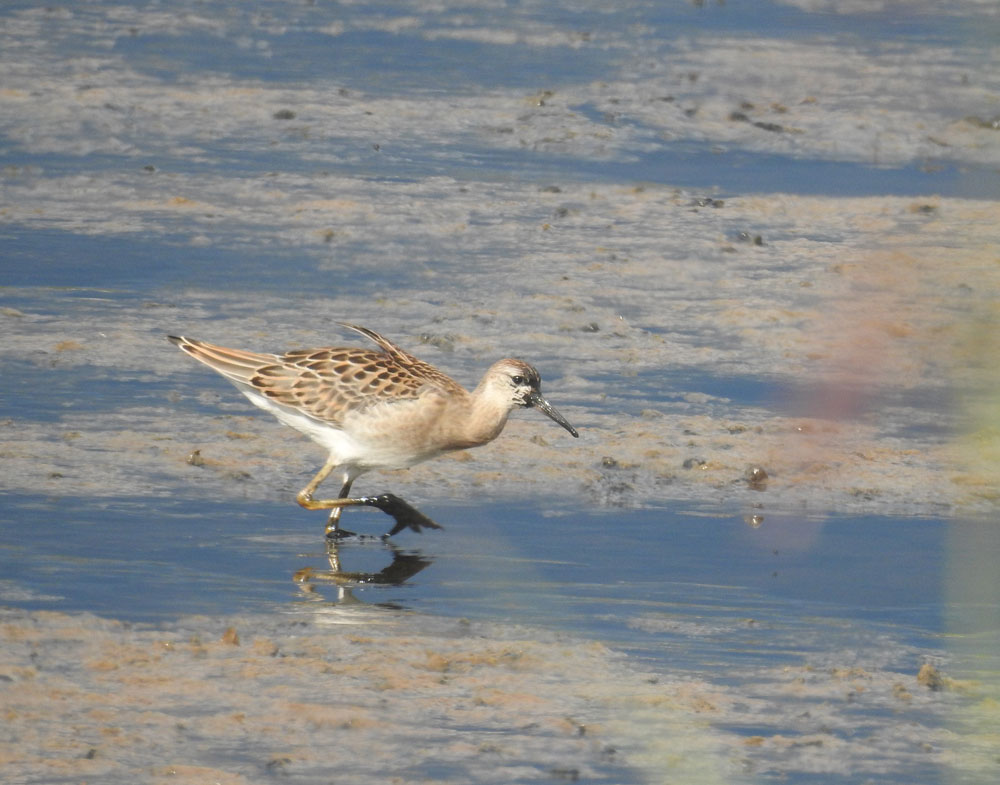
And the most recent addition to the Black Hole crowd is a Little Stint first found by Derek Carter on 12th.  Surprisingly it was also a juvenile - another example of what I believe to be an early date for a juv wading bird. 2020 really is proving the year of early juvenile waders, which hopefully is a sign they've had a good breeding season.  

As you can probably tell from my pics though, the two times I've seen it it hasn't been particularly close...


Whilst on the subject of juvenile wading birds, I always look forward to seeing my first juv Black-tailed Godwit of the year.  This year that was on 4th August, but it wasn't the first of a flurry - I have only seen one more since!


Not that there's anything wrong with summer adult Black-tailed Godwits, so richly coloured...


Other bits and bobs on the marsh have included up to 51 Dunlin, 25 Teal, 20 Common Sandpipers, nine Ringed Plover, four Green Sandpipers, four Snipe and my first Yellow Wagtail of the autumn on 5th August.  The lingering juvenile Marsh Harrier is still around too, although can be surprisingly sporadic in its' appearances.

I'll finish this blog post on a different topic.  Yesterday morning before work I spent fifteen minutes sat on Seaton Beach with Jess and Harry, and as we wandered down to the shore I mentioned that the flat sea looked good for cetacean spotting.  About five seconds later I was showing Jess two distant Dolphins out in the bay, including one frequently breaching - pirouettes and everything!  Unfortunately though they were too distant to ID and I couldn't get any other local birders on to them.

So I was dead chuffed to find a video of them on a local Facebook page today, clearly shot at the same time we were watching them from dry land.  Here's a screen shot from the video, showing they were my second ever Common Dolphins here...


And here's a link to the actual video, which is well worth a watch: https://www.facebook.com/watch/?v=321669915550419.


Friday, 30 August 2019

It's Autumn on the Axe

It's been a good week locally for birds, one of the best autumn weeks we've enjoyed for several years I'd say, and this is why...

First of all I'll start with Ospreys. A couple of weeks ago, on the 18th in fact, I happened to be outside at work (in the middle of Seaton) when an Osprey flew low south west overhead shortly after 10am.  It disappeared as quickly as it appeared, unlike the juvenile Sue Smith found from Tower Hide on 25th.  This one, clearly an amateur fisher, is still around today, and can be easily seen fishing on the Axe given a bit of time.  It's great having a long-stayer again, our first proper lingering bird for what seems like years...

Osprey with a typical back drop - lots of alarming gulls!

The Tower Hide is the best place to see it from, although I have stayed clear of here as I know it's proving a busy place for photographers at the moment - and rightly so.  This has to be one of the best sites to photograph fishing Osprey in the UK (away from breeding grounds)?

Going in for a dive

I had a second Osprey on the 27th, when one flew in from the north west over Seaton cricket pitch, then continued south west at quite a height.  Our usual bird was back fishing on the Estuary an hour or so later so am happy this was a different individual.  Whilst on raptors, at least one Marsh Harrier remains in the valley, and I had a second fly west over Lyme Regis on the morning of the 23rd.

Now to the wading birds and Black Hole Marsh.  After another little pulse of Wood Sandpipers with three on 25th, it really kicked off yesterday.  Late afternoon on 29th, inline with something of a national arrival of these species, Phil texted with news of three Curlew Sands and three Ruff - nice.  I went down there that evening and saw all six of these goodies, along with three Greenshank, a juvenile Knot, several Yellow Wags and plenty of the usual species...

All three Curlew Sands - a cracking adult and two juvs
Three juv Ruff - I think a male and two females
Juv Knot

Over the course of today, the three Ruff have dispersed, but a lovely adult Little Stint has joined the fun and games.  Unlike the adult Curlew Sand which is still very summery, the stint is more advanced in its moult to winter plumage...

Little Stint on the left, and Curlew Sand in shot too
On the right here, such a delicate little beauty

A juvenile Bar-tailed Godwit was also new in, mixed in with the vast numbers of Black-tailed Godwits...

Note the difference in leg-length!

Had some better views of the Curlew Sands too.  The adult really is cracking, only seen one or two better than this on the Axe before...

Look at that!
Constantly feeding though! 

Also tonight a Green Sand, two Ringed Plover, the Knot still (which has developed an occasional limp), a Whimbrel and heaps of the usual species.  I am so glad the water levels have now been sorted on Black Hole because the mass of birds it's attracted will no doubt continue to attract even more - the next few weeks could be really good.

The one thing I have really missed this August is Beer Head. I simply haven't had chance to get up there, but those who have have been seeing plenty.  Phil turned up the highlight, with a brief Wryneck yesterday morning, but the large counts of migrants coming in most mornings have proved equally gripping.  Looking forwards, Yellow Wags will start picking up in numbers now, they usually peak over the few days when August ends and September begins, so hopefully I will be able to cash in on this at least.

 'til next time...

Tuesday, 6 November 2018

Late Little Stint

I jumped into action the other day, when Phil made a surprise discovery of an apparent Little Stint on Black Hole Marsh. He didn't have his telescope or camera with him, so considering the late date (31st Oct) I just had to check it out.....

Phil's impressions were dead right, it was a Little Stint.  The only one we've had this year so it was well worth the effort, although aiming my camera at it probably wasn't as the light was dreadful...

Little Stint


A lone Lesser Redpoll flew over Black Hole during my short visit there, and as well as the stint, on Black Hole there was a male Shoveler and a Greenshank.

This evening I dashed out after work to try and catch up with a tern sp. that was seen on the Estuary mid afternoon.  It was virtually dark when I made it over there so wasn't surprised to miss it, although there was just enough light left to see a redhead Goosander fly down river at about 5pm.

Earlier today it was great to see numerous Redwings and Song Thrushes bombing around my housing estate at dawn, easily the best arrival of thrushes so far this autumn - but hardly surprising given the numbers calling overhead during the previous night. 

Good news on the Cetti's Warbler front.  The snow of last winter knocked out all our local Cetti's Warblers, well singing males at least, there may have been one or two females still hanging on.  In the past it's taken years to get numbers of this species back on the Axe after cold weather wipe-outs, but within the last two weeks alone I've noted two at Lower Bruckland Ponds and two around Black Hole Marsh, then yesterday morning the Axe Estuary Ringing Group ringed four around Stafford Marsh (see HERE). Excellent news indeed.

A Cetti's Warbler struggling in the snow and ice - taken on 2nd March this year

Tuesday, 19 September 2017

Patch Update

This won't take long. Well it can't to be honest as I've got to go....

Our first Little Stint of the autumn appeared mid morning today on Black Hole Marsh, found by Clive (it wasn't there at 9am!). Also present two Ruff (a second juvenile joined the lingering bird yesterday morning - present at first on Colyford Marsh but now both are on Black Hole), the juvenile Curlew Sandpiper (for its fourth day) along with small numbers of Greenshank, Green and Common Sandpipers, 26 Dunlin and seven Ringed Plover.  The Spotted Redshank wasn't on Colyford Scrape this morning, but this is where it has been most days.

Here's some (poor) pics of the star birds...

Juvenile Little Stint - it remained distant but no doubting this one!

Dreadful pic of the juv Curlew Sandpiper

Ruff number one

Ruff number two - with a Snipe in the early morning sun on Colyford Marsh. Why wasn't it a Buff-breast!?

Juvenile Spotted Redshank


And that's that.  I'll leave you with the view from Colyford Common hide early yesterday, the sun rising over the Axe Valley on a lovely mid September morning...


Saturday, 9 September 2017

Osprey and Continental Black-tailed Godwit

Although we see several Ospreys each year on the Axe, both in spring and autumn, we've not had a lingering bird since mid August 2014 - this one unusually preferred fishing over the sea not the Estuary!  Before that we had two lingering birds in 2012 (though neither for very long) and the most watched was THIS colour-ringed juvenile that stayed for over a week back in September 2010.  So it was high time we enjoyed another loitering bird, and that we have...

Thanks to a tweet from Martin Bennett early Thursday afternoon (a lovely chap from the New Forest who I'd met that morning in the Island Hide) we were made away of the presence of a fishing Osprey on the Estuary. It remained all of the Friday, and was around today until late morning when it flew off south west.  I though it was leaving us earlier in the day as at 9:20am it flew west over Stafford Marsh with pace...


Gladly though it came back east to offer the gathered crowd some more fishing views...


There's nothing like an Osprey to pull in the crowds! Pity it left us so soon but hopefully we will see some more before the autumn is out.

The bushes were deadly quiet this morning, and the wading bird situation isn't much better now Black Hole is full of water. All I noted here and on Colyford Marsh were four Greenshank, two Green Sandpipers and a couple of Ringed Plovers.  The highlight for me this morning was without doubt one of the 90+ Black-tailed Godwits that are currently on the Axe.  Among a small flock of Black-tailed Godwits feeding on Colyford Common I was delighted to notice a larger bodied, billed and legged bird, a Continental limosa Black-tailed Godwit (as apposed to Icelandic islandica race which are the norm for the Axe).....

Limosa Black-tailed Godwit (front bird)


I have got several more pics of this beast, but am going to save them for another post within the next couple of days which will be about all things Blackwit.

Since my last post, the only other sightings I have to add are of a drake Gadwall that I've seen on the Borrow Pit twice, and good numbers of migrants around the Wetlands on Thursday morning which included singles of Wheatear, Whitethroat, Lesser Whitethroat and Willow Warbler, six Yellow Wagtail, 15 Blackcap and 20 Chiffchaff.

Colyford Common Wheatear


I have missed a few birds since my last post, mostly thanks to work. Tim White reported two Knot from the Tower Hide on Friday, and I was annoyed to miss a juvenile Little Stint found by Phil on Thursday evening which sadly didn't stay the night.  The most annoying thing about missing the Stint was that I really wanted to give it a good grilling as Phil reported that night, that it was a particularly long-billed individual. Hope Phil doesn't mind me sticking one of his record shots of it up here...

Little Stint (c) Phil Abbott


As you can see, quite a long-billed bird. But nothing else suggested it was anything other than a Little Stint.

Be sure to check back here soon for that Black-tailed Godwit post, which who knows may even prove educational!?

Monday, 14 November 2016

Wildlife in the Limelight

I love Christmas. An event that brings so much joy and happiness to the world in the midst of winter is always going to sit well with me. I am one of those annoying people who can't get enough of it, and it doesn't matter what the date is!  Within the last week various retail outlets have been showcasing their 2016 Christmas adverts, and anyone who has any interest in wildlife and conservation MUST be delighted at what is on offer.  

Although the main character in the John Lewis ad is a dog, two foxes, a badger, a squirrel and a hedgehog play major roles. In fact John Lewis have partnered up with the Wildlife Trusts - they are their chosen charity campaign partner, superb news!


Already being delighted by this, imagine my excitement when I first saw the Waitrose Christmas advert. The whole advert is about the treacherous autumn migration of a Robin from its breeding grounds in Scandinavia to its winter home in the UK (yes, nothing to do Waitrose!).  Back of the net for UK wildlife.


You may well be a Christmas humbug, but if you are a nature lover then please just be happy that our wildlife is taking center stage in something that is so much anticipated, far reaching and positive. Result.

And now usual service resumes...

I only need a paragraph to summarise today's bird sightings. A lovely male Goosander that flew up the River Coly at Colyford mid afternoon was the highlight, with the Estuary offering the Little Stint, two Grey Plover, 13 Dunlin, an adult Med Gull and a large dark mantled Gull that could only have been a hybrid of some sorts (it was too pink-legged, streaky headed and the wrong shade of dark grey for a Yellow-legged).

Thursday, 10 November 2016

A Little Little Stint

It was nice to see the lingering first-winter Little Stint again this morning, it was feeding with a group of five Dunlin half way up the Estuary at low tide. There were two more Dunlin further up river, to have a Dunlin to Little Stint ratio of 7:1 in November is pretty impressive! Be nice if it stayed as it would provide a handy year tick on January 1st, if one was that way inclined.

Little Stints always look small, but for some reason I often find the late autumn/winter birds appear really tiny...


No sign of either of our two recent Spoonbills today or yesterday, but I did manage to see the unringed bird briefly on and over Black Hole Marsh mid morning Tuesday.

This morning I also enjoyed another encounter with the lingering first-winter male Black Redstart, he was at Axe Yacht Club. In flight the pale wing panels were so striking I thought I had finally jammed into the elusive adult male, but when he turned and began flying back towards me I could see his underparts were grey and not black. I got some nice views though when he touched down, no Black Redstart could ever disappoint they are such characterful birds...


Monday, 7 November 2016

A Lovely Late Autumn Day

I had a lovely wander around town and along the sea front this morning, the clear blue skies and chill in the air made it such a pleasurable outing. Really seasonal. 

Wood Pigeons have been moving in fairly small numbers each morning since my last blog post, but the stronger northerly wind this morning ensured they were all sticking tight to the coast and remained fairly low.  Flocks were still of mostly between 200-400 birds, so no massive flocks or really impressive numbers yet, but it's always great to see Pigeon passage whatever the numbers...


The sea was quiet, with my first Red-throated Diver west the only notable sighting. There was a distinct lack of birds on the flat calm sea, I do hope we get some settled sea duck off here again this winter.

Over the last week there's been up to four Black Redstarts around Seaton. Sadly I didn't find the adult male that Phil had yesterday, but I did see three female/first-winter types...


The situation is much the same in the valley. Waders include the lingering Little Stint (will it over winter?), three Grey Plover and about a dozen Dunlin. Among the Canada Geese the first-winter Dark-bellied Brent Goose is still with us, and two Shoveler were on the upper section of the Estuary mid morning.

On Saturday morning four Golden Plover were with Lapwing along the A3052 by the Honiton turn off, a typical cold weather sighting.

Lastly, here's an absolutely stunning first-winter male Blackbird from the Borrow Pit this afternoon.  The all dark bill suggests it's a Scandinavian bird, which is probably true as so many of our wintering thrushes originate from here...


Saturday, 15 October 2016

A Good Day On Patch

First of all, I must just thank everyone who's phoned/texted/emailed/commented/tweeted/facebooked me regarding the Nikon video. Hopefully I have got back to everyone, but your kind comments really do mean a lot. It will be interesting to see what this all leads too.

And now to the patch, and today is the first time in what seems a long long time (well the whole of this autumn!) that I feel like I've had a good day on patch. A really good day.  Although the rares I am so yearning for never came, or a Yellow-browed still, I have seen a really nice and varied selection of notable birds.  And this is how, where and when...

Black Hole Marsh for half an hour from dawn didn't show anything new, but everything that's been around was here and I noted;

65 Canada Goose
1 Barnacle Goose
3 Water Rail
2 Grey Plover
5 Dunlin
1 Curlew Sandpiper
1 Little Stint (not the pale bird from a few days ago, a new juv)
1 Ruff
1 Common Sandpiper

I know many of you would have sighed at reading Barnacle Goose in that list, but it was the first time I have seen it at such close quarters, although I wouldn't be surprised if it roosts on Black Hole Marsh every night with the Canada flock. Whatever it's origin, there's no doubt over how smart (and cute!) it is...


Beer Head after this was disappointing bird-wise (just a few Chiffs and Goldcrest, a few more Robins and Song Thrush but very little overhead), as was a walk from here to Branscombe and back with Jess and Honey late morning to mid afternoon.

A mid afternoon whistle stop tour of the Estuary was much better though, as the gull flock at the top end of the river included two Yellow-legged Gulls. Both were distant from where I was viewing, but easy to pick out nonetheless. October is the best month of the year for non first-year Yellow-legged Gulls on the Axe by a mile, a good blow usually produces a few (plus the odd Caspian Gull).


You can't see much detail on the adult Yellow-legged Gull in this photo, but you can see it's large size and heavy build, yellow legs (they were brighter than they appear in this dull photo), darker grey mantle (if you look VERY closely!) and almost clean white head.


The above second-winter Yellow-legged Gull (right in the middle of the picture) was an absolute beast. The mantle colour was a bit darker than this photo suggests, but look how big it is - and it was so long winged! Typical moult stage for a second-winter (lots of grey) and the head area looked perfect with that grey smudging around the back and sides of the neck.  This photo shows the mantle colour better...


And then this evening, the cherry on top - and what a cherry it was!  Twilight Tim has seen a Turtle Dove a couple of times in the Colyford area over the last week and a bit, but it's not been pinned down. I was at the Bridge Marsh gateway, and after checking the Egrets and ducks on the marsh, I almost didn't notice the brown lump next to me as I was walking back to my car...


I'm so glad I did! At first it was raining, so the poor thing looked a bit bedraggled...


But eventually the sun peaked through the clouds allowing it to dry up...


What a bird, and as you can see showing ridiculously well! Only my second ever on patch following my overdue patch first on 13th May 2012.  It remained here for about 25 minutes, allowing six others to get to see it which was nice -  always nice to share a good bird.  As can be seen from my pics it's a first-year bird with a mixture of juvenile (plain dull orange-brown) and adult (bright orange and black) feathers. I wonder if this is the last one I will ever see on patch though?

So nice to finally have a decent day here - lets hope the rares start flowing now...