Pages

Monday, 31 January 2022

Not Bad For January!

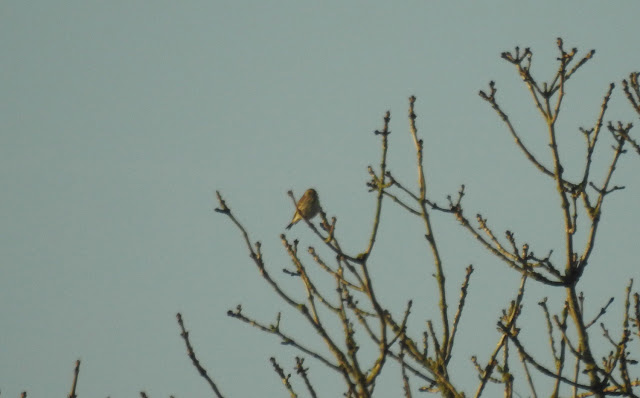
Well Kevin turned up a rather nice mid-winter surprise last week, when he found a Serin lingering around an uncut crop field in Axmouth.  

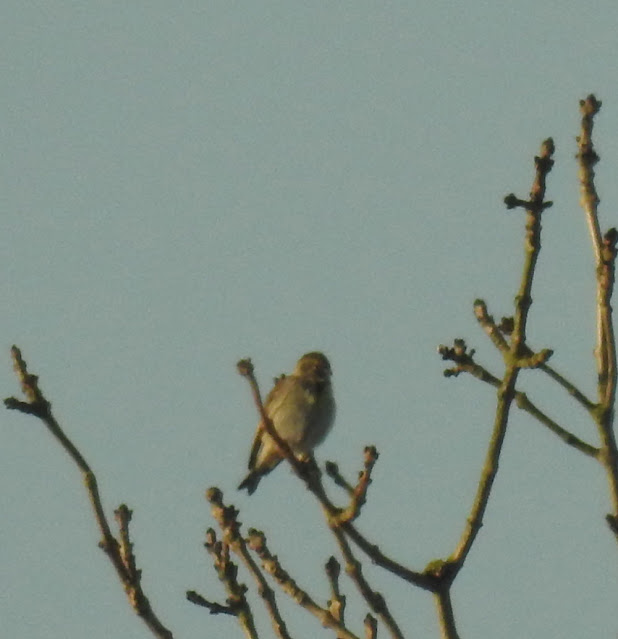
It took me about a week before I had the chance to get to it, but when I did it didn't take much searching although my views were distant. Great to get my third patch Serin under the belt, all of which have been between Nov and Jan which isn't at all what you would except for this central and southern European breeder! Delighted that Phil was able to see this one, having missed the previous records.

A dreadful photo but if you squint you might be able to make it into a compact yellow-tinted streaked finch!

That's a bit better! A typical Serin head and bill shape with a nice glint of yellow on the nape


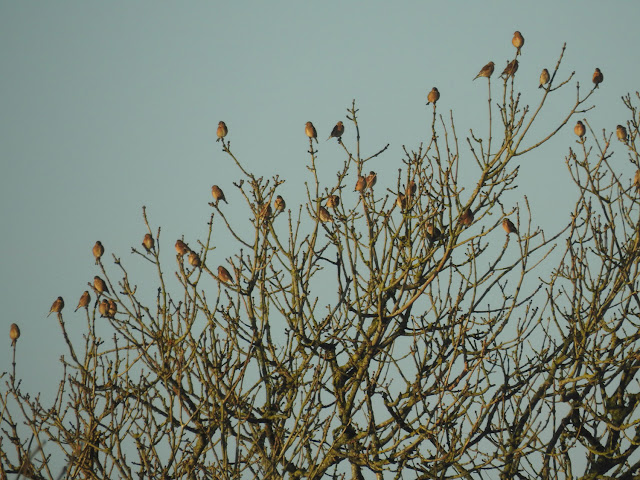
There's plenty of other birds in this field which made the hour I spent there a thoroughly enjoyable one!  I logged a couple of Yellowhammer, 120+ Linnet, 40 Chaffinch and 80+ Redwing.  When I saw the Serin it was sat up with five Linnet, but whenever the whole Linnet flock sat up the Serin wasn't with them. So basically I couldn't say if it has actually tagged on to this flock or was just going around on its own.

Always great to see good numbers of birds these days - whatever the species!


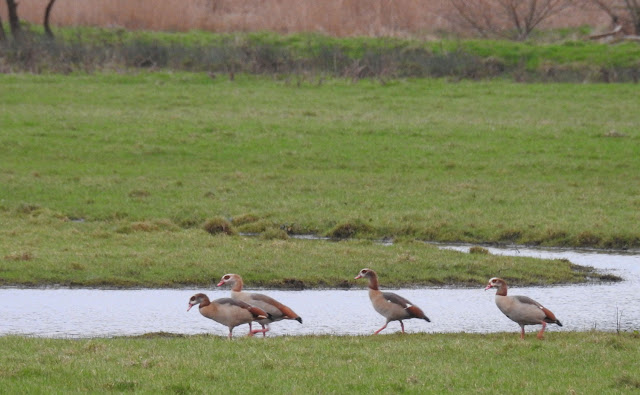
Although am still hoping a Bean Goose or two might drop in on the Axe this winter, these four Egyptian Geese were better than nothing.  Will admit to actually 'semi-twitching' these after a message from Phil to say they had just flown up the Estuary and had appeared to have landed...

A gaggle of Egyptians!  


Actually enjoyed watching these. Just about annual on the Axe but never predictable. Can appear in practically any month!


Other recent highlights include two Jack Snipe with a dozen Common Snipe near Boshill Cross, up to four Cattle Egret still feeding in Colyton by day and roosting alongside the Estuary by night, and at least three Black Redstart dotted around the town...

This bird kept disappearing under the solar panel, either looking for food or an attempt to keep warm early on this frosty morning? Strikes me as a great roosting spot!

Unusually it feels like January has been and gone pretty quickly this year, so it won't be long until we are all out looking for our first Wheatears!  


Saturday, 22 January 2022

A Quick Update From The Axe

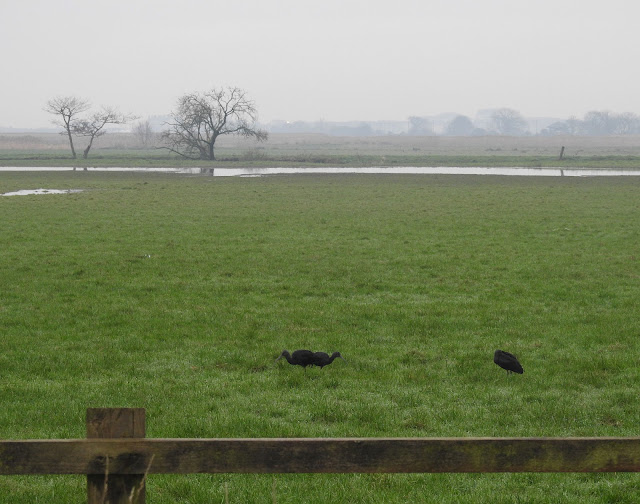
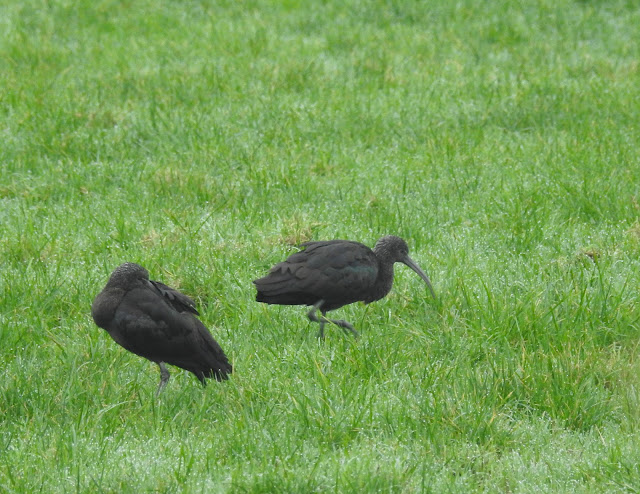
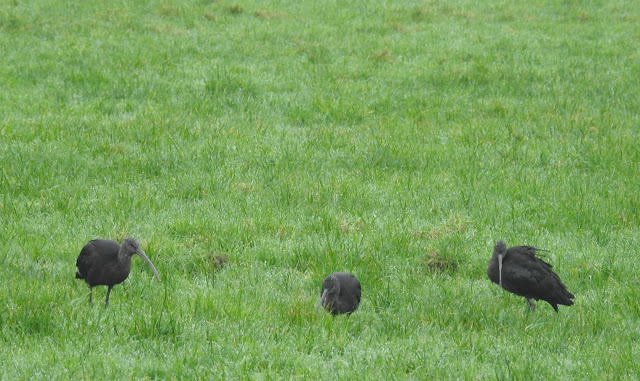
Although there has been no sign of any Glossy Ibis on the Axe for a couple of days now, the three I previously blogged about became four on the 16th.  And pleasingly for most of their stay they really did show this well...

I took this snap with my phone whilst on my walk to work

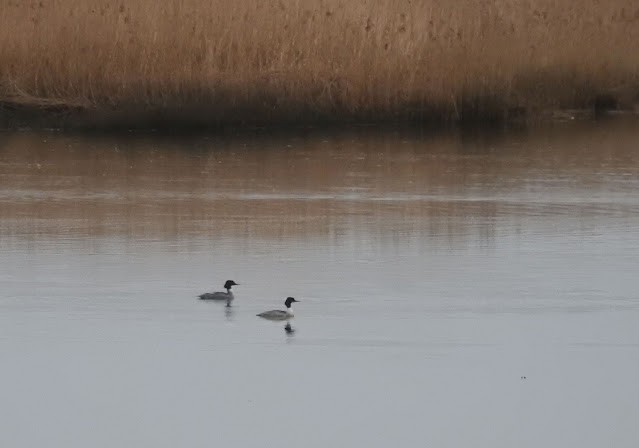
I was out early this morning as the flock of nine Glossy Ibis that have recently been frequenting the Otter and Exe were seen to fly our way yesterday at dusk.  No luck with them but being down Black Hole Marsh early had its benefits.  Four Cattle Egret flew north out of roost (three in a sizeable flock of Little Egrets, and one lonesome about five minutes earlier) and these two Goosander were loafing on the Estuary...

Taken in the half-light of pre-dawn, they flew off south at around 8am

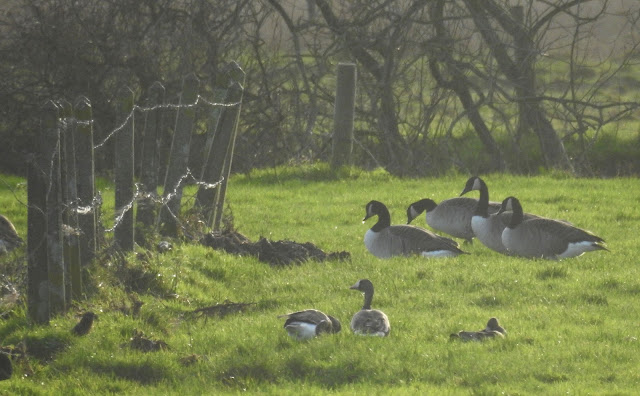
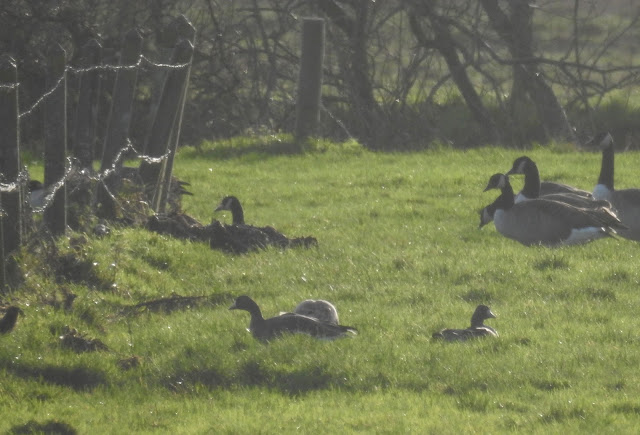
Otherwise over the last few days I've seen a couple of female-type Black Restarts around Seaton, a Dipper on the River Coly at Colyford, and have just notched up my third Blackcap of the winter - they really are in short supply this winter.   The only oddity amongst our Canada Goose flock at the moment is a Dark-bellied Brent Goose, I do hope we haven't missed our chance of a Bean Goose

Saturday, 15 January 2022

Ibis Influx Reaches The Axe

This morning I was delighted when Kev messaged with the news the three Glossy Ibis Viv found on the Axe yesterday were still present.  And they've been showing exceptionally well all day in the vicinity of Bridge Marsh, and really were as close as the following photos suggest...


This trio takes my Axe Glossy Ibis tally to an impressive 32. Although I reckon the next 30 will come around a lot quicker, may even be before this winter is out if things keep going the way they are!

Other nuggets of interest from me since the White-fronted Geese (they only stayed until the next day) includes singles of Dark-bellied Brent Goose and Greylag Goose on Bridge Marsh, and although others have seen more Pintail about, I just keep seeing this female... 

Spot the imposta!

A subtly beautiful duck


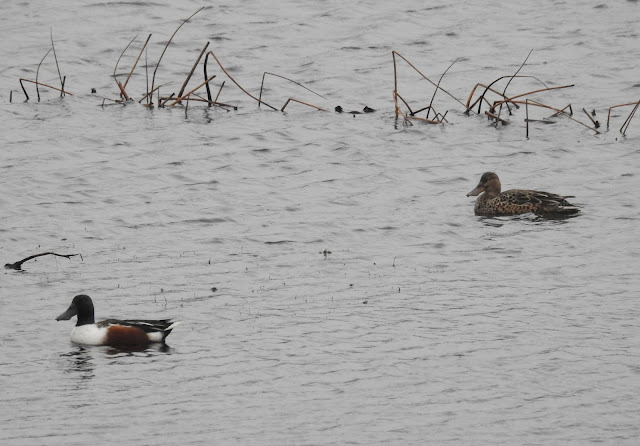
There's been good numbers of Shoveler about too, mostly at Seaton Marshes, which is still looking spot on for wildfowl...


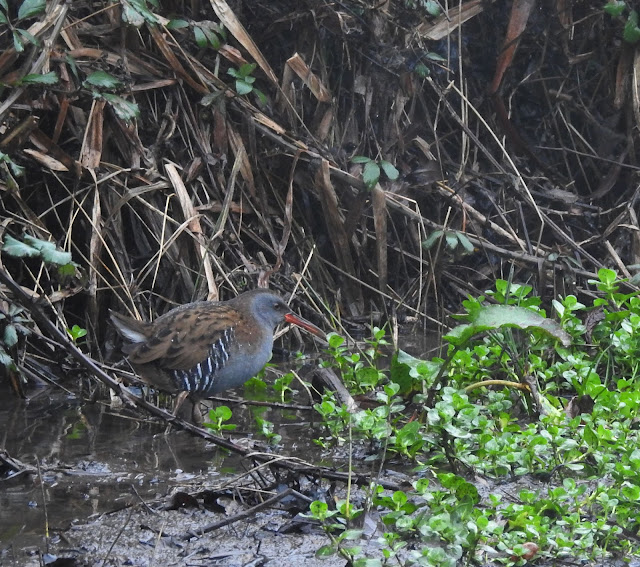
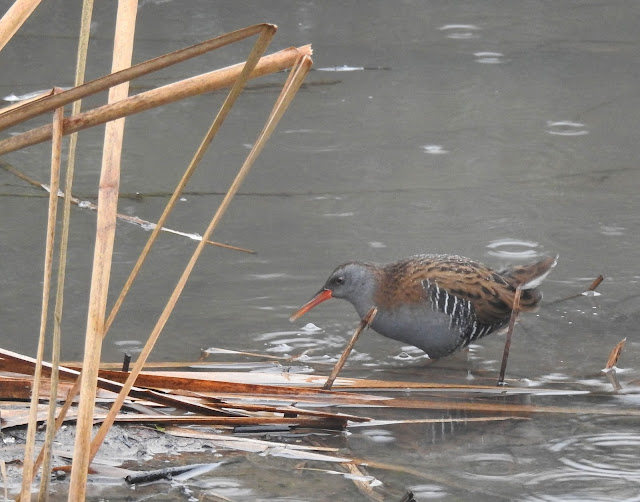
Also at Seaton Marshes it was nice to stumble across this showy Water Rail the other day...


It's been nice to finally have some dry weather to get out and about in.  Although a bit more ice and frost would be much appreciated...

Sunday, 2 January 2022

Happy New Year

And what a start to 2022 the Axe Patch has had! 

Mid afternoon today Phil messaged with the pleasing news our ever-increasing Canada Goose flock had finally pulled in some small grey geese!   He had found three White-fronted Geese on Bridge Marsh...

A nice adult

My views were distant and in dreadful light, but as expected they were Eurasians showing stubby pink bills and squarish head shapes.  I had OK views of two of them, which were both adults, the third far more sleepy bird looked to be a first-winter, but I wouldn't put money on that until I get better views.

So small compared to the Canadas. Think the right hand bird may be the first-winter

These were my first White-fronted Geese on patch since a single adult in January 2018, although I have missed one in between (Clive had a brief early morning bird on 28th May 2020).

I've not had time today to see the Pochard (fem) and Tufted Duck (drake) that Kev found earlier on Seaton Marshes - just a pity the Scaup isn't still with us as that would have made a fantastic trio!  Pochard is rare enough mind being our first since June 2020 (Clive) and only a handful of records in the last decade.

One that slipped us all was a Spoonbill watched feeding on the Estuary mid-afternoon yesterday, but wasn't present during the morning or evening (we had a quick look around at last light once the news was out). Thanks Mike Lock for this record, a species we didn't record at all in 2021.

Other snippets of interest since 00:01 on 01/01/2022 include the continued regular evening appearances of Goosander (up to four) and Cattle Egret (up to five), the odd Pintail sporadically showing up (Kev had four today) and the wintering Firecrest at Seaton Hole (Phil).  

All I need to do is get out myself a bit more!  

Thursday, 23 December 2021

Scaup on Seaton Marshes!

I have lost count of how many times I have mentioned on this blog just how scarce diving ducks are on the Axe. But it is somewhat ironic that the first year I've known with not a single Tufted Duck or Pochard record, is the year an Aythya patch mega puts in an appearance!

SCAUP!

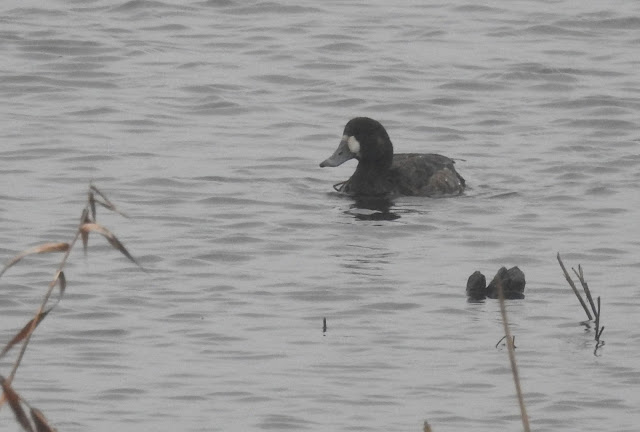
Clive found a female Greater Scaup on Seaton Marshes this morning. The first patch record since the winter of 1988/89 when a male spent some time on the Borrow Pit, also Seaton Marshes. Thanks for clarifying the date Phil. 

Great to watch it frequently dive in this shallow lagoon

Note that distinctive pale cheek spot

I always thought my first patch Scaup would likely be during a spell of cold weather, which clearly was not the case today. However although it's not cold here, something notable is happening with wildfowl presumably due to easterly winds and cold temperatures on the continent. Across the south and south west of England during the last week odd ducks like our Scaup have been appearing at unusual locations, as well as a noticeable arrival of grey geese (Tundra Bean, Pink-feet and Russian White-fronts) and the odd wild swan. Am sure it's only time before we get something else - I really wouldn't mind a slice of Exminster Marshes current luck! They currently have singles of all three of the above mentioned geese and three Whooper Swans.

Being the first patch Scaup in 35 years this was obviously a patch tick for me, my second tick of 2021 in what is turning out to be my year of 'unblocking'.  Just need a mid-winter Puffin now!


Wednesday, 8 December 2021

Back in Play

Not blogged for so long because, well, since I came out of self-isolation work has been hectic.  I haven't really even got a catch up post to do because there isn't anything to tell!

One thing I do want to share (which was actually over a month ago) was my very first morning out after Covid-19.  Although I had seen some fairly good vismig from my garden, I was absolutely gunning to get back up to Axe Cliff.  On 4th Nov that was exactly where I went on my first morning of freedom, and what an absolutely stunning morning it was...


In such a strong northerly wind, finch vismig was a bit all over the place, although I still managed nine Brambling which was my best count of the autumn. This included a lovely group of three that came up from under the cliff, circled over my head calling for thirty seconds and then headed off west. Also noted three Reed Bunting, two Redpoll and a Siskin.

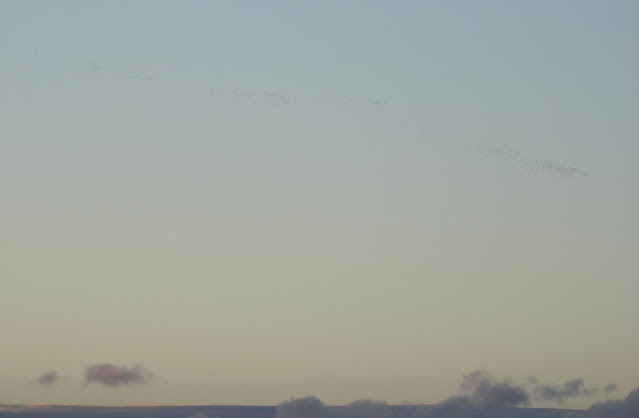
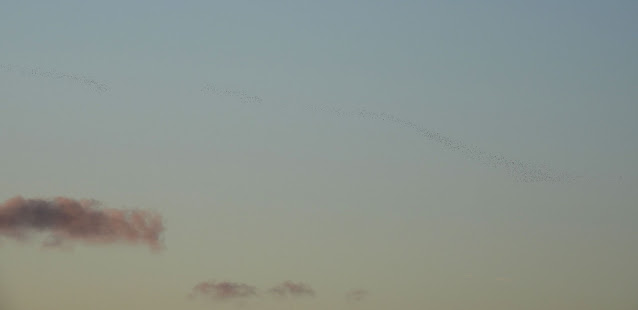
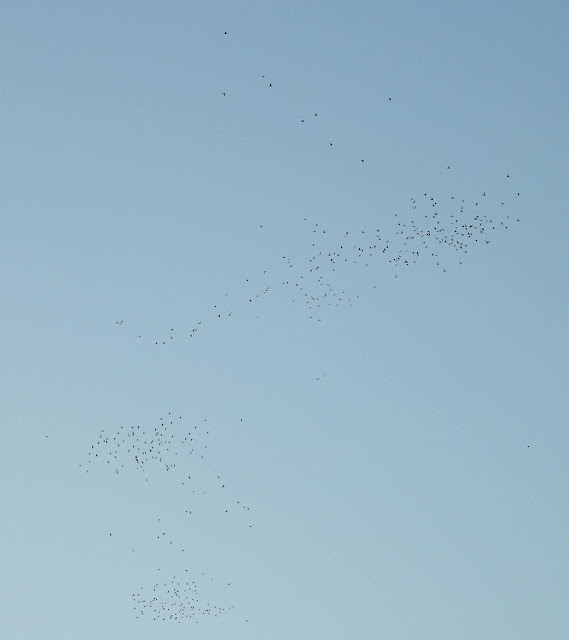
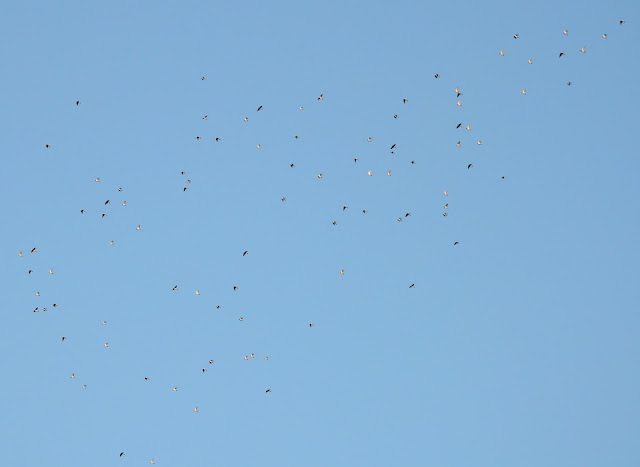
As I'd hoped Wood Pigeons were on the move in incredible numbers.  The earliest flocks hugged the coast west, but I soon noticed flocks passing way out to sea - and I mean miles out! Often I would be watching a (still distant) large flock, when I noticed behind it a slow moving dark mass heading west, which was of course yet more Pigeons!  I recorded 20k birds in no time at all.  As ever photographs didn't capture the spectacle well at all, but enlarge the lower two pics out of the four below to get an idea of how the view out to sea often looked...


On the way home I was pleased to see one of the four or five Black Redstarts that were around Axe Yacht Club in early November...


Since this freedom day, two Pintail over the Estuary on Sunday morning were literally my only interesting snippet of bird news from the Axe since early November. Sure I haven't been out much, but whenever I have it's been quiet on all fronts.

Tuesday, 2 November 2021

Plenty of Pigeons

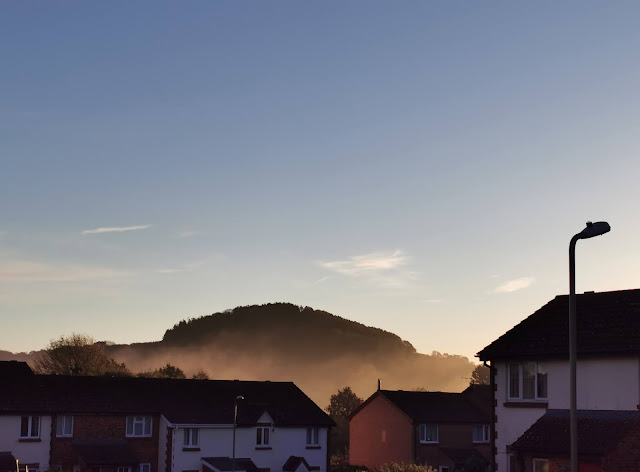
The last couple of mornings have been absolutely stunning. Although I have only been able to enjoy them from the back garden, they've still offered me some spectacular seasonal sights.

The valley mist looked like it was on fire this morning

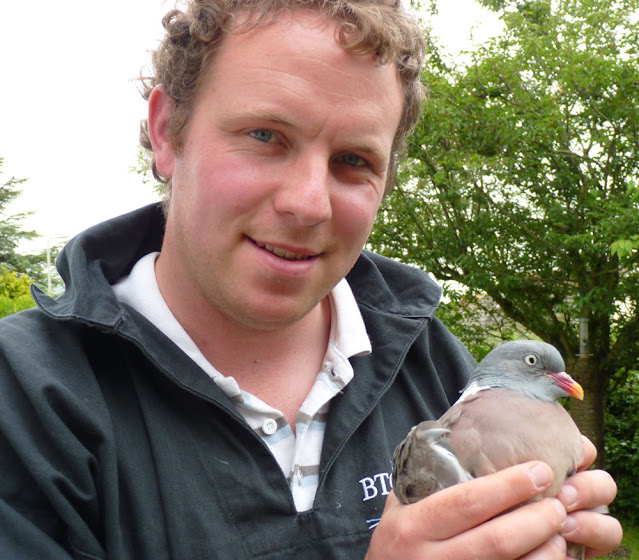
Now, this is a Wood Pigeon...

and a much younger version of me!

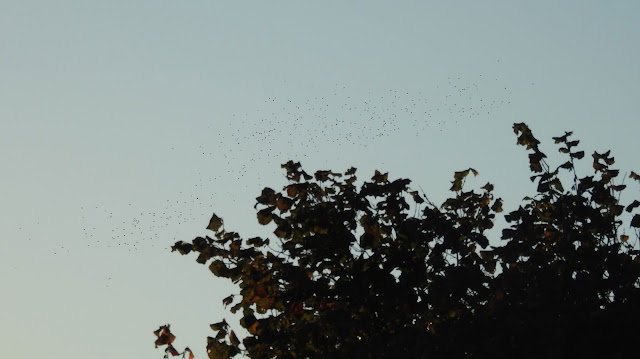
And these are also Wood Pigeons.  But because they are many Wood Pigeons together, migrating, they are of a completely different league to the one pictured above...


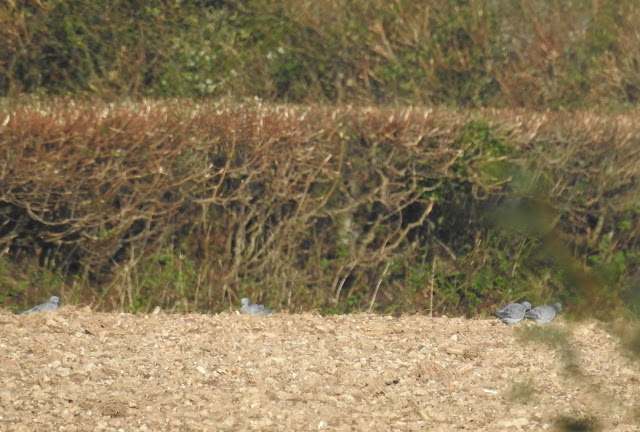
Phenomenal numbers of Wood Pigeons have been passing over during the last couple of days, some astonishing counts have been made today especially including 59,000 at Start Point and 110,000 through one site in south Wales.  Being over a mile inland I am missing out on most of these as passage here tends to follow the coast south west.  Thankfully however there have been plenty of stray flocks flying south down the valley before veering south west to join the main flight-path, and all these I can see.  There's been quite a few Stock Doves in with them too, and unusually I saw three grounded from the back garden yesterday...

Three with a young Wood Pigeon

Other than Wood Pigeons yesterday there wasn't all that much going over, and all day I didn't record anything new for the 'mini-lockdown list'.  

Today however I was able to give it an hour and a half of uninterrupted attention (07:00 - 08:30) and recorded the following 'vismigging' over the garden:

3 Lapwing, 1 Snipe, 90 Jackdaw, 9,500 Wood Pigeon, 48 Stock Dove, 18 Skylark, 82 Redwing, 8 Song Thrush, 140 Starling, 35 Chaffinch, 2 Brambling, 8 Linnet, 1 Siskin and 7 Reed Bunting.

I added three new species to the mini-lockdown list today, bringing it up to 70. One of those being the Bramblings mentioned above, as well as a Redshank (finally) and Shoveler. The latter thanks to a male that did a few laps over Black Hole Marsh this evening before flying south, no doubt back to Seaton Marshes.  

One more day of mini-lockdown listing to go, and I cannot wait for it to be over...


Sunday, 31 October 2021

Lockdown Number Four

Well the man that ate a bat in Wuhan City has now touched me, well via 246 million other people.  Since my last post my whole household has gone down with Covid-19.  My wife first, who suffered with it the worst but is now thankfully out of the woods, then Harry, and just as I was thinking I had dodged the bullet, me. 

A second line appeared on my lateral flow last Sunday, which is also when I went for a PCR test.  I knew the result before it came in on Monday, which made Monday day one of my ten days of self-isolation.  

I am certainly not going to moan about being forced to stay home for ten days, because many people have had far worse problems when it comes to this virus, and I certainly don't want to be spreading it around.  However, if at the start of the year I was asked which ten days I would least like to take out of my birding calendar, I'd say the end of Oct/early Nov (with late April a close second).   So let me just call it inconvenient, which if is my only complaint about catching Covid-19 then I'll consider myself lucky. 

Ten days of no birding in late Oct was never going to happen though, I just had to adjust my patch-size...
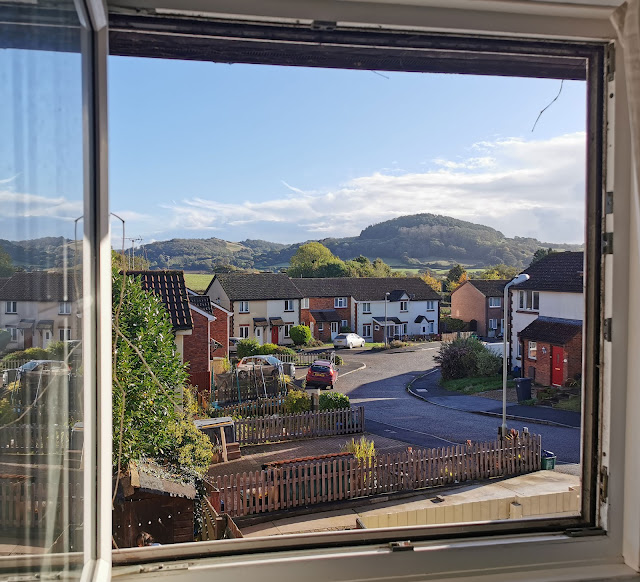
I am so blessed for this as a bedroom view! Behind those houses is Black Hole Marsh and the Axe Valley, not that I can quite see them!


I do have more views, and this one out the back garden (looking north) has been really useful and full of potential. Am just waiting for another species of goose to join the flock...
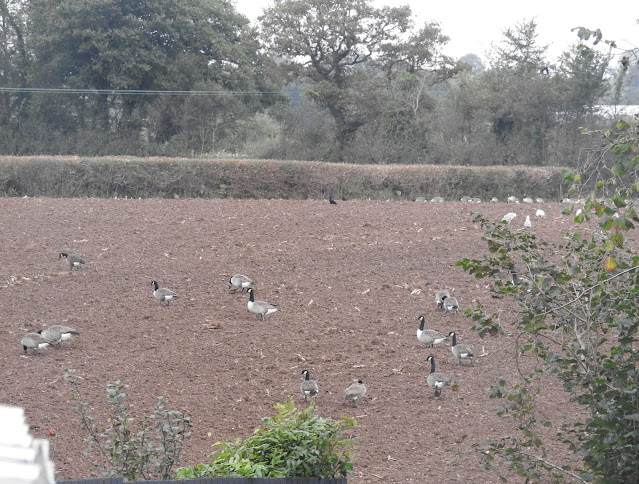
Pity I don't live in Norfolk where these would all be Pink-feet!

I also of course have plenty of sky to look at.  Although I am not on a vismig flight-path anywhere is ok at this time of year to be honest.  Looking up is where many of my highlights have come from so far, as has the highlight.

At 08:15 on 29th (day five) I was sat on the sofa in the conservatory enjoying a morning coffee, back doors wide open, when I heard 'seep'....'seep'... and I knew exactly what it was - Hawfinch!  I jumped off the sofa grabbing my bins, and stepped outside just as it flew right over the garden, still calling as it headed east.  The great front-heaving lump that it was.  A garden first, my first on patch since Jan 2018 (the winter when they were everywhere) and a cracking good patch record - what a result.  It is interesting that it flew east, as all vismig that day was flying west so I have been hoping to see it again, but nothing yet.  

I have to be honest and say I am so thrilled Hawfinch call was still sufficiently logged in my brain that I knew exactly what it was when I heard it, as they are subtle.  During the winter of 2017/2018 I made the absolute most of seeing Hawfinches (see THIS post) and the opportunity of hearing them so frequently.  

Something I always say to people wanting to learn bird vocalisations is the key is to link the sound to a visual image or a moment in time.  This Hawfinch-find was proof of how efficient that technique can be.  When I heard the first 'seep' I was instantly transported to the minor road behind Shute church in December 2017 when a couple of Hawfinches flew out of a Yew Tree calling.  I have to be honest, if my bird was giving just the 'tic' call it wouldn't have registered without seeing it, but there's a unique quality to a Hawfinch 'seep', take a listen HERE. Similar in structure to Redwing but shorter, cleaner and thinner.

Right, now to the rest of the birds...

I am on day seven of my ten day isolation, and have managed a total of 67 species. Days four and five were my illest so I didn't spend much time looking on these at all, and since I have felt better work has been my main priority.  Currently my birding is restricted to early mornings whilst Harry eats his breakfast, then a bit at lunchtime. At all other times my ears don't stop working though, as I work from a desk in the conservatory with the doors wide open (whatever the weather - much to Jess' delight!). The highlights from the rest of the 66 species are:

Wood Pigeon - obviously very common, but some good movement on two dates as expected at this time of year.  Best was yesterday with several large flocks south down the valley and then turning west, with plenty of Stock Doves mixed in.
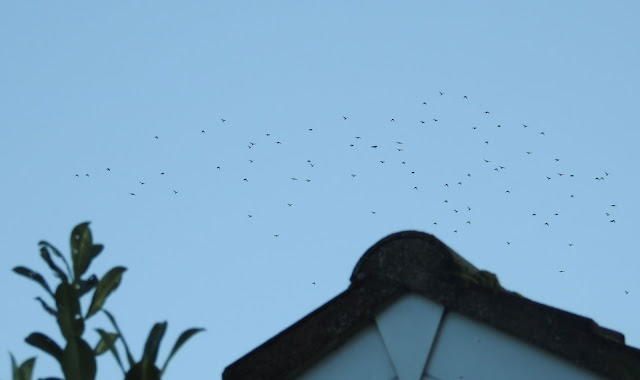
Wood Pigeons heading west


Moorhen - one heard calling on day three.

Greenshank - heard calling three times from my bedroom on day four.

Snipe - three flew high west overhead just before dusk on day four.

Cattle Egret - one flew north up the valley out of roost with Little Egrets on day three (sadly failed to connect with the Great White seen in the valley briefly the previous afternoon).

Sparrowhawk - seen daily since day three, including a male in full display.

Peregrine - Great to watch an adult and a juvenile play-hunting corvids around the house on day four.

Tawny Owl - one calling pre-dawn on day one and not heard one since!

Jay - seen every day in small numbers, most over high west clearly migrating. Max of seven on day two. This really is far from 'the norm', we are witnessing an exceptional autumn for this species without doubt.

Two migrating Jays

Skylark - birds seen/heard 'vismigging' most days, with day six the best so far with a couple of >10 flocks flying west.

Cetti's Warbler - heard singing on two occasions from Black Hole Marsh on day four. Only second time I have ever heard from the garden!

Chiffchaff - just the one on day five, very poor considering the date.

Redwing - seen daily, often just small numbers but today and yesterday a more notable passage with 80+ west over yesterday, and 40+ grounded and 90+ high north east today. 

Chaffinch - as expected commonly occurring but obvious vismig noted most days with some small flocks noted.

Bullfinch - two on day one in trees by house, a decent garden record.

Lesser Redpoll - one over calling on day two.

Siskin - noted most mornings, but only odd birds no big numbers.

Reed Bunting - surprised to have noted a total of seven singles over west, probably a vismig and more local movements.

It is surprising just how hard it is to see some of the Estuary and Wetland birds despite the above view.  We have just shy of 100 Black-tailed Godwits on the Estuary, and I hadn't seen one until this morning (day seven) when a flock of 50+ flew up the valley.  Even the commonest species like Lapwing, Wigeon, Teal and Curlew aren't easily seen, as they can only be seen when they happen to fly though the small patch of sky that I can see from the house, when I am looking at it. A combination which clearly occurs surprisingly infrequently. I am yet to record Redshank, have only seen one Teal, and it took me six days to see a Mute Swan.   

Here's a typical view of two of the species mentioned above...
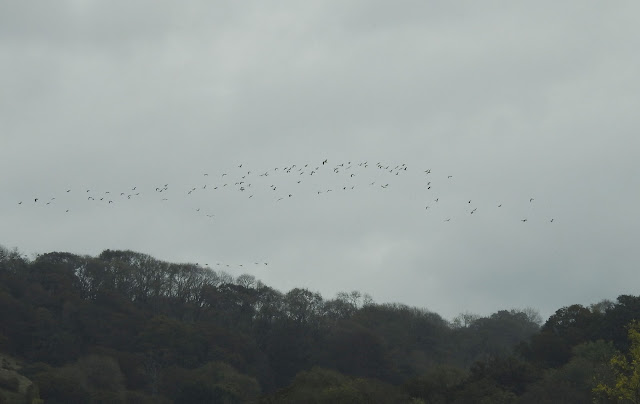
Lapwing flock as viewed from the house with the tail end of a Wigeon flock flying in front of the far hill

Most of the days have been a bit wet and windy, so with clearer skies forecasted for the remainder of my self-isolation, I am hoping I have even more success looking up.
Thursday, 21 October 2021

Whooper Swans and Water Pipit

Well I can only start this blog post by mentioning the staggering rainfall that Seaton and the surrounding area witnessed last night. 
Very sadly this led to many properties in Seaton being flooded out, and my heart goes out to all those who have fallen victim of this. The Fire Brigade were in my road for most of the evening, as the torrent of water in the below video (almost destroying a neighbours fence) was pouring right into someone's kitchen a little further down the hill.  Our local Fire Station received over 30 calls during the night, they had to call in a further three appliances to assist.


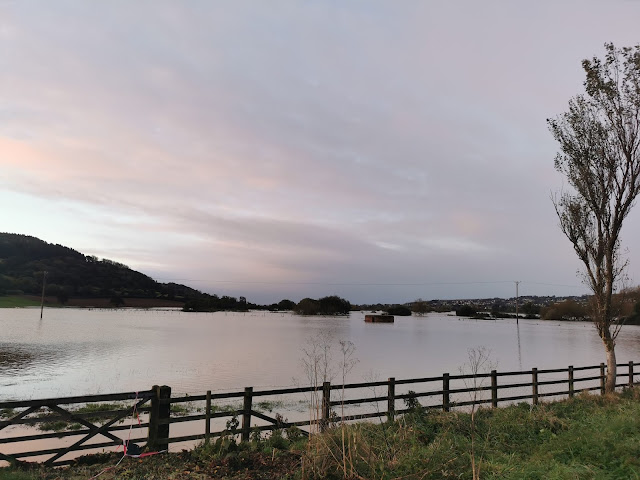
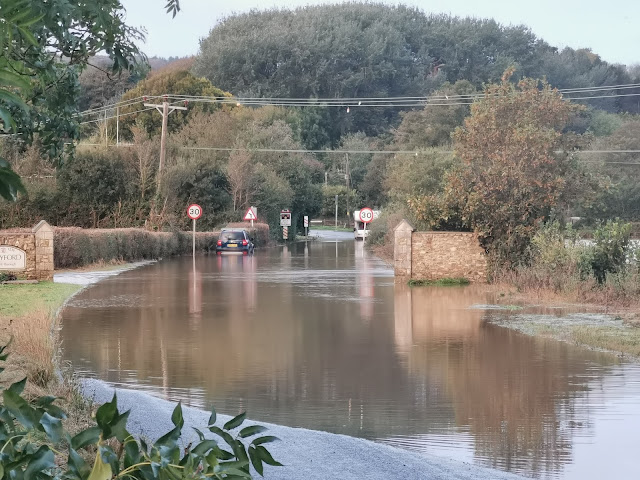
And it was no surprise to see the river valley full to the brim this morning...

Looking south from the A3052. On an average day you wouldn't be able to see any water from this viewpoint.

The A3052 itself.  That campervan was still there at 3pm today, this photo was taken at 07:40!

By this afternoon much of the flood water south of the A3052 had rescinded, thankfully.  Although Seaton Marshes remained much wetter than it has been for what feels like about five years! I took this at 5pm ish...

Looking like a proper marsh at last!

And the reason why I was there? Well to walk the dog along the cycle track of course.  The fact Clive shortly before found two Whooper Swans on the flood water (viewable in the picture above) was a pure coincidence!

Sadly I didn't have the chance to get to a closer view point, so pleased to see them though!

Love how the yellow bills are so vivid in this pic. These two birds could well have been in Iceland at dawn yesterday.


Something I noticed about one of the birds was a narrow black line where the bill met the forehead, which you can just see here...

Distinctive


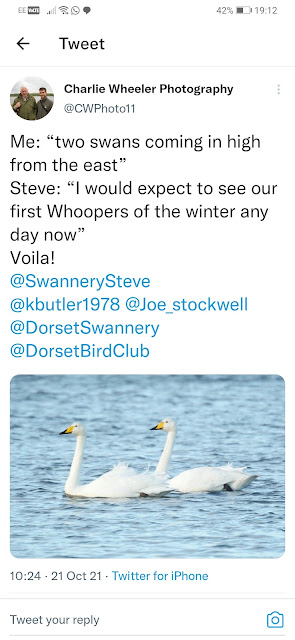
And I'm pleased I noticed this, because here's a screenshot of a tweet from Charlie Wheeler about two Whooper Swans which flew into Abbotsbury Swannery this morning, but had gone by early afternoon...

Bingo!

An exact match.  And yet another example of big white birds leaving Abbotsbury and turning up here (we've had numerous Whoopers, Spoonbills and three Great White Egrets do it over the years!). Shame their wintering Scaup never follow suit!

Anyway, these were my first patch Whoopers since one on 14th October 2019, and the first ones on patch since two on 2nd Dec 2020. From the patterns of our previous records, these two will either be gone by the morning or stay until March!   I am going for the former option, although would love to know where they go next!

And finally I must mention (as they are no longer a regular wintering species here) the Water Pipit I saw on Bridge Marsh yesterday morning.  It didn't hang around long enough for a photo and flew off towards Colyford Marsh, but it is good to know we have at least one around.    I always pick these up on call here, not that I can at all ID them on call - it's a Rock/Water until I see it properly.  

Is there anyone out there who can separate these two species on calls?  I certainly get the impression Water Pipits sound thinner, but it's not consistent enough for me. I have heard thinner calls from Rock Pipits, but must admit have never heard a definite Water Pipit quite sound like a Rock. If that at all makes sense?  Thankfully yesterday's bird showed well enough before darting off that it didn't at all matter what it sounded like.


Tuesday, 19 October 2021

A landmark Caspian Gull

I didn't have chance for much today, but after a trip into town with Harry mid-morning I thought I'd drive back home via the Estuary. When I saw the number of resting gulls there I simply could not drive on by without at least a cursory glance!  

Wet and windy October days are one of my favourites for gulling, so I thought I'd test Harry's patience and see how long he'd let me scan through the vast flocks whilst he was occupying himself in the back seat.  Thankfully he was actually pretty good, as I came away with two cracking rewards...

I almost completely fluffed the Caspian Gull though.  I was scanning the mass of gulls on the water (must have been 200 here at least) when a darker mantle, white head and clear neck shawl shone out like a beacon.  I just knew it had to be a Caspian Gull so didn't go for my scope but went straight for the camera instead.  However I couldn't find it in the view finder, and when I went back to my bins I couldn't relocate it!  A quick look in the air didn't show any large gulls flying away, so I began scanning the river bank opposite where about 250 large gulls were resting.  

I almost immediately picked up a darker mantled sub-adult gull with my bins, I transferred to the telescope (learnt my lesson!) and found myself looking at a Yellow-legged Gull, an absolutely huge third-winter...

Look how big it is compared to all those Herring Gulls. Lovely white head as to be expected for this species.

I just know this bird is going to look absolutely stunning in adult plumage. Please come back in a year or two!


Anyway, although this bird clearly didn't have a neck shawl, I started to think I'd been seeing things with the bird on the water and that this must have been it. However, I then lost the Yellow-legged Gull when a few gulls took off and had a fly round, but shortly after resuming scanning came across this...

Well hello there!


I was right all along - Caspian Gull! Complete with neck shawl, a lovely white head and small dark eye, a narrow parallel bill, nice darker mantle tone (but less dark than the YLG) and overall a bit of a brute.  

It then decided to completely show off, and very kindly struck a very typical Caspian-pose...

Classic belly, neck and head shape. Also note the 'saggy nappy' appearance. Compare size with the Herring Gull to left and the subtly darker mantle tone.

On a bird this old, a streaky and defined neck shawl contrasting with no other head, neck or underpart streaking is a pretty solid and obvious Casp-trait.

A clearer shot showing neck shawl, nice long-winged appearance and that lovely little eye.


I sent a message out on the patch WhatsApp group, but about thirty seconds later the darn thing took off and flew away south west.  At least I was pointing my camera at it when it took to the air...

Long white tip to P10 and grey tongues protruding into the black feather tips


When I first saw this bird in my bins I thought it was going to be second-winter, but you can see from the above pics it is clearly a third-winter with its adult-like wing pattern and all white tail.   And that makes this the most mature Caspian Gull ever to have been recorded on the Axe. Before today we've not had anything older than a second-winter, but this is not the reason it's a landmark Caspian Gull as the post title implies...

This is (if accepted!) the 25th Caspian Gull for the Axe Estuary - we are a quarter of a century in!  The total consists of 19 first-winter/summers, five second-winters and today's third-winter.  The quest for an adult continues but it certainly feels like it is getting ever closer.

And if you find yourself yearning for just a bit more detail on these Casps then you are in luck. It's time for another appearance of my Axe Casp chart, which documents each of the Axe's Casps by year, month and age...


I have seen 16 of these, having found 13.  Gav adds the other 12. It is really quite remarkable that only two people have found every single one of them.  Tim White so nearly got his name to one, but looking closer at photos after the event revealed it was highly likely the same bird I had seen a week or so earlier - sorry Tim!

And finally to complete today's bird news, another quick look along the Estuary mid afternoon revealed 29 Med Gulls and 1x Gav.  It's great to see plenty of Common Gulls around now as well, they have suddenly arrived in numbers.  It's just a pity Ring-billed Gull no longer feels like a realistic possibility - although that will never stop me trying!